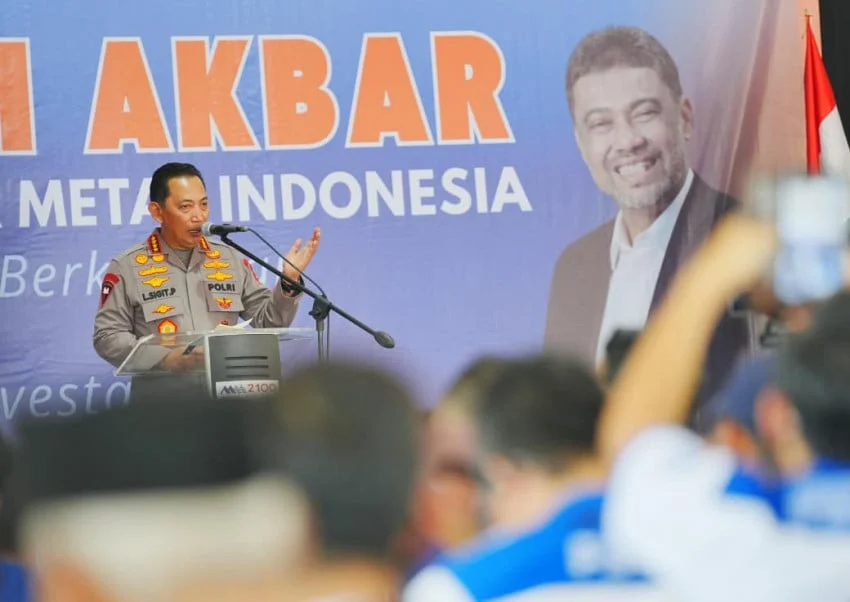
The Indonesian National Police Chief, General Listyo Sigit Prabowo, issued a significant call for a paradigm shift in industrial relations during the Grand Consolidation of the Federation of Indonesian Metal Workers Union (FSPMI) at the MM2100 Industrial Zone in Bekasi, West Java, on Friday, September 11, 2026. Addressing thousands of workers and industrial stakeholders, General Sigit emphasized that the traditional view of labor as merely a cost component or a disposable workforce is obsolete and counterproductive to national economic stability. Instead, he advocated for a framework where laborers are treated as foundational assets, strategic partners, and integral members of the corporate family.
The New Industrial Paradigm: A Call for Synergy
General Sigit’s address highlighted that the survival and growth of the Indonesian manufacturing sector depend heavily on the strength of the relationship between management and labor. According to the National Police Chief, the misconception that the interests of a company and its workers are inherently adversarial is a primary driver of industrial disputes.
"The longevity of a company and the welfare of its workers are not two competing interests that must be traded off against one another," Sigit stated during the event. "They are interdependent. A company requires a productive, skilled, and motivated workforce to remain competitive in a globalized market. Conversely, laborers require a stable, profitable, and ethically managed enterprise to ensure their job security and long-term economic well-being. When we shift the perception of the worker from a tool of production to an ‘asset’ and ‘partner,’ we foster a culture of collective ownership and shared success."
This strategic shift is seen as a proactive measure by the state to maintain social order and economic productivity in one of Indonesia’s most critical industrial hubs. The MM2100 industrial area, where the event took place, serves as a microcosm of the national manufacturing landscape, hosting hundreds of multinational and domestic companies that contribute significantly to the country’s GDP.
Chronology of Industrial Relations and Police Involvement
The involvement of the National Police in labor affairs stems from the institution’s role in maintaining national security, which includes ensuring that industrial zones remain productive and free from destructive unrest. Over the past several years, the Indonesian government has moved to professionalize how police manage labor-related issues, shifting from a reactive approach to one centered on mediation and collaborative problem-solving.
In late 2025, the government intensified efforts to revise labor regulations to attract foreign investment while simultaneously addressing grievances from the labor sector regarding wage inflation and job security. Following these policy shifts, the National Police, under General Sigit, initiated a series of dialogues with various labor unions to ensure that the implementation of these regulations did not lead to widespread social friction.
The event on September 11, 2026, served as the culmination of these regional dialogues. It follows a significant milestone in July 2026, when General Listyo Sigit Prabowo was formally recognized by international labor organizations for his efforts in mediating complex industrial disputes and protecting the rights of workers during a period of economic transition. This recognition served as the backdrop for his recent appearance in Bekasi, where he reiterated that police intervention should always prioritize the protection of all stakeholders’ rights under the rule of law.
Supporting Data: The Economic Context
Indonesia’s manufacturing sector, which accounts for approximately 18-20% of the national GDP, has faced significant challenges in the post-pandemic era. According to recent data from the Central Statistics Agency (BPS), labor productivity has been a focal point of concern for investors, while the cost of living remains a critical issue for the working class.
- Manufacturing Growth: As of the second quarter of 2026, the manufacturing industry showed a modest growth rate of 4.2% year-on-year, indicating a need for greater stability to reach the government’s target of 5.5%.
- Labor Force Demographics: With a massive youth demographic entering the workforce, the demand for high-skilled manufacturing jobs is at an all-time high.
- Conflict Statistics: Data from the Ministry of Manpower indicates a 15% reduction in industrial strikes compared to the 2023-2024 period, a trend that experts attribute to the increased involvement of mediating bodies and improved communication between labor unions and management.
General Sigit’s comments are timely, as they address the necessity of "Industrial Harmony." Analysts suggest that as Indonesia strives to become a global leader in the electric vehicle (EV) battery and semiconductor manufacturing supply chains, the stability of the industrial workforce is a non-negotiable prerequisite.
Official Responses and Stakeholder Perspectives
The reception to General Sigit’s remarks among labor union leaders and industry representatives has been largely positive, though tempered by a call for concrete implementation.
FSPMI leaders expressed appreciation for the police chief’s acknowledgment of their role as partners. "For too long, workers have felt ignored in the decision-making processes of the companies they build," said a union representative following the event. "General Sigit’s endorsement of a ‘family’ approach is a signal that the state is paying attention to the human element of industry. However, we look forward to seeing how this translates into corporate policy, particularly regarding profit-sharing and worker representation on company boards."
On the other side, representatives from the Indonesian Chamber of Commerce and Industry (KADIN) have indicated that they share the vision of a more collaborative workplace. "Productivity is tied to worker satisfaction," a KADIN spokesperson noted. "Most forward-thinking companies already view their staff as their most valuable asset. Promoting this as a national standard is helpful, provided that the legal framework remains supportive of operational flexibility and investment security."
Analysis: Implications for Future Industrial Relations
The implications of the National Police Chief’s call to action are manifold. First, it signals a shift in the role of the state in labor disputes. By moving toward a model of "Industrial Partnership," the police are positioning themselves as facilitators of dialogue rather than just enforcement agents. This is likely to decrease the frequency of violent or disruptive protests, as workers feel they have a pathway to communicate their grievances through official channels.
Second, the push for a "family" model of management may influence future legislative amendments to the Labor Law. If the government adopts this rhetoric, companies may be encouraged—or perhaps eventually incentivized through tax benefits—to implement more inclusive management practices, such as employee stock ownership plans (ESOPs) or improved vocational training programs.
Third, the emphasis on the worker as an "asset" reinforces the need for human capital development. In an era of increasing automation and artificial intelligence in manufacturing, the quality of the workforce becomes the primary competitive advantage for any nation. By encouraging companies to invest in their people, the government is essentially preparing the Indonesian workforce for the transition into Industry 4.0.
Conclusion
General Listyo Sigit Prabowo’s address in Bekasi represents a significant moment in the evolution of Indonesia’s industrial landscape. By framing the relationship between management and labor not as a zero-sum game, but as a symbiotic partnership, the National Police Chief has set a tone for a more collaborative future.
While the challenges of balancing corporate profitability with worker welfare remain, the consensus emerging from the event is that the old models of adversarial management are no longer sufficient for the complexities of the modern economy. Whether this vision of "partners and family" can be fully realized across the diverse spectrum of Indonesian industry remains to be seen, but the high-level endorsement from the police institution marks a vital step toward fostering a more stable, productive, and equitable industrial environment for the years to come. The path forward will require continued cooperation between the state, the private sector, and the labor unions to ensure that the vision of economic growth is shared by all who contribute to it.