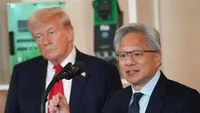
In a striking convergence of high-stakes politics and silicon valley innovation, former United States President Donald Trump abruptly telephoned Nvidia Chief Executive Officer Jansen Huang during a live session at the prominent All-In Summit in Los Angeles, California. The unexpected phone call, broadcasted to a global audience via the YouTube platform of the All-In Podcast on a Monday afternoon, immediately shifted the technological discourse from academic projections to executive-level pragmatism. The conversation between two of the most influential figures in modern technology and governance centered around the escalating debates over artificial intelligence regulation, the surging energy demands of data centers, and the economic imperative of maintaining relentless technological acceleration.
The live intervention underscored a broader ideological battleground within the United States. While Silicon Valley and Washington grapple with ethical dilemmas, environmental footprints, and existential anxieties surrounding artificial intelligence, the Trump administration and its allies are championing an aggressive, pro-growth paradigm. By framing advanced computing infrastructure as the modern equivalent of oil, the discourse surrounding AI has transformed from a nuanced software discussion into a fundamental pillar of national sovereignty and economic dominance.
Chronology of the All-In Summit Disruption and Phone Call
The sequence of events leading up to the unexpected phone call began earlier in the day on September 15, as technology leaders, venture capitalists, and policymakers gathered in Los Angeles for the high-profile All-In Summit. Jensen Huang, whose semiconductor empire has become the undisputed backbone of the global AI hardware boom, took the stage to address a multitude of pressing industry topics. During his primary speaking slot, Huang engaged in deep analytical discussions regarding the trajectory of artificial intelligence, refuting recent doomsday narratives propagated by certain industry researchers and executives.
Toward the middle of the panel discussion, as Huang was addressing the ethical and practical boundaries of accelerated computing, his mobile device rang. Acknowledging the identity of the caller with characteristic composure, Huang revealed to the live audience and the podcast hosts that the caller was Donald Trump. Putting the conversation on speaker or relaying its contents to the auditorium, the interaction instantly became the focal point of the tech world’s news cycle.
The dialogue touched upon the contentious proposals circulating in various regulatory bodies to intentionally slow down the development of foundational AI models. Trump did not mince words during the impromptu call, dismissing the widespread anxieties regarding artificial intelligence taking over human civilization as unfounded exaggerations and conspiracies. He pivoted the conversation firmly toward the immense financial and strategic value of artificial intelligence infrastructure, particularly data centers.
Economic Nationalism: Data Centers as the New Oil
During the broadcasted conversation, Trump articulated a bold economic vision that equates the physical infrastructure of artificial intelligence with the energy commodities that powered the twentieth-century industrial revolution.
"I katakan bahwa semuanya adalah hoaks," Trump noted in translation and direct reporting, emphasizing that "Pusat data itu bagus, dan mereka membuat orang kaya, dan mereka membuat negara kaya, dan itu akan seperti minyak 20-25 tahun yang akan datang."
By characterizing data centers as the "oil of the next 20 to 25 years," the political leadership is signaling to global markets that the physical architecture housing graphics processing units (GPUs) and server racks is vital national infrastructure. Trump reiterated his conviction that robots and autonomous systems will augment rather than supplant human labor, rejecting dystopian science-fiction tropes that suggest mass human obsolescence is an inevitable byproduct of machine learning.
Furthermore, the economic stakes highlighted during the discussion are monumental. Proponents of the current technological trajectory point to astronomical revenue streams and productivity gains. Trump cited an estimated figure of US$20 trillion in economic value that the nation stands to capture annually from the artificial intelligence sector. Consequently, any regulatory framework designed to artificially throttle innovation is viewed by this camp as self-sabotage, directly threatening the competitive edge of the United States against global rivals such as the People’s Republic of China.
Jensen Huang and Nvidia Push Back Against Tech Doomerism
Jensen Huang’s alignment with Trump’s perspective on the All-In Summit stage was neither accidental nor surprising, given Nvidia’s market position. As the primary manufacturer of the advanced AI chips required to train large language models, Nvidia stands to lose billions of dollars should regulatory bodies implement mandatory cooling-off periods, moratoriums, or stringent developmental caps on AI research.
Earlier in the summit, Huang directly confronted the cautionary warnings issued by prominent figures within the artificial intelligence ecosystem. Specifically, he addressed recent essays published by Anthropic CEO Dario Amodei and statements from former Anthropic researcher Jacob Coxon, both of whom have publicly called for heightened oversight and expressed profound concern over the existential risks posed by frontier AI models.
Huang systematically dismantled these arguments by pointing out that such bold, apocalyptic predictions frequently lack rigorous scientific backing. He drew historical parallels to previous technological revolutions where doomsday prophets warned of catastrophic societal collapse, none of which materialized in the predicted manners. Regarding the pervasive fear of widespread job displacement, Huang maintained that while labor markets will inevitably evolve, the net historical outcome of technological innovation has consistently been the creation of higher-value industries and enhanced human productivity.
Responding to Trump’s insistence that artificial intelligence must remain unfettered, Huang validated the administration’s growth-oriented stance. "Kita akan memastikan semua diuntungkan. Semua industri, semua perusahaan, semua negara bagian, dan semua orang," Huang stated, reinforcing a populist narrative that advanced technology will democratize prosperity rather than concentrate it exclusively within elite corporate enclaves.
Trump and JD Vance Double Down on Anti-Regulation Stance
The phone call with Jensen Huang was part of a broader, sustained communications campaign waged by Donald Trump and Vice President JD Vance against what they perceive as excessive government overreach and unwarranted technological fatalism. Writing on his proprietary social media platform, Truth Social, Trump launched a sharp critique against technology executives who have actively petitioned federal regulators to impose strict safety standards and slow down the commercialization of generative AI.
"Orang-orang yang mengatakan AI bakal menghancurkan dunia dan pusat data itu buruk buat lingkungan sekitar adalah orang yang sama yang dulu menyebut bahwa dunia bakal kiamat karena perubahan iklim," Trump posted, dismissing the convergence of environmental and existential anxieties as alarmist rhetoric.
Vice President JD Vance echoed these sentiments during related policy discussions, casting a suspicious eye toward the underlying motivations of Silicon Valley elites who march to Washington demanding government oversight. Vance suggested that calls for heavy regulation from established technology monopolies might be a calculated maneuver designed to erect insurmountable compliance barriers, thereby stifling disruptive startup competition and protecting legacy firms from nimble market entrants.
"Memang ada risiko nyata dari AI, tapi manfaatnya juga ada. Jujur saja, agak aneh melihat begitu banyak perusahaan teknologi terdepan justru datang dan memohon ke pemerintah agar mereka diregulasi," Vance observed, highlighting a paradox where capitalist enterprises ostensibly championing free markets are simultaneously seeking bureaucratic protection.
Societal Skepticism Versus Executive Optimism
The widening chasm between the political-industrial alliance represented by the White House and Nvidia, on one side, and public sentiment on the other, remains one of the most critical socio-political dynamics of the current technological era. While executive leadership champions accelerationism, the general populace exhibits mounting skepticism, apprehension, and caution regarding the rapid deployment of generative tools.
Public opinion surveys consistently reveal two primary categories of anxiety among everyday citizens:
- Labor Market Displacement: Millions of workers across white-collar sectors—including law, finance, customer service, software engineering, and creative arts—fear that automation will erode their livelihood before social safety nets or retraining programs can adequately adapt.
- Environmental Degradation: The sheer electrical power required to operate massive data centers housing tens of thousands of specialized AI accelerators has placed unprecedented strain on regional power grids. Communities adjacent to proposed data center developments have raised fierce objections concerning massive water consumption for cooling systems and the potential increase in carbon emissions if facilities rely on fossil-fuel energy sources.
This disconnect poses a formidable governance challenge. If political leaders dismiss public concerns as mere "hoaxes" or unfounded conspiracies, they risk alienating a significant portion of the electorate that demands accountability, environmental stewardship, and labor protections in the age of algorithmic decision-making.
Broader Implications and Future Outlook
The impromptu telephone exchange between Donald Trump and Jansen Huang at the All-In Summit serves as a definitive case study in how artificial intelligence has transitioned from a niche computer science discipline into the ultimate geopolitical battleground.
The economic implications are clear: the United States federal government is signaling a deregulatory, highly supportive environment designed to secure domestic supremacy in hardware manufacturing, cloud computing, and neural network development. Companies like Nvidia, Microsoft, Google, Meta, and Amazon are likely to interpret this political climate as a green light to continue aggressive capital expenditures in data center construction and silicon chip procurement.
However, the longer-term societal fallout remains fraught with uncertainty. Navigating the delicate balance between fostering necessary technological innovation to outpace international adversaries and addressing legitimate public concerns over grid capacity, environmental sustainability, and job security will test the efficacy of modern democratic governance. As the debate intensifies, the intersection of political ambition, corporate revenue, and societal welfare will determine whether the artificial intelligence revolution fulfills its promise of universal prosperity or exacerbates systemic socioeconomic inequalities.