
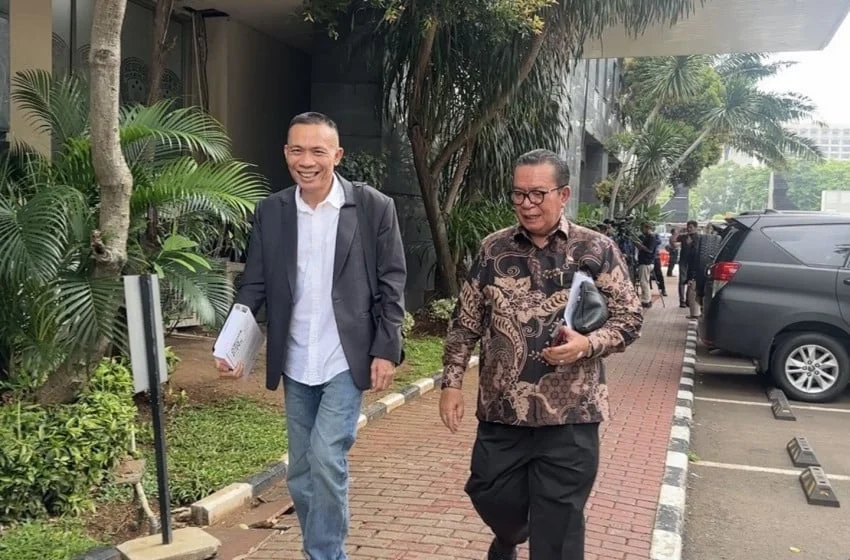
JAKARTA – Forensic expert Rismon Sianipar has vehemently denied allegations made against him by former Vice President Jusuf Kalla (JK), who filed a defamation lawsuit following a video circulating online that purportedly accused Kalla of funding an operation to discredit former President Joko Widodo (Jokowi) over a disputed diploma. Sianipar, speaking to reporters at Polda Metro Jaya on Wednesday, April 15, 2026, asserted that the video in question was a product of artificial intelligence (AI) manipulation, rendering him a "victim" of sophisticated digital fabrication and not responsible for its contentious content.
The legal entanglement began when Jusuf Kalla lodged a formal complaint with the Criminal Investigation Unit (Bareskrim) of the Indonesian National Police on Wednesday, April 8, 2026. The former Vice President’s report targeted Rismon Sianipar directly, alongside four specific YouTube accounts identified as primary disseminators of the alleged defamatory material. According to Kalla’s statement, the video accused him of providing Rp5 billion to a group led by Roy Suryo, a prominent figure in digital forensics and politics, to manage and propagate the issue surrounding former President Joko Widodo’s academic credentials, specifically allegations of a fake diploma. This sum, if true, would imply a significant, clandestine financial backing for a politically charged campaign. Kalla’s decision to pursue legal action underscores the gravity with which he views the allegations, aiming to protect his reputation and integrity against what he considers baseless and damaging claims.
Background to the Dispute: The Jokowi Diploma Controversy
The allegations concerning former President Joko Widodo’s diploma have been a recurring point of contention in Indonesian political discourse, resurfacing periodically since his initial presidential campaign. While official bodies and academic institutions have repeatedly affirmed the authenticity of President Widodo’s academic records, claims of a "fake diploma" have persisted, often fueled by various political opponents and online provocateurs. These allegations typically question the legitimacy of his degree from Gadjah Mada University, a respected institution, despite official confirmations from the university itself.
Roy Suryo, a figure often associated with digital forensics and known for his outspoken commentary on public issues, has been implicated by the circulating video as a recipient of funding from Jusuf Kalla for this specific campaign. While the precise nature and extent of Suryo’s involvement in the diploma debate have varied over time, his name has frequently appeared in discussions surrounding the controversy. The sensitivity of such claims, particularly when directed at a former head of state and involving prominent political figures like Jusuf Kalla, escalates the potential for reputational damage and political instability. The alleged funding of Rp5 billion, a substantial sum, would suggest a concerted effort to manipulate public opinion, making the current lawsuit a critical test of digital accountability in the political sphere.
Rismon Sianipar’s Defense: A Victim of AI Fabrication
In his defense, Rismon Sianipar firmly stated that the video at the heart of Kalla’s lawsuit is not an authentic representation of his views but rather a sophisticated AI-generated fabrication. He clarified that an original video, from which the manipulated content was derived, was recorded on March 11, 2026, and uploaded to his YouTube channel, Balige Academy. Crucially, Sianipar emphasized that this original video was produced before his scheduled meeting with former President Joko Widodo in Solo, suggesting that its content could not have included the allegations against Kalla, which emerged later.
"The video circulating is a result of AI manipulation of my video on the Balige Academy YouTube channel," Sianipar explained to journalists. "That video was recorded on March 11, 2026, before I went to Solo to meet Pak Joko Widodo. The circulating video has been modified using AI; I am a victim." This statement places Sianipar in a unique position, claiming innocence through the very technology that has become a growing concern globally. He further stressed that the creators of the AI-modified video, not himself, should bear the responsibility for its content. He called upon law enforcement to initiate a comprehensive digital forensic investigation to trace the origins of the AI-generated content. "The police need to conduct a digital forensic investigation to find out who first created and disseminated it. I am not responsible for the content of the manipulated video," he asserted, shifting the onus of accountability to the unidentified creators and distributors of the deepfake.
The Rise of AI Deepfakes and Emerging Legal Challenges
This case highlights a critical and rapidly escalating global phenomenon: the proliferation of AI-generated content, particularly "deepfakes." Deepfakes utilize advanced machine learning techniques, primarily generative adversarial networks (GANs), to create incredibly realistic but entirely fabricated videos, audio recordings, or images. These technologies can seamlessly swap faces, alter speech, or even generate entirely new scenarios, making it increasingly difficult for the average person to distinguish between authentic and synthetic media. The sophistication of these tools has advanced to a point where even trained eyes can be deceived, posing significant challenges to truth, trust, and public discourse.
Globally, the misuse of deepfakes has led to a surge in disinformation, defamation, and even extortion. From manipulated political speeches designed to sway elections to revenge porn, the applications of deepfake technology raise profound ethical and legal questions. In Indonesia, while the Electronic Information and Transactions (ITE) Law has provisions for defamation and the dissemination of false information, its application to AI-generated content presents novel challenges. The law typically focuses on the intent and actions of human perpetrators. However, when an individual’s likeness or voice is used without their consent to create defamatory content, as Sianipar claims, the question of liability becomes complex. Who is responsible: the AI developer, the person who commissioned the deepfake, the one who first disseminated it, or the platforms that host it? This case could set a crucial precedent for how Indonesian legal frameworks adapt to the evolving landscape of digital deception.
Chronology of Events Leading to the Lawsuit
The sequence of events leading to the current legal dispute can be outlined as follows:
- March 11, 2026: Rismon Sianipar records and uploads an original video to his YouTube channel, Balige Academy. According to Sianipar, this video did not contain any allegations against Jusuf Kalla.
- Undetermined Date (Prior to April 8, 2026): An AI-modified version of Sianipar’s original video begins circulating on various online platforms, including at least four YouTube accounts identified by Jusuf Kalla. This manipulated video allegedly contains the defamatory claims linking Kalla to the funding of Roy Suryo Cs for the Jokowi diploma issue.
- April 8, 2026: Former Vice President Jusuf Kalla, through his legal counsel, files a formal report with Bareskrim Polri, naming Rismon Sianipar and four YouTube accounts as parties responsible for the dissemination of defamatory content.
- April 15, 2026: Rismon Sianipar, accompanied by his legal team, appears at Polda Metro Jaya and issues a public statement, denying the allegations and asserting that he is a victim of AI manipulation, calling for a digital forensic investigation.
- Ongoing: The Indonesian National Police, particularly Bareskrim Polri, initiates investigations into Kalla’s report, which will likely involve digital forensic experts to verify Sianipar’s claims regarding AI manipulation and identify the creators and initial disseminators of the contentious video.
Police Investigation and the Critical Role of Digital Forensics
The Indonesian National Police face a formidable task in investigating Jusuf Kalla’s complaint. The core of Sianipar’s defense — that the video is an AI deepfake — necessitates a highly specialized and technically sophisticated investigation. Digital forensics will be paramount in this case. Forensic experts will need to analyze the video files to detect anomalies characteristic of AI manipulation, such as inconsistencies in lighting, subtle distortions in facial features, unnatural speech patterns, or metadata irregularities. They will also attempt to trace the video’s journey online, identifying its initial point of creation and subsequent dissemination across various platforms.
This process is not without its challenges. AI deepfake technology is constantly evolving, making detection increasingly difficult. Sophisticated deepfakes can be designed to resist detection by common forensic tools. However, specialized units within Bareskrim Polri are equipped with advanced software and expertise to tackle such cases. A successful investigation would not only determine Sianipar’s culpability (or lack thereof) but also potentially identify the true perpetrators behind the AI manipulation, who could then face charges under Indonesia’s ITE Law for spreading false information and defamation. A police spokesperson, speaking generally on such complex digital cases, could be inferred to state: "We are committed to a thorough and impartial investigation. Our digital forensic teams possess the necessary expertise to analyze alleged AI-manipulated content and trace its origins. We will follow all digital trails to identify those responsible for creating and spreading any illegal content, ensuring justice is served."
Statements from Related Parties and Expert Perspectives
While direct statements from all parties were not immediately available beyond Sianipar’s, logical inferences can be made regarding their positions and the broader expert community’s views.
- Jusuf Kalla’s Legal Team (Inferred): "Mr. Kalla views these allegations as a grave attack on his character and a blatant attempt to undermine his integrity. Regardless of the technological means used to fabricate and disseminate these falsehoods, the act of defamation remains. We trust the legal process to uncover the truth and hold all responsible parties accountable, ensuring Mr. Kalla’s name is cleared and justice is upheld." Their focus would remain on the defamatory nature of the content, irrespective of its origin, while challenging Sianipar’s claim of being a "victim" until proven by investigation.
- Legal Experts and Academics (Inferred): Prominent legal scholars and experts in cyber law would likely emphasize the groundbreaking nature of this case. "This lawsuit represents a critical juncture for Indonesian jurisprudence," remarked a hypothetical professor of cyber law. "It will set a significant precedent for how our legal system addresses the intersection of traditional defamation law with the unprecedented challenges posed by AI-generated disinformation. The outcome will influence future cases involving deepfakes and help shape the legislative response to the ethical and legal implications of advanced AI technology."
- AI Ethics Advocates (Inferred): Organizations dedicated to AI ethics would likely use this case to highlight the urgent need for greater public awareness and robust regulatory frameworks. "The incident involving Mr. Sianipar and Mr. Kalla is a stark reminder of AI’s dual nature," commented a representative from an AI ethics think tank. "While AI offers immense benefits, its misuse for disinformation and character assassination poses a serious threat to democracy and social cohesion. Stronger regulations, platform accountability, and public education on media literacy are essential to combat this growing menace."
Broader Implications: Defamation in the Digital Age and AI’s Role
The legal battle between Rismon Sianipar and Jusuf Kalla transcends a mere defamation case; it represents a microcosm of the profound challenges facing societies in the digital age, particularly with the advent of advanced AI. The implications are far-reaching:
- Erosion of Public Trust: When it becomes impossible to distinguish between real and fake content, public trust in news, official statements, and even personal interactions erodes. This can lead to widespread cynicism and make it difficult for citizens to make informed decisions.
- Challenges for Public Figures: Public figures, already vulnerable to intense scrutiny, face an unprecedented threat from AI-generated smear campaigns. Defending one’s reputation against fabricated evidence is far more complex and costly than refuting traditional false claims.
- Legal and Regulatory Lacunae: Most existing laws were not designed to address AI-generated content. Governments worldwide are grappling with how to regulate deepfakes without stifling innovation or legitimate artistic expression. This case could accelerate discussions in Indonesia about specific legislation or amendments to the ITE Law to address AI misuse more directly.
- Platform Responsibility: Social media companies and video-sharing platforms play a crucial role in the dissemination of such content. Their policies on content moderation, deepfake detection, and user accountability will come under increased scrutiny. The four YouTube accounts cited in Kalla’s report highlight the platforms’ complicity, intentional or unintentional, in amplifying potentially defamatory material.
- Technological Arms Race: The battle against deepfakes is an ongoing technological arms race. As deepfake generation tools become more sophisticated, so too must the detection technologies. This requires significant investment in research and development by both law enforcement and private entities.
In conclusion, the Rismon Sianipar-Jusuf Kalla legal dispute serves as a poignant illustration of how cutting-edge technology intersects with traditional legal principles. While Jusuf Kalla seeks justice for alleged defamation, Rismon Sianipar champions the cause of victims of AI manipulation, urging a thorough digital forensic examination to unmask the true perpetrators. The outcome of this case will not only determine the fate of the individuals involved but will also undoubtedly contribute to shaping Indonesia’s legal landscape concerning digital accountability, the ethical use of artificial intelligence, and the enduring fight against disinformation in an increasingly complex and technologically driven world.