
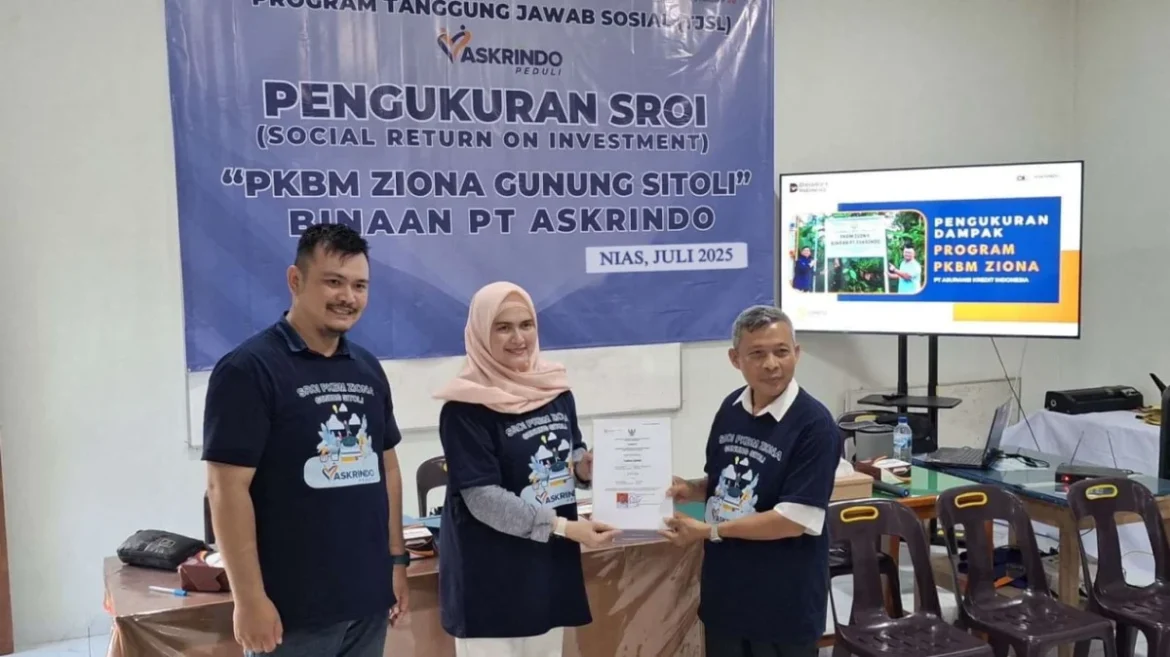
In a significant move to validate the efficacy of its corporate social responsibility initiatives, PT Asuransi Kredit Indonesia, popularly known as Askrindo, has undertaken a rigorous Social Return on Investment (SROI) measurement for its ongoing partnership with the Pusat Kegiatan Belajar Masyarakat (PKBM) ZIONA in Gunungsitoli, North Sumatra. This initiative, conducted in mid-July 2025, represents a sophisticated approach to corporate philanthropy, moving beyond traditional charity toward a data-driven model of social impact and sustainable development. By assessing the tangible and intangible benefits of its educational interventions, Askrindo aims to ensure that every rupiah invested in the community yields maximum social value, particularly in the underdeveloped regions of the Nias Islands.
The evaluation process is a cornerstone of Askrindo’s Tanggung Jawab Sosial dan Lingkungan (TJSL) framework, which seeks to align corporate activities with the United Nations’ Sustainable Development Goals (SDGs). Under the leadership of President Director M Fankar Umran, the company has increasingly focused on the qualitative and quantitative outcomes of its community programs. The decision to focus on PKBM ZIONA highlights the critical role of non-formal education in bridging the gap for marginalized populations who have been excluded from the formal schooling system.
The Strategic Importance of SROI in Corporate Governance
Social Return on Investment (SROI) is an internationally recognized framework for measuring and accounting for a much broader concept of value than traditional financial metrics. It seeks to reduce social and environmental outcomes to a monetary value, allowing organizations to compare the "social profit" generated against the financial investment required. For a state-owned enterprise like Askrindo, which operates under the umbrella of the Indonesia Financial Group (IFG), SROI serves as a vital tool for transparency and accountability to both the government and the public.
M Fankar Umran emphasized that the SROI measurement is not merely a bureaucratic exercise but a strategic necessity. By quantifying the impact on literacy, employability, and local economic growth, Askrindo can refine its programs to be more effective and efficient. "Through this TJSL program, we are committed to empowering the community, increasing financial literacy, and opening wider opportunities for the younger generation in areas such as Gunungsitoli," Umran stated. He further noted that the measurement helps the company control the use of resources, ensuring that they are utilized in a way that promotes long-term sustainability rather than temporary relief.
The methodology employed in Gunungsitoli involved a collaborative and structured approach. Data collection included deep-dive interviews with various stakeholders, including current students, alumni, tutors, and the management of PKBM ZIONA. By analyzing these diverse perspectives, Askrindo was able to map the "change journey" of the participants—from the acquisition of basic literacy to the development of vocational skills and, eventually, to economic independence.
Empowering the Nias Community through PKBM ZIONA
PKBM ZIONA has emerged as a vital institution in Gunungsitoli, providing "Paket A" (elementary equivalent), "Paket B" (junior high equivalent), and "Paket C" (senior high equivalent) education. In many parts of North Sumatra, particularly in the Nias archipelago, economic hardship and geographical isolation often force children to drop out of formal schools. PKBMs provide a second chance for these individuals to earn their diplomas, which are essential for securing formal employment or pursuing higher education.
The recent event in Gunungsitoli was marked by the graduation ceremony for the 2024/2025 academic year. Askrindo’s involvement went beyond financial sponsorship; the company participated in the distribution of certificates and the implementation of modern educational administrative tools. Rido Favorit S. Waruwu, the Head of PKBM ZIONA, highlighted the introduction of e-certificates and transparent transcript systems, which facilitate easier verification for graduates when they apply for jobs or further studies.
"The impact of this program on the lives of our students is profound," Waruwu explained. "Many of our alumni have already transitioned into the workforce or started their own micro-enterprises. Specifically, we have seen a rise in graduates entering the creative economy, focusing on services like graphic design and video editing." This shift toward digital skills is particularly significant in a region like Gunungsitoli, as it allows young people to participate in the national digital economy without needing to migrate to major urban centers like Medan or Jakarta.
Alignment with Sustainable Development Goals
Askrindo’s intervention in Gunungsitoli is designed to address several key pillars of the Sustainable Development Goals (SDGs). By supporting PKBM ZIONA, the company directly contributes to SDG 4 (Quality Education) by providing inclusive and equitable learning opportunities. Education is widely regarded as the most effective "social equalizer," capable of breaking the cycle of intergenerational poverty.
Furthermore, the program aligns with SDG 8 (Decent Work and Economic Growth). By equipping students with vocational skills such as design and multimedia, the program fosters entrepreneurship and enhances the local labor pool’s competitiveness. The transition of alumni from students to business owners in Gunungsitoli provides a direct boost to the local economy, creating a multiplier effect where one successful graduate can provide employment for others in their community.
Finally, the initiative addresses SDG 10 (Reduced Inequalities). Remote regions like Nias often lag behind Java and other central hubs in terms of educational infrastructure and economic investment. Askrindo’s targeted focus on this region demonstrates a commitment to "Indonesia-centric" development, ensuring that the benefits of national economic growth are distributed to the country’s outer reaches.
Integrating Financial Literacy and Insurance Products
As a leading credit insurance provider, Askrindo recognizes that education and financial security are deeply intertwined. During the evaluation and graduation event, the company also conducted educational sessions on financial literacy and the importance of risk management. For many in Gunungsitoli, the concept of insurance is still relatively new or perceived as a luxury for the wealthy.
Askrindo used the platform to introduce accessible insurance products, specifically fire insurance and personal accident insurance. These products are particularly relevant for small business owners and families in rural areas, where a single unforeseen disaster—such as a house fire or a medical emergency—can lead to total financial ruin. By integrating these products into the PKBM ZIONA ecosystem, Askrindo is helping to build a more resilient community.
"Investment in education is the best investment for the future of the nation," Umran added. "However, that investment must be protected. By introducing insurance literacy, we are teaching the community how to safeguard their hard-earned progress." The interactive sessions included testimonials from alumni who have benefited from the program, creating a peer-to-peer learning environment that demystifies financial services.
Chronology and Future Implications
The SROI measurement in Gunungsitoli was the culmination of a multi-month assessment period. It began with the identification of key performance indicators (KPIs) relevant to the local context of North Sumatra. Following the data collection phase in early 2025, the team moved toward the valuation of outcomes, where they assigned "proxy values" to social changes, such as the increased earning potential of a Paket C graduate compared to someone without a high school diploma.
The event on July 14, 2025, served as both a reporting milestone and a celebration of achievement. The presence of Askrindo’s top management in Gunungsitoli sent a strong signal to local government officials and stakeholders that the company’s commitment to the region is long-term.
The implications of this SROI study are expected to influence Askrindo’s nationwide TJSL strategy. If the Gunungsitoli model proves to have a high SROI ratio—meaning the social value generated significantly outweighs the capital invested—Askrindo is likely to replicate this vocational-based PKBM support in other "Frontier, Outermost, and Remote" (3T) regions of Indonesia.
Moreover, this data-driven approach sets a benchmark for other state-owned enterprises (BUMN). As the Ministry of BUMN continues to push for more impactful and transparent CSR activities, Askrindo’s use of SROI provides a blueprint for how companies can move away from "transactional" CSR (one-time donations) toward "transformational" CSR (long-term empowerment).
Conclusion: A Vision for Sustainable Empowerment
The partnership between Askrindo and PKBM ZIONA is a testament to the power of collaborative development. By focusing on education, vocational training, and financial literacy, Askrindo is addressing the root causes of economic stagnation in Gunungsitoli. The SROI measurement ensures that this is not just a feel-good story but a verified success that provides real, lasting value to the people of North Sumatra.
As the graduates of PKBM ZIONA step into the world with their new diplomas and skills, they carry with them the hope of a community that is slowly but surely closing the gap with the rest of the country. For Askrindo, the journey does not end with a graduation ceremony; it continues through the ongoing monitoring of these alumni and the constant refinement of their social programs. In the landscape of Indonesian corporate responsibility, the Gunungsitoli initiative stands out as a model of how financial institutions can act as catalysts for profound social change. Through rigorous evaluation and a heart for the community, Askrindo is proving that the return on investment for social good is perhaps the most valuable dividend a company can ever pay.