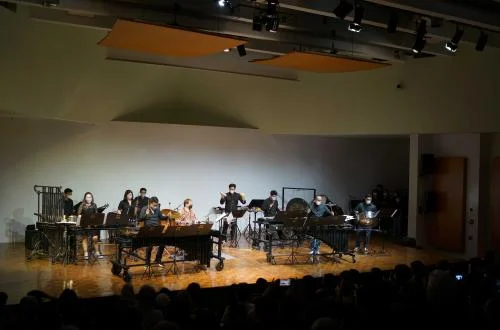
Indonesia’s rich tapestry of musical traditions, particularly its vibrant and often understated percussion heritage, possesses the potential to ascend as a beacon for percussion development across Asia and indeed, the world. Despite this inherent strength, this significant cultural asset has yet to be fully realized on a global scale. Recognizing this untapped potential, the Yayasan Musik Amadeus Indonesia (YMAI), a cornerstone of musical education and promotion in the nation, has orchestrated a groundbreaking initiative named "Kenopsia." This ambitious endeavor marks a pivotal moment, featuring the foundation’s first-ever full percussion concert in its 30-year history, showcasing the Amadeus Percussion Ensemble (Ampere) and featuring renowned Austrian percussionist Adi Schober.
A Multifaceted Approach to Percussion Advancement
The "Kenopsia" concert, held at the esteemed GoetheHaus Jakarta, was not an isolated event but the culmination of a broader strategic effort by YMAI to foster the growth of Indonesian percussion. Prior to the concert, the foundation successfully organized the Indonesia Percussion Composition Competition (IPECC) and the Indonesia Percussion Meeting (IPM). These complementary events served to identify and nurture emerging talent, facilitate knowledge exchange, and establish a platform for contemporary percussion creation within Indonesia.
The "Kenopsia" concert itself was a landmark occasion, not only for YMAI but also for the Indonesian percussion scene. It proudly presented the world premieres of several compositions that emerged victorious from the IPECC. This commitment to showcasing new works underscores YMAI’s dedication to expanding the repertoire and pushing the boundaries of percussion music in Indonesia.
A Program of Diverse Rhythms and Global Influences
The concert program was meticulously curated to offer a diverse and engaging listening experience, blending established repertoire with original Indonesian compositions and featuring prominent international guest artists. The evening commenced with "Novena," a piece by James Swearingen, skillfully arranged by I Nyoman Trieswra Minartha, setting a compelling tone for the performances to follow.
The heart of the first half was dedicated to the premieres of the IPECC winning compositions, offering a glimpse into the innovative spirit of Indonesian composers. These included the intellectually stimulating "Dialektika, Dualitas, Kontradiksi" by Arya Pugala Kitti and Lucy Freia, the emotionally resonant "Restrained" by Andre, the meticulously structured "March 16th" by Jeremia Saputra, and the evocative title piece, "Kenopsia," by Regina Budiyanto Sutisno. The inclusion of these works provided a crucial platform for these nascent talents to gain exposure and recognition.
The second half of the concert transitioned into a dynamic exploration of varied styles and instrumental combinations. It featured the energetic "Blue Samba" by Murray Houllif, a captivating "Solo" performance by Adi Schober, and a thrilling rendition of "The Music of James Bond" by James Bocook, expertly arranged by I Nyoman Trieswara Minartha. The program continued with the vibrant "Mambo Africano" by Alice Gomez and Marily Rife, and culminated in a masterful performance of "Suite for Solo Drumset and Percussion Ensemble" by David Mancini, with Adi Schober as the distinguished soloist. This diverse selection demonstrated the versatility of the percussion ensemble and highlighted the technical prowess of the performers.
The Genesis of Amadeus: A Legacy of Musical Education
The roots of this ambitious undertaking can be traced back to the establishment of the Sekolah Musik Amadeus (SMA) in 1992 by Grace Soedargo, under the umbrella of the Yayasan Musik Amadeus Indonesia. Since its inception, SMA has been instrumental in nurturing generations of musicians, educating thousands of students of all ages, starting from as young as two years old.
Currently, SMA boasts a student body exceeding 200 individuals actively engaged in the study of a wide array of instruments, including piano, strings, woodwinds, and percussion. With a dedicated faculty of 25 educators, SMA remains steadfast in its mission to cultivate classical music appreciation and proficiency in Indonesia. This is achieved not only through rigorous classroom instruction but also through invaluable ensemble playing opportunities, fostering collaborative musicianship within its numerous student orchestras and ensembles. Notably, SMA holds the distinction of being the sole music school in Southeast Asia with an affiliation to the Johann Sebastian Bach Musikschule (JSBM) in Vienna, Austria, a testament to its commitment to international standards of musical pedagogy.
A Vision for Global Competitiveness in Percussion
Grace Soedargo, the visionary founder of YMAI and SMA, articulated the driving force behind the "Kenopsia" initiative. "By organizing the IPECC, IPM, and the ‘Kenopsia’ concert, Amadeus intends to make a significant impact on percussion music in Indonesia," she stated. Her aspiration is clear: to inspire and invigorate Indonesian percussionists, motivating them to elevate their skills and creative output to meet and exceed global standards. This initiative is more than just a series of events; it is a strategic investment in the future of Indonesian percussion on the international stage.
Spotlight on a Master Percussionist: Adi Schober
The presence of Adi Schober, a distinguished percussionist from Austria, lent significant international gravitas to the "Kenopsia" event. Born in 1967 in Holabrunn, Austria, Schober’s musical journey began at the tender age of five with percussion studies. His early education was further enriched by parallel explorations of piano, organ, and trumpet, providing him with a broad musical foundation.
His formal percussion education was pursued at the Hochschule für Musik und darstellende Kunst Wien under the tutelage of Professor Horst Berger. He further honed his skills in drum set and percussion with Professor Fritz Ozmec and delved into jazz percussion at the Konservatorium der Stadt Wien under Professor Walter Grassmann. His pedagogical understanding was deepened through studies in percussion pedagogy with Professor Kurt Prihoda.
Schober’s extensive career includes teaching engagements across various Austrian cities, founding the "Adi Schober Quintett," performing with orchestras and big bands, and serving as music director for numerous festivals in Austria. Since 2009, he has been at the forefront of developing rhythm-based therapy in collaboration with Dr. Kurt Sindermann and Dr. Barbara Schaffer, focusing on individuals with mental health challenges. Schober also maintains a private recording studio, which serves as a hub for his improvisational work and is utilized by esteemed organizations such as the "Internationale Ignaz J Pleyel Gesellschaft" and record labels like "Gramola" and "Apollon." His participation in "Kenopsia" provided Indonesian musicians and audiences with a direct connection to world-class percussion artistry.
The Amadeus Percussion Ensemble: Forging a New Generation
The Amadeus Percussion Ensemble (Ampere) was established in August 2017, coinciding with the celebration of the silver anniversary of both the Yayasan Musik Amadeus Indonesia and the Sekolah Musik Amadeus. This ensemble emerged as a direct consequence of the establishment of the percussion department at the Sekolah Musik Amadeus in the same year, under the leadership of Ryan Saputro. The primary objective behind Ampere’s formation was to cultivate and produce internationally competitive percussionists. The ensemble’s active participation in the "Kenopsia" concert signifies its growing maturity and its role as a flagship performance group for YMAI’s percussion initiatives.
Broader Implications and Future Outlook
The "Kenopsia" event, alongside the IPECC and IPM, represents a significant step forward in YMAI’s long-term vision for the percussion landscape in Indonesia. By providing a platform for new compositions, international collaboration, and high-caliber performances, YMAI is actively contributing to the professionalization and global recognition of Indonesian percussionists and composers.
The success of "Kenopsia" is likely to catalyze further interest and investment in percussion education and performance within Indonesia. It has demonstrated the immense talent pool that exists and the potential for Indonesian percussion to carve out a unique and respected niche on the international music scene. The foundation’s commitment to sustained development, evident in its multi-faceted approach, suggests that this is not a one-off event but rather the beginning of a sustained movement to elevate Indonesian percussion. The lessons learned and the connections forged through these initiatives are expected to foster a more vibrant and globally connected percussion community in Indonesia for years to come. The future of Indonesian percussion, ignited by events like "Kenopsia," appears to be a rhythmically dynamic and promising one.