
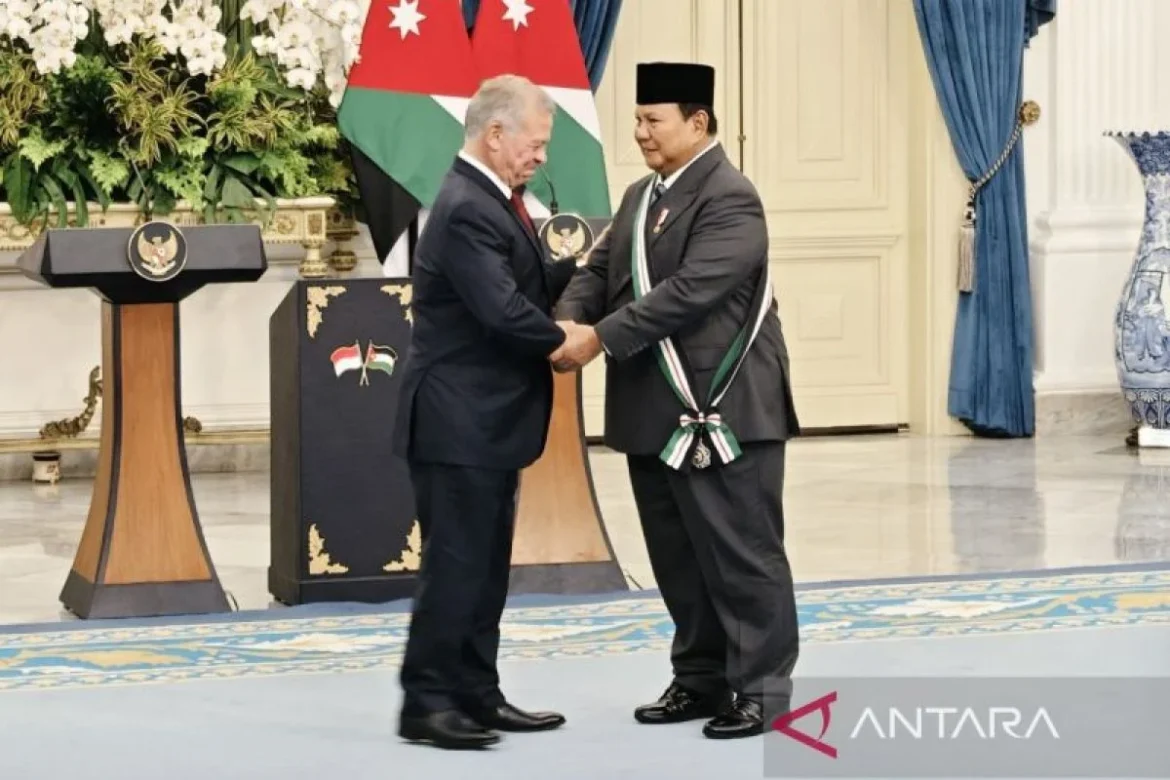
Jakarta (ANTARA) – His Majesty King Abdullah II bin Al-Hussein of Jordan is scheduled to undertake a significant state visit to Indonesia this Friday afternoon, marking a pivotal moment in the bilateral relations between the two nations. The royal visit underscores a long-standing friendship and strategic alignment, particularly between King Abdullah II and Indonesian President-elect Prabowo Subianto, whose personal bond has evolved from shared military training to leading their respective countries on the global stage. This high-profile engagement is poised to strengthen diplomatic, economic, and security ties, with a particular focus on crucial regional and international issues.
The agenda for King Abdullah II’s visit includes a formal meeting with President-elect Prabowo Subianto, followed by discussions with representatives from Danantara Indonesia, a key entity in potential economic cooperation. A significant outcome anticipated from these deliberations is the signing of a bilateral Memorandum of Understanding (MoU), signaling a concrete commitment to enhancing collaboration across various sectors. This visit is part of a broader tour by King Abdullah II across several Asian nations, including Japan, Vietnam, Singapore, and Pakistan, highlighting Jordan’s strategic pivot towards strengthening partnerships within the dynamic Asian continent.
High-Stakes Agenda: Diplomacy, Trade, and Regional Stability
The discussions between King Abdullah II and President-elect Prabowo Subianto are expected to cover a wide array of topics, reflecting the multifaceted nature of modern international relations. Economically, the focus will likely extend beyond the specific engagement with Danantara Indonesia, which, according to earlier reports, is geared towards cooperation in the phosphate sector. Jordan is one of the world’s largest exporters of phosphates, a vital raw material for fertilizers, crucial for agricultural productivity and global food security. For Indonesia, a vast archipelago with a growing population and significant agricultural sector, securing a stable supply of phosphates could be instrumental in bolstering its food resilience strategies. This collaboration could involve joint ventures in mining, processing, or even direct long-term supply agreements, fostering a more robust and resilient supply chain for both nations.
Beyond phosphates, discussions will likely touch upon broader trade and investment opportunities. Indonesia, with its robust economy and large domestic market, presents an attractive destination for Jordanian investment, particularly in sectors such as tourism, halal industry, infrastructure development, and renewable energy. Conversely, Indonesian businesses could explore avenues for investment in Jordan, leveraging its strategic location as a gateway to the Middle East and North Africa. Bilateral trade between Indonesia and Jordan, while present, has historically been modest compared to its potential. This visit offers a fresh impetus to explore untapped synergies and remove barriers to greater economic exchange. Potential areas of cooperation could also include technology transfer, educational exchanges, and cultural programs, aimed at fostering deeper people-to-people connections and mutual understanding.
On the diplomatic front, the leaders are expected to deliberate on regional security concerns, counter-terrorism efforts, and global challenges. Given the current geopolitical landscape, the situation in the Middle East, particularly the ongoing conflict in Gaza and the broader Israeli-Palestinian issue, will undoubtedly feature prominently. Both Jordan and Indonesia share a strong commitment to the Palestinian cause, advocating for a two-state solution and providing humanitarian aid. King Abdullah II has been a vocal proponent of Palestinian rights and the custodian of Muslim and Christian holy sites in Jerusalem, while Indonesia, as the world’s largest Muslim-majority nation, has consistently championed Palestinian statehood. Their coordinated efforts and shared perspectives on this critical issue could lend significant weight to international calls for peace and justice.
A Friendship Forged in Service: The Prabowo-Abdullah II Bond
What makes this state visit particularly compelling is the extraordinary personal relationship between King Abdullah II and President-elect Prabowo Subianto, a bond that spans decades and transcends conventional diplomatic protocols. Their friendship, rooted in shared military training and a mutual respect for service, offers a unique foundation for state-to-state cooperation. This enduring connection dates back to their youth, long before either assumed the highest office in their respective countries.
Both leaders are distinguished alumni of the prestigious U.S. Army Ranger School at Fort Benning, Georgia. This grueling combat leadership course is renowned for its demanding physical and mental challenges, designed to develop elite infantry small-unit leaders. Graduating from Fort Benning signifies a high level of military prowess, resilience, and strategic thinking. This shared experience instilled in them not only a common understanding of military doctrine and leadership but also a deep sense of camaraderie and mutual respect that has persisted throughout their lives.
Their paths also converged in leading special forces units. King Abdullah II served as the Commander of the Jordanian Special Forces in 1994, a critical role in safeguarding national security and projecting regional influence. Similarly, Prabowo Subianto commanded Indonesia’s elite Special Forces Command (Kopassus), a highly decorated unit known for its specialized operations and strategic importance within the Indonesian military. Their leadership roles in these elite units further cemented their understanding of military strategy, discipline, and the complex demands of national security, providing a common ground for strategic dialogue.
From Fort Benning to Global Leadership: A Shared Path
The initial formal meeting between King Abdullah II and Prabowo Subianto took place on December 4, 1995, during the inauguration ceremony of Prabowo as the Commander General (Danjen) of Kopassus. This early encounter set the stage for a relationship that would later evolve into a significant diplomatic asset. The trajectory of their careers, from commanding elite military units to eventually assuming the highest political offices, is a testament to their leadership qualities and dedication to public service. King Abdullah II ascended to the throne as King of Jordan in 1999, following the passing of his revered father, King Hussein. Prabowo Subianto, after a distinguished military career and a foray into business and politics, was recently elected President of Indonesia and is set to be inaugurated on October 20, 2024. Their parallel journeys to national leadership underscore a shared destiny and a unique perspective on governance and statecraft.
A Refuge and a Reunion: The 1998 Chapter
Perhaps one of the most poignant chapters in their friendship unfolded in 1998, a tumultuous period in Indonesian history marked by political upheaval and the fall of President Suharto’s New Order regime. During this time, Prabowo Subianto left Indonesia and sought refuge in Jordan. His arrival in the Hashemite Kingdom was met with exceptional hospitality and honor, reportedly extended by the Jordanian royal family. It is widely documented that during his time in Jordan, Prabowo was even offered Jordanian citizenship, a testament to the profound respect and warmth he received from the royal court. However, he ultimately chose to retain his Indonesian citizenship, demonstrating his unwavering commitment to his homeland. This period of refuge not only solidified his bond with King Abdullah II and the Jordanian monarchy but also highlighted Jordan’s role as a stable and welcoming nation in a complex region.
The deep personal connection was further evident during President-elect Prabowo’s reciprocal visit to Jordan on April 14, 2025. During this visit, King Abdullah II extended an exceptionally warm reception, personally driving Prabowo to his hotel in downtown Amman. This gesture, highly symbolic in diplomatic circles, showcased the extraordinary personal rapport between the two leaders, transcending the formal protocols typically associated with state visits. During their private meeting at the Al Husseiniya Palace in Amman, the leaders discussed strengthening bilateral ties and coordinating efforts on regional issues, particularly the Palestinian question, which remains a core concern for both nations.
Reciprocal Gestures: Amman to Jakarta
This is not King Abdullah II’s first state visit to Indonesia. The two leaders also met during the King’s previous state visit to Indonesia in 2014, when Prabowo was a prominent political figure. These reciprocal visits underscore a consistent commitment to fostering strong bilateral relations. The current visit, however, holds particular significance as both leaders now stand at the helm of their respective nations, empowered to translate their personal camaraderie into tangible state-level cooperation.
The personal endorsement from King Abdullah II for Prabowo’s leadership has also been noted. Earlier reports quoted King Abdullah II as assessing that "Prabowo brings Indonesia in a very good direction," indicating a strong vote of confidence in Indonesia’s future under Prabowo’s leadership. Such a statement from a respected head of state serves to further validate the strategic importance of this bilateral relationship.
Geopolitical Alignment: Addressing Regional and Global Challenges
Beyond the personal rapport, the visit carries significant geopolitical weight. Both Indonesia and Jordan, despite their geographical distance, share common interests in promoting regional stability, combating extremism, and fostering interfaith dialogue. Jordan, a key Western ally in the Middle East, plays a crucial role in regional security, counter-terrorism efforts, and mediating conflicts. Indonesia, as the world’s largest Muslim-majority democracy, champions a non-aligned foreign policy and actively participates in international peacekeeping and humanitarian efforts.
The shared commitment to the Palestinian cause serves as a powerful unifying factor. Jordan, bordering the West Bank, has a direct stake in the Israeli-Palestinian conflict and hosts a large Palestinian refugee population. Its historical role as custodian of Islamic and Christian holy sites in Jerusalem places it at the forefront of efforts to preserve the city’s status quo. Indonesia, though geographically distant, has consistently and vocally supported the establishment of an independent Palestinian state, providing political and humanitarian assistance. The alignment of their positions on this sensitive issue strengthens their collective voice on the international stage and could lead to coordinated diplomatic initiatives aimed at achieving a lasting peace.
Looking Ahead: Strategic Partnership and Future Prospects
The state visit by King Abdullah II to Indonesia is more than a ceremonial exchange; it is a strategic maneuver to deepen a relationship built on mutual respect, shared experiences, and converging interests. The anticipated signing of the bilateral MoU will likely pave the way for enhanced cooperation in vital sectors such as defense, trade, investment, and food security. The emphasis on phosphate cooperation with Danantara Indonesia highlights a pragmatic approach to addressing critical national needs through international partnerships.
Furthermore, the unique personal bond between King Abdullah II and President-elect Prabowo Subianto provides an unparalleled advantage in navigating complex diplomatic challenges and fostering trust at the highest levels. This personal chemistry can expedite negotiations, facilitate understanding, and lay the groundwork for a more robust and resilient strategic partnership between the two nations. As Indonesia prepares for a new presidential era under Prabowo Subianto, and Jordan continues to play a pivotal role in a volatile region, the strengthening of this bilateral relationship promises to yield significant benefits for both countries, contributing to peace, stability, and prosperity in Asia and the Middle East. The visit not only reinforces existing ties but also sets a forward-looking agenda for comprehensive cooperation in an increasingly interconnected world.