
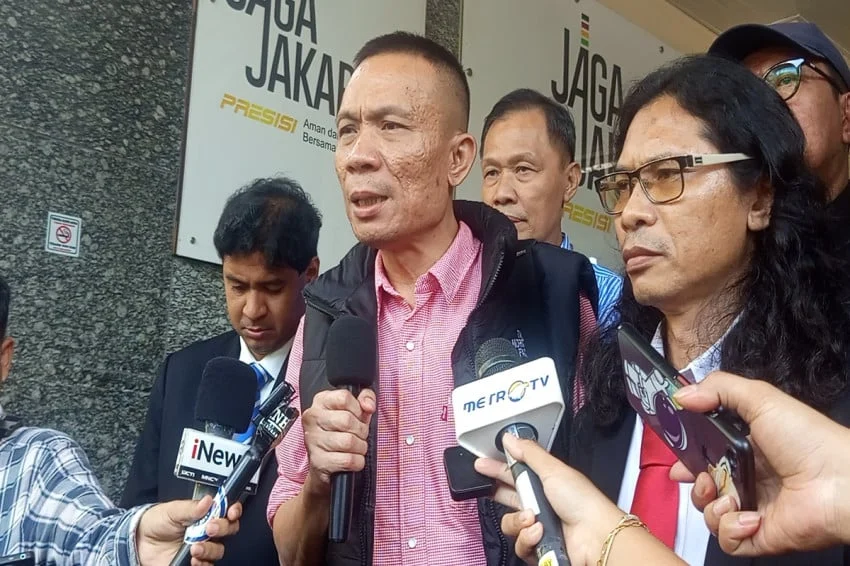
JAKARTA – Prominent forensic expert Rismon Sianipar has vehemently refuted allegations from the camp of former Minister Roy Suryo, which claim he received billions of rupiah after issuing a public apology and admitting errors regarding his previous statements concerning former President Joko Widodo (Jokowi). Sianipar, speaking on Wednesday, April 15, 2026, launched a direct challenge to Roy Suryo, demanding scientific proof for the claims made in the controversial book "Jokowi’s White Paper," which had previously fueled doubts about President Widodo’s academic credentials. This latest development adds another layer to a protracted and often acrimonious public dispute that has spanned several years and touched upon issues of political integrity, academic honesty, and the credibility of forensic analysis in public discourse.
The controversy surrounding President Widodo’s academic qualifications first gained significant traction several years ago, primarily amplified by critics and opposition figures. At the heart of the matter was a dispute over the authenticity of Jokowi’s diploma from Gadjah Mada University (UGM), a prestigious Indonesian institution. Doubts were cast on whether he genuinely graduated from the university, leading to widespread speculation and public debate. It was in this charged atmosphere that figures like Roy Suryo, known for his expertise in telematics and often vocal political commentary, became involved. Suryo, along with others, presented what they claimed to be evidence questioning the diploma’s validity, culminating in the publication of "Jokowi’s White Paper." This book purported to offer a comprehensive analysis supporting the allegations of irregularities in President Widodo’s academic background, thereby fueling a significant political narrative.
Rismon Sianipar, a forensic expert, initially lent his professional insights to the public discussion surrounding the diploma. His early statements or analyses, though not explicitly detailed in the brief original report, are understood to have contributed to the perception of a credible challenge to Jokowi’s academic record. However, Sianipar’s recent pivot marks a significant turning point in the ongoing saga. He recently issued a public apology to President Widodo, retracting his earlier position and admitting that his initial findings or interpretations were erroneous. This recantation, delivered with an acknowledgment of fault, was a dramatic reversal that surprised many observers and immediately drew intense scrutiny, particularly from those who had previously championed the allegations against the former president.
The Allegations of Financial Inducement and Rismon’s Strong Rebuttal
Following Sianipar’s public apology, the camp associated with Roy Suryo swiftly responded with counter-accusations. These allegations suggested that Sianipar’s change of heart was not motivated by a newfound commitment to scientific truth or a correction of error, but rather by financial incentives. Specifically, Sianipar recounted that he had been accused of receiving substantial sums, ranging from "billions, even tens of billions, up to Rp50 billion," as a payoff for his recantation. The implication was clear: Sianipar had been bought, and his apology was a performative act designed to quell the controversy surrounding President Widodo, rather than a genuine scientific correction.
Sianipar, however, vehemently denied these accusations. "I want to clarify the issue circulating outside that I received billions, even tens of billions, up to Rp50 billion. I strongly refute that," Sianipar declared during his public statement. He underscored that his entire process of "RJ" – likely referring to his research journey or rectification efforts – was entirely his own initiative, driven by rigorous, independent research. He emphasized that his decision to apologize and admit fault was a direct consequence of his re-evaluation of the evidence and his commitment to scientific integrity. "This entire process of RJ is my initiative, based on the research I conducted," he asserted, stressing the independent nature of his revised findings.
Moreover, Sianipar pointed out the logical inconsistency of the financial allegations. He argued that if he were the party admitting fault and seeking forgiveness from President Widodo, it would be illogical for the former president, the aggrieved party, to then offer him a multi-billion rupiah payment. "I admitted my mistake and apologized to Jokowi, so logically it wouldn’t be possible. Because I, who am at fault, am instead given money by the person who forgives my mistake. I should be the one compensating Jokowi," Sianipar explained, highlighting the absurdity of the claims. This rhetorical question served to underscore his position that the accusations of bribery defy common sense and the natural order of restitution.
The Challenge to Roy Suryo and the Principle of Scientific Integrity
Beyond merely denying the financial allegations, Rismon Sianipar issued a direct and pointed challenge to Roy Suryo regarding the scientific validity of "Jokowi’s White Paper." This challenge shifts the focus back to the core issue of evidence and research methodology that underpinned the original controversy. Sianipar explicitly called upon Suryo to scientifically prove the claims made within the book, particularly those pertaining to President Widodo’s diploma. This move by Sianipar positions him not just as a defendant against accusations, but as an advocate for rigorous scientific scrutiny and accountability in public discourse.
Sianipar’s challenge implicitly questions the methodology, data, and conclusions presented in "Jokowi’s White Paper." As a forensic expert, his professional ethos dictates a commitment to verifiable evidence and reproducible results. His statement suggests that his own re-evaluation led him to conclude that the "White Paper" might not withstand rigorous scientific examination, or at least that its claims require independent, verifiable proof. "Regarding the book Jokowi’s White Paper, as a researcher, I must be independent and free from bias. When I know my research is wrong, I must admit it," Sianipar stated, outlining the fundamental principle of academic and scientific integrity that he believes should guide all researchers, including those involved in public commentary.
This principle is crucial in fields like forensic science, where objectivity and freedom from bias are paramount. Forensic experts are expected to present findings based solely on evidence, regardless of personal or political leanings. Sianipar’s recantation, therefore, is framed as an act of adherence to these professional ethics, rather than a capitulation for monetary gain. By challenging Suryo to scientifically substantiate the book’s claims, Sianipar is effectively calling for a peer review, not in an academic journal, but in the court of public opinion and scientific scrutiny, demanding that the underlying evidence be laid bare and subjected to critical examination.
Background and Chronology of the "Ijazah Jokowi" Controversy
The "ijazah Jokowi" (Jokowi’s diploma) controversy has been a recurring theme in Indonesian political discourse, particularly during election cycles. Here is a brief chronology of key events:
- Pre-2019 Elections: Whispers and allegations regarding Jokowi’s academic background begin to circulate, often spread through social media and opposition channels.
- 2019 Presidential Election Campaign: The issue gains significant traction as a political attack point. Opponents question the authenticity of his Gadjah Mada University diploma, suggesting it was fabricated or obtained irregularly.
- 2020-2022: The allegations persist and intensify. Roy Suryo emerges as a prominent figure advocating for scrutiny of the diploma, often citing his expertise in telematics and image analysis.
- Late 2022: The book "Jokowi’s White Paper" is published, co-authored or heavily promoted by figures critical of President Widodo, including Roy Suryo. The book compiles alleged evidence and analyses aimed at discrediting the diploma. Rismon Sianipar’s initial analyses or statements are made public during this period, seemingly supporting aspects of the critique.
- Early 2026 (Leading up to April 15, 2026): Rismon Sianipar conducts further independent research or re-evaluates his previous findings.
- April 15, 2026: Rismon Sianipar publicly apologizes to President Jokowi, admitting errors in his previous stance on the diploma controversy. Simultaneously, allegations emerge from Roy Suryo’s camp, accusing Sianipar of receiving billions of rupiah for his recantation. Sianipar issues a strong denial of these financial inducements and challenges Roy Suryo to provide scientific proof for "Jokowi’s White Paper."
The enduring nature of this controversy highlights the susceptibility of public figures to character attacks and the difficulty of definitively dispelling politically motivated allegations, even with official statements and university confirmations. Gadjah Mada University itself has repeatedly affirmed the authenticity of President Widodo’s diploma, providing official statements and documentation to quell the doubts. However, these official validations have often been dismissed by critics as part of a cover-up, demonstrating the deep-seated distrust that can pervade certain segments of public discourse.
Implications for Public Trust and Expert Credibility
This latest development carries significant implications for several aspects of Indonesian public life:
-
Credibility of Forensic Experts: Rismon Sianipar’s case underscores the immense pressure and scrutiny faced by forensic experts when their work intersects with high-stakes political issues. His recantation, framed as a commitment to scientific truth, could potentially enhance the perception of experts as independent truth-seekers, willing to correct errors. However, the counter-accusations of bribery could also erode public trust, making it harder for the public to discern genuine scientific corrections from politically motivated reversals. The incident serves as a stark reminder of the ethical tightrope experts must walk.
-
Academic and Research Integrity: The challenge to "Jokowi’s White Paper" calls into question the standards of research and evidence used in politically charged publications. If the claims in the book cannot be scientifically substantiated, it raises concerns about the potential for academic platforms to be used for partisan attacks rather than objective analysis. Sianipar’s insistence on scientific proof reinforces the critical importance of peer review, verifiable data, and unbiased methodology in any public research.
-
Political Discourse and Information Warfare: The dispute highlights the ongoing battle over narratives and information in the political arena. Accusations of bribery, often difficult to prove or disprove definitively, serve as a powerful tool to discredit opponents and their arguments. This tactic contributes to a climate of distrust, where every statement, especially a reversal, is viewed with suspicion. It further complicates the public’s ability to differentiate between factual reporting, genuine expert analysis, and politically motivated propaganda.
-
Legal Ramifications: Should the accusations of financial impropriety against Rismon Sianipar persist without evidence, or if Sianipar’s challenge to Roy Suryo is left unaddressed, there could be potential legal ramifications. Defamation lawsuits are not uncommon in Indonesia’s political landscape. The current situation could escalate into legal battles if either party feels their reputation has been unduly harmed or if concrete evidence emerges to support or refute the claims.
-
Role of Public Apologies: Sianipar’s public apology, initially intended to rectify a perceived wrong and restore his professional integrity, has instead become a new flashpoint for controversy. While apologies are generally seen as a step towards reconciliation and truth, in this highly polarized context, they can be weaponized by opposing factions, further entangling the individual in protracted disputes.
The Presidential Palace, through its spokespersons, has generally refrained from engaging directly with such personal accusations and counter-accusations once official matters, such as the authenticity of the diploma, have been confirmed by relevant institutions. Their typical stance is to allow legal processes or public discourse to run their course, focusing instead on the former president’s achievements and policies. However, the persistent nature of such allegations, even years after the initial controversy, underscores the lasting impact of information, misinformation, and disinformation on political legacies.
In conclusion, Rismon Sianipar’s firm denial of receiving multi-billion rupiah payments and his subsequent challenge to Roy Suryo mark a pivotal moment in a long-standing public debate. By demanding scientific validation for the claims in "Jokowi’s White Paper," Sianipar is not only defending his personal and professional integrity but also advocating for a return to objective, evidence-based discourse. The resolution of this dispute, whether through further scientific scrutiny, legal action, or public consensus, will undoubtedly influence the standards of truth, accountability, and expert credibility in Indonesia’s vibrant yet often tumultuous public sphere. The saga continues to underscore the complexities of navigating truth and perception in an era of rapid information dissemination and heightened political polarization.