
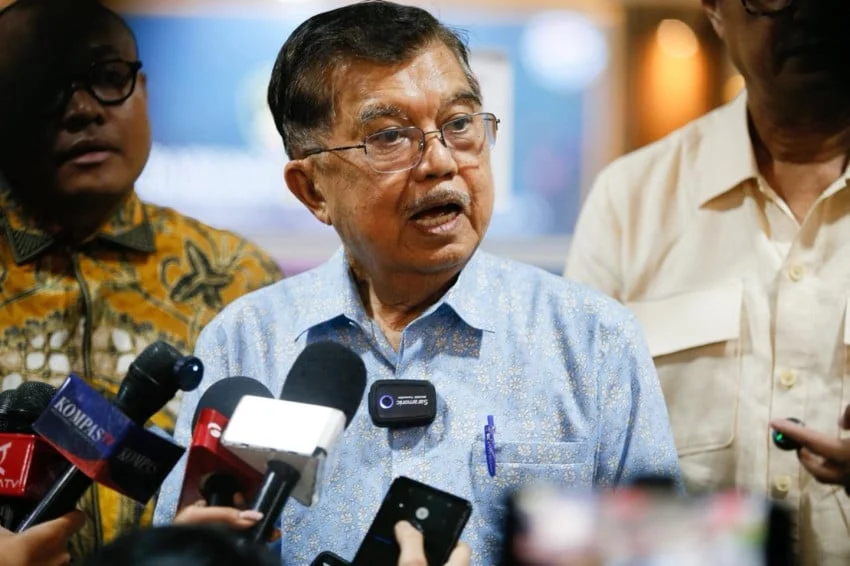
JAKARTA – Former Vice President Jusuf Kalla (JK) is facing accusations of religious defamation, which a prominent policy and national political analyst suggests are politically motivated and lack objective basis. Nasky Putra Tandjung, Chairman of the Indonesia Youth Epicentrum, argued that the accusations against Kalla are disproportionate, lack objectivity, and fail to offer a comprehensive assessment of the issue.
The controversy stems from interpretations of a lecture delivered by Jusuf Kalla at Gadjah Mada University (UGM). Nasky contends that the ensuing public debate is excessive and points to a deliberate effort to manipulate public opinion through systematic negative framing aimed at discrediting Kalla. He characterized the reactions as overly emotional, reactionary, and driven by agitational and provocative narratives that risk escalating broader societal conflict.
"The legal attempts to report Mr. Kalla to the police are also considered baseless, given that Mr. Kalla did not accuse, insult, or demean any particular religion, let alone pass a negative judgment upon it. Therefore, the accusation of religious defamation is entirely unfounded and fabricated," Nasky stated in a press release on Wednesday, April 15, 2026.
Background of the Controversy
The statement that triggered the controversy was reportedly made during a lecture at UGM, a prestigious public university known for its academic freedom and diverse student body. While the exact wording of Kalla’s remarks has been subject to varying interpretations, sources indicate that the discussion revolved around the complex relationship between religion and societal progress in Indonesia. Indonesia, a nation with a significant Muslim majority, also recognizes several other religions, including Christianity, Hinduism, Buddhism, and Confucianism, and embraces the principle of religious pluralism enshrined in its national ideology, Pancasila.
Jusuf Kalla, a seasoned politician with extensive experience in both government and public life, has often been a vocal commentator on national issues. His remarks at UGM, intended to foster dialogue and understanding, appear to have been taken out of context by some segments of the public, leading to the accusations of religious defamation.
Timeline of Events and Reactions
The timeline of events leading to the current accusations can be broadly outlined as follows:
- Date of UGM Lecture (Approximate): Jusuf Kalla delivers a lecture at Gadjah Mada University, addressing topics related to religion and society. The specific date is not detailed in the original report but is understood to have occurred prior to the public outcry.
- Emergence of Interpretations and Accusations: Following the lecture, various interpretations of Kalla’s statements begin to circulate. Some individuals and groups perceive his remarks as offensive or blasphemous towards a particular religion.
- Public Outcry and Media Coverage: The perceived controversy gains traction on social media and is subsequently picked up by news outlets. This leads to widespread public discussion and debate, often characterized by strong emotional responses.
- Formal Complaints Filed: Reports indicate that formal complaints are lodged against Jusuf Kalla with law enforcement agencies, specifically the Polda Metro Jaya (Jakarta Metropolitan Police). This escalates the matter from public discourse to a potential legal investigation.
- Statements from Supporters and Analysts: In response to the accusations and legal actions, figures like Nasky Putra Tandjung issue statements defending Kalla, arguing for a more nuanced and less politically charged interpretation of his words. Kalla’s spokesperson also reportedly issued a statement addressing the allegations, though details were not fully provided in the initial report.
- Ongoing Legal and Political Scrutiny: The legal process initiated by the complaints is expected to unfold, while the political implications of the accusations continue to be a subject of discussion.
Analysis of the Accusations
Nasky Putra Tandjung’s assessment highlights several key points that warrant closer examination:
1. Political Motivation: The suggestion that the accusations are politically motivated implies that Kalla’s past political roles or potential future influence might be a factor. In Indonesia’s dynamic political landscape, public figures are often subject to scrutiny that can be influenced by rivalries or attempts to undermine their standing. Accusations of religious defamation can be potent tools in such contexts, capable of galvanizing specific voter bases and creating significant public pressure.
2. Lack of Proportionality and Objectivity: Nasky argues that the reaction is disproportionate to the alleged offense. This suggests that the interpretation of Kalla’s words might be stretched beyond their intended meaning or context. Objectivity, in this view, would require a careful analysis of the entire speech, the speaker’s intent, and the specific religious tenets allegedly violated, rather than a selective focus on controversial phrases.
3. Systematic Negative Framing and Opinion Manipulation: The claim of "systematic negative framing" suggests a coordinated effort to portray Kalla in a negative light. This can involve selectively quoting remarks, misrepresenting intentions, and amplifying negative interpretations across various platforms to create a widespread perception of wrongdoing. Such tactics are often employed to shape public discourse and influence opinions without necessarily engaging with the substance of the original statement.
4. The Role of Emotional and Agitative Narratives: Nasky’s observation about "agitational and provocative narratives" points to the use of language designed to incite strong emotions, particularly anger or outrage, among the public. This approach bypasses rational discourse and can lead to polarization and conflict, making it difficult to engage in constructive dialogue.
5. Legal Basis of the Accusations: The assertion that Kalla did not "accuse, insult, or demean" any religion is central to the defense. In Indonesia, the blasphemy laws, while controversial, typically require proof of intent to insult or defame a recognized religion. If Kalla’s remarks were indeed aimed at promoting interfaith understanding or analyzing societal dynamics, as Nasky suggests, then the legal basis for defamation would be weak.
Broader Implications for Religious Tolerance and Public Discourse
The controversy surrounding Jusuf Kalla’s remarks has significant implications for the broader discourse on religious tolerance and freedom of expression in Indonesia.
- Chilling Effect on Dialogue: If individuals are constantly at risk of facing legal repercussions or public condemnation for expressing nuanced views on religion or society, it can create a chilling effect on open dialogue and academic discourse. This is particularly concerning in a diverse nation like Indonesia, where robust discussion is essential for navigating complex social issues.
- Weaponization of Religious Sensitivities: The ease with which accusations of religious defamation can be mobilized raises concerns about the weaponization of religious sensitivities for political or personal gain. This can undermine genuine efforts to protect religious freedom and promote interfaith harmony.
- Importance of Context and Intent: This incident underscores the critical importance of understanding statements within their full context and considering the speaker’s intent. Without this, even well-intentioned remarks can be misconstrued and lead to unnecessary conflict.
- Role of Media and Social Media: The amplification of such controversies through media and social media platforms highlights the dual-edged nature of these tools. While they can facilitate information sharing, they can also be exploited to spread misinformation and inflame tensions.
- Upholding Universal Values: Nasky’s concluding remark that Kalla’s statement aimed to encourage the embracing of "universal values, namely humanity" through interfaith relations, offers a positive interpretation. It suggests that the underlying message was one of unity and shared human dignity, a perspective that can be lost in the heat of accusation.
The legal proceedings that follow will be closely watched, not only for their outcome concerning Jusuf Kalla but also for the precedent they might set regarding religious discourse and freedom of expression in Indonesia. The ability of the nation to foster an environment where diverse perspectives can be shared and debated respectfully, without fear of unwarranted accusation, remains a crucial challenge. The case serves as a reminder of the delicate balance between safeguarding religious sensitivities and upholding the principles of open dialogue and intellectual freedom.