
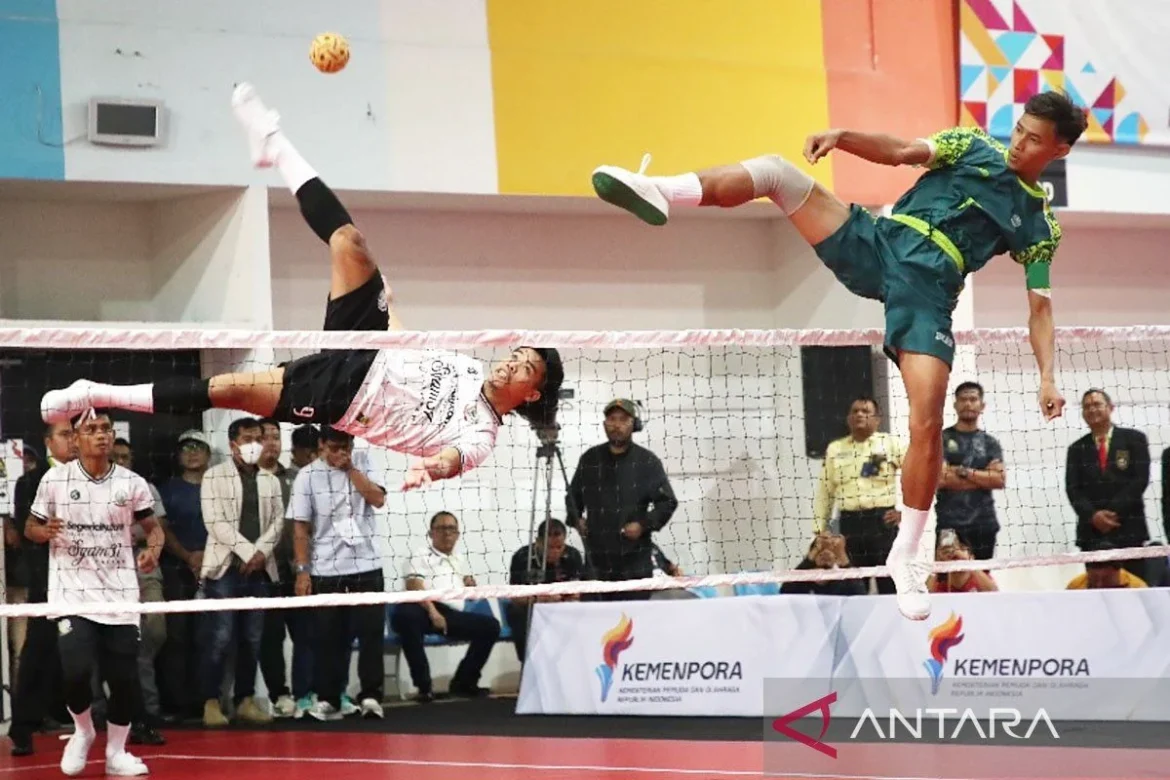
Jakarta (ANTARA) – Imagine a sport that marries the aerial agility of volleyball with the acrobatic kicking prowess of football, all played without a single touch of the hand. This is Sepak Takraw, a traditional Southeast Asian sport that continues to captivate audiences and participants across a wide swath of the region, including Indonesia, Thailand, Malaysia, and the Philippines. Its unique blend of athleticism, skill, and cultural heritage makes it a compelling spectacle, one that is gaining increasing international recognition.
The very name "Sepak Takraw" offers a glimpse into its origins and essence. Derived from a fusion of two languages, "Sepak" from Malay signifies "to kick," while "Takraw" from Thai refers to a "woven rattan ball." Thus, Sepak Takraw literally translates to "kicking the rattan ball." This unique nomenclature was officially recognized following a match between Malaysia and Thailand in Kuala Lumpur in 1960, a pivotal moment that helped standardize and promote the sport on a broader stage.
Before this official codification, the sport bore different names and variations. In Malaysia, it was known as Sepak Raga Jaring. The addition of "Jaring," meaning "net," is attributed to Hamid Mydin, widely regarded as a foundational figure in the development of Sepak Takraw. In Penang around 1945, Mydin’s innovation distinguished the game from its predecessor, Sepak Raga, which was played without a net, underscoring a significant evolution in its gameplay and strategic depth.
Often described as "kick volleyball," Sepak Takraw is a team sport typically played by two to four players per side on a court resembling that of badminton. It ingeniously integrates elements of volleyball and footvolley, but with a crucial distinction: players are strictly forbidden from using their hands. Instead, they must utilize specific parts of their body – feet, knees, shoulders, chest, and head – to propel the ball over the net and into the opponent’s court, demanding an extraordinary level of dexterity and control.
Internationally, the sport’s governance falls under the purview of the International Sepaktakraw Federation (ISTAF), established in 1988. ISTAF plays a crucial role in organizing global competitions, standardizing rules, and promoting the sport’s growth worldwide. The organization’s commitment is evident in its efforts to foster fair play and a high standard of competition among its member nations.
Sepak Takraw boasts a rich tapestry of local names across different countries, reflecting its deep roots in regional cultures. It is known as Sepak Raga in Indonesia, Brunei, Malaysia, and Singapore; Sipa in the Philippines; Chinlone in Myanmar; and Takraw in Thailand, among other variations in various Asian nations. This linguistic diversity highlights the sport’s widespread adoption and adaptation within different cultural contexts.
The Genesis of Sepak Takraw: A Historical Journey
The origins of Sepak Takraw are believed to trace back to Malaysia, with evidence suggesting its existence approximately 500 years ago. It gained significant popularity among royal courts during the 15th century, a testament to its intricate play and aesthetic appeal. By the 16th century, the game had traversed borders, reaching Indonesia under the name Sepak Raga. Its widespread popularity across Southeast Asia truly blossomed in the 1940s with the formalization of its rules and the establishment of structured competitions.
A landmark event in the sport’s history was the first official competition held in Penang in 1945, then known as "Sepak Raga Jaring." This marked a significant step towards standardization. The establishment of the Malaysian Sepak Raga Federation in Penang in 1960 further solidified its organizational structure. A pivotal moment arrived in 1965 when the sport was included in the Southeast Asian Peninsular Games. It was during this prestigious event that the sport was officially christened "Sepak Takraw," a name that would come to represent its unique identity on the international sporting landscape.
Interestingly, some historical accounts suggest that Sepak Takraw may have been introduced to Southeast Asia by the Chinese and shares a common ancestry with football. The sport is thought to have evolved from Cuju, an ancient Chinese traditional game recognized by FIFA as one of the earliest forms of modern football. Cuju, primarily an ancient military exercise, involved groups of soldiers kicking a leather ball, with the objective of keeping it airborne for as long as possible. This historical connection to ball-kicking games underscores the deep-seated human fascination with such athletic endeavors.
Understanding the Mechanics: Rules and Gameplay of Sepak Takraw
The fundamental rules of Sepak Takraw are designed to emphasize skill, strategy, and physical prowess while strictly prohibiting the use of hands. The game is played on a court similar in size to a badminton court, divided by a net. Each team consists of three players: two inside players (known as "Tekong" and "Feeder") and one outside player (the "Killer").
Player Positions and Court Dynamics:
The court is divided into two sides, with specific zones for each player. The "Tekong" is typically positioned at the back, responsible for serving. The "Feeder" operates in the middle, setting up plays and assisting the "Killer." The "Killer" is the offensive powerhouse, positioned at the front to execute powerful spikes and scoring shots. This strategic positioning ensures a dynamic interplay of offense and defense, requiring each player to understand their role and cooperate effectively.
The Flow of Play:
The game commences with a serve initiated by the "Tekong." The server must toss the ball and kick it over the net into the opponent’s court. The choice to serve or receive is typically determined by a coin toss, granting strategic advantage to the winning team.
Following the serve, a rally ensues where players from both teams engage in a rapid exchange of the ball. The objective is to score by making the ball land within the opponent’s court boundaries or by forcing the opponent into committing a fault. Players can use their feet, knees, chest, shoulders, and head to control and propel the ball. The intricate passing sequences and acrobatic maneuvers employed to keep the ball in play are what make Sepak Takraw so visually spectacular.
A crucial aspect of the gameplay is the synergy between the "Feeder" and the "Killer." The "Feeder" skillfully sets up the ball, often with precise aerial passes, enabling the "Killer" to unleash powerful, acrobatic kicks or spikes aimed at finding gaps in the opponent’s defense. The "Tekong," beyond their initial service role, also contributes to the defensive and offensive strategy, demonstrating the all-around athleticism required for success in this sport.
Scoring System:
Points are awarded when the ball lands in the opponent’s court, or when the opposing team commits a fault, such as hitting the ball out of bounds, touching the net with their body or the ball, or making an illegal contact. A standard set is played to 21 points, with a team needing to win by a margin of at least two points. A match is typically won by the team that secures victory in two out of three sets. This scoring system ensures that matches are often tightly contested, demanding sustained focus and performance from the players.
Global Reach and the ISTAF’s Role
The International Sepaktakraw Federation (ISTAF) plays a pivotal role in the sport’s global development. Since its inception in 1988, ISTAF has been instrumental in organizing international tournaments, including the prestigious King’s Cup in Thailand, which attracts top talent from around the world. ISTAF’s efforts extend to promoting the sport in non-traditional regions, developing coaching programs, and ensuring a standardized set of rules that are applied consistently across all major competitions.
The federation has also been actively involved in resolving administrative issues within national federations. For instance, recent reports indicate successful efforts in resolving dualism within the Indonesian Sepak Takraw association, a move that has been warmly welcomed by ISTAF. Such resolutions are crucial for fostering a stable and unified environment for athletes and governing bodies, paving the way for smoother development and increased participation.
Sepak Takraw’s Cultural Significance and Broader Implications
Sepak Takraw is more than just a sport; it is a cultural ambassador for Southeast Asia. Its roots are deeply embedded in the region’s history and traditions, and its continued popularity speaks to its enduring appeal. The sport’s unique characteristics, demanding exceptional physical attributes and strategic thinking, make it a compelling spectacle that can attract a diverse audience.
As Sepak Takraw gains more international traction, there are significant implications for the participating nations. Increased global recognition can lead to greater investment in sports infrastructure, athlete development programs, and enhanced tourism opportunities. The sport’s ability to showcase the agility, discipline, and cultural richness of Southeast Asia positions it as a valuable asset in the global sporting arena.
The continuous efforts by ISTAF and national federations to refine rules, promote fair play, and expand competitive opportunities are vital for the sport’s sustained growth. As more athletes hone their skills and more audiences discover the thrill of Sepak Takraw, its journey from a traditional pastime to a globally recognized sport is set to continue, promising an exciting future for this captivating display of human athleticism.
Pewarta: Putri Atika Chairulia
Editor: Suryanto
Copyright © ANTARA 2025
All rights reserved. No part of this publication may be reproduced, distributed, or transmitted in any form or by any means, including photocopying, recording, or other electronic or mechanical methods, without the prior written permission of ANTARA News Agency. Unauthorized use of content, crawling, or automated indexing for AI purposes is strictly prohibited without written consent.