
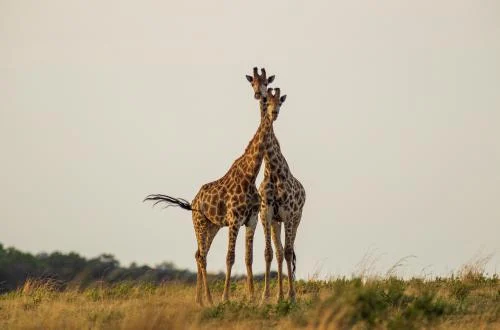
A groundbreaking study has shed light on the surprisingly unconventional mating practices of giraffes, revealing a complex courtship ritual that hinges on the detection of female urine by the male. Unlike many species that rely on vocalizations or elaborate displays, giraffes employ a sensory approach involving direct contact and chemical analysis to determine reproductive readiness. This discovery, stemming from extensive observations in Namibia’s Etosha National Park, challenges long-held assumptions about giraffe social behavior and reproductive strategies.
The research, led by Professor Lynette Hart and her husband, Emeritus Professor Benjamin Hart, from the University of California, Davis School of Veterinary Medicine, meticulously documented the intricate steps involved in a male giraffe’s pursuit of a mate. Their findings indicate that the seemingly passive giants possess a sophisticated, albeit peculiar, method for assessing a female’s fertility and willingness to breed. This detailed examination provides a rare glimpse into the secretive world of giraffe reproduction, a topic that has historically been less understood compared to other large mammals.
The Courtship Unfolds: A Sensory Dialogue
The typical initiation of a mating encounter begins with a male giraffe nudging a female he has identified as a potential partner. This physical contact is not merely an attempt to solicit attention but serves as the prelude to a crucial olfactory examination. The male then proceeds to sniff the female’s genital area, a critical step in gathering vital chemical information. This act of sniffing is more than just a casual gesture; it is the male’s primary tool for assessing the female’s reproductive status.
Following the male’s olfactory investigation, the female giraffe often responds by urinating. This is where the courtship takes a unique turn, as the female’s urine is then collected by the male directly into his mouth. This collected urine is held there for approximately five seconds, a period crucial for the subsequent analysis. The urine, laden with pheromones and other chemical signals, becomes the key to the male’s decision-making process.
The Flehmen Response: Decoding the Scent
Upon receiving the urine sample, the male giraffe engages in a behavior known as the "flehmen response." This distinctive facial contortion involves the male curling his upper lip upwards, exposing his teeth and gums. Simultaneously, he closes his nostrils and inhales deeply. This action is not exclusive to giraffes; it is a behavior observed in various ungulates, including horses, cattle, and goats, all of which utilize it to enhance their olfactory capabilities.
The scientific explanation behind the flehmen response lies in its ability to facilitate the transfer of scent molecules to a specialized sensory organ called the vomeronasal organ, or Jacobson’s organ. This organ, located in the roof of the mouth, is highly adept at detecting and processing pheromones and other chemical cues that are imperceptible to the regular olfactory system. By drawing the urine into his mouth and engaging the flehmen response, the male giraffe is effectively "tasting" the chemical signature of the female, gaining access to information about her hormonal state.
Assessing Fertility and Readiness
The primary objective of this elaborate ritual is for the male giraffe to determine the female’s fertility and her readiness to mate. The urine contains a complex array of hormones and other biochemical markers that signal the stage of her estrous cycle. If the chemical signals detected through the urine do not indicate ovulation or receptivity, the male will typically disengage and move on to seek another potential mate. This ensures that his energy and resources are not expended on a female who is not fertile or not prepared to conceive.
This selective process highlights the evolutionary advantage of such a refined courtship strategy. It minimizes wasted effort and increases the probability of successful reproduction. For a species with a relatively low reproductive rate, optimizing each mating opportunity is paramount to population sustainability.
A Time-Consuming Pursuit
The entire process of courtship and mate selection for giraffes can be remarkably time-consuming and energy-intensive. The study revealed that a male giraffe might approach a female up to 150 times before a successful mating occurs. This high number of attempts underscores the challenges involved in finding a receptive mate and the dedication required by the males. Each approach involves a series of nudges, sniffs, and urine assessments, interspersed with periods of observation and potential rejection.
This protracted courtship period also suggests that mating opportunities may not be uniformly distributed throughout the year, or that female receptivity is carefully timed. Unlike species with defined breeding seasons, giraffes appear to have a more continuous mating system, but the success of any given encounter depends heavily on the female’s hormonal status.
The Reproductive Act and Subsequent Gestation
Once a receptive female has been identified and the courtship culminates in successful mating, the reproductive act itself is relatively brief, as is common among many mammal species. The gestation period for giraffes is exceptionally long, lasting approximately 400 days, or about 13 months. This extended period of development is characteristic of large mammals and allows for the significant growth of the fetus within the womb.
A particularly striking aspect of giraffe reproduction is the birth process. Female giraffes give birth while standing. This means that the newborn calf, upon entering the world, experiences a dramatic drop from a height of several feet. This seemingly precarious introduction to life is, in fact, an evolutionary advantage. The fall helps to break the amniotic sac, stimulating the calf to breathe and encouraging it to stand and walk shortly after birth. This rapid mobility is crucial for the calf’s survival, enabling it to keep pace with the herd and evade predators.
The Significance of the Study and its Researchers
The detailed insights into giraffe mating rituals are largely attributable to the dedication and keen observation skills of Professor Lynette Hart and Professor Benjamin Hart. Their decision to conduct this research in Etosha National Park in Namibia provided an ideal environment for prolonged and close-range observation of giraffe behavior. The park’s relatively dense giraffe population and the researchers’ access allowed for the monitoring of numerous individuals and their interactions.
Professor Hart described the experience of being so close to the animals as "very unique," highlighting the privileged position they were in to gather such intimate data. The study, published and reported by LiveScience on Tuesday, February 14, 2023, represents a significant contribution to our understanding of animal behavior and reproductive biology. It underscores the importance of field research in uncovering the intricate and often surprising adaptations that species develop for survival and propagation.
Broader Implications and Future Research
The findings of this study have several broader implications. Firstly, they emphasize the diversity of reproductive strategies employed by mammals, demonstrating that evolutionary pressures can lead to highly specialized and unexpected adaptations. The reliance on chemical cues, particularly urine, for mate assessment in giraffes challenges the common perception of these animals as simply majestic grazers.
Secondly, this research contributes to a deeper appreciation of the complex social dynamics within giraffe populations. Understanding how individuals find mates and the challenges they face provides valuable information for conservation efforts. Knowledge of reproductive cycles and mating behaviors can inform strategies for captive breeding programs and for protecting wild populations from threats such as habitat loss and poaching.
The study also opens avenues for future research. For instance, further investigation could explore the specific chemical compounds within giraffe urine that are most indicative of fertility. Analyzing these compounds could lead to a more precise understanding of the signals being exchanged. Additionally, comparative studies with other giraffe subspecies could reveal variations in their mating rituals and reproductive strategies, offering further insights into the evolutionary pressures shaping these magnificent creatures.
The successful identification of a potential mate and the subsequent reproductive success are not guaranteed. The study’s statistics suggest a low success rate per approach, meaning that a male giraffe’s reproductive life may involve a considerable amount of effort and a degree of luck. This highlights the challenges of reproduction in the wild and the sophisticated adaptations that have evolved to overcome them. The long gestation period, while demanding, ensures that the calf is born at a stage of development where it has a higher chance of survival in its challenging environment. The standing birth, though seemingly harsh, is a critical adaptation that promotes immediate mobility and self-sufficiency for the newborn.
The work of the Harts in Etosha National Park is a testament to the power of dedicated scientific inquiry. By patiently observing and meticulously documenting the behaviors of giraffes, they have unveiled a fascinating aspect of their biology that was previously unknown. This research serves as a reminder that even the most familiar animals can hold profound secrets, waiting to be discovered through careful study and a commitment to understanding the natural world. The implications of their findings extend beyond the academic realm, fostering a greater appreciation for the intricate web of life and the remarkable adaptations that enable species to thrive.