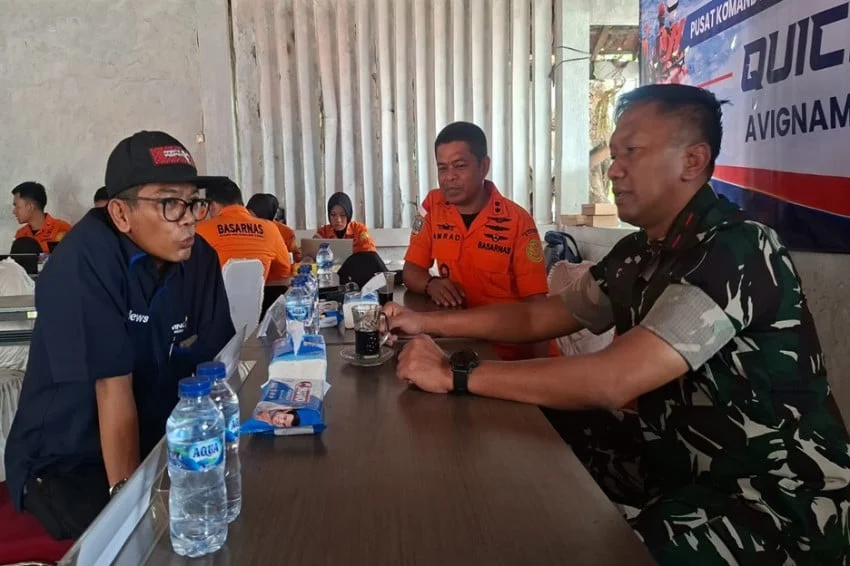
The ongoing search and rescue operation for five journalists and three vessel crew members who went missing in the treacherous waters of the Sunda Strait reached a critical juncture on Monday, September 14, 2026. Head of News Gathering for iNews Media Group, Lukman Hanafi, traveled directly to the Joint Search and Rescue (SAR) Post located at Carita Beach in Pandeglang Regency, Banten Province. His visit served as an official expression of profound gratitude and solidarity with the multi-agency task force, which has worked tirelessly under challenging maritime conditions to locate the missing individuals.
The disappearance of the eight-person contingent—comprising media professionals and maritime crew navigating the Sunda Strait—has triggered one of the most intensive regional search operations in recent months. During his visit to the coastal command center, Lukman engaged in high-level operational briefings with key regional stakeholders, including Banten Governor Andra Soni, Head of the Banten Search and Rescue Office Al Amrad, Commander of Military Resort Area (Danrem) 064/Maulana Yusuf Brigadier General TNI Daru Cahyadi Soeprapto, and Banten Regional Police Public Relations Head Commissioner Maruli Ahiles Hutapea.
The high-level discussions focused heavily on evaluating the operational strategies deployed thus far, analyzing maritime drift models, and mobilizing additional resources to locate the missing persons. The visit underscores the gravity of the situation, highlighting the profound risks faced by media workers in the field and the unwavering commitment of national rescue agencies to bring them home.
Chronology of the Incident and Maritime Challenges
The maritime tragedy unfolded in the Sunda Strait, a dynamic and heavily trafficked body of water connecting the Java Sea to the Indian Ocean, situated between the islands of Java and Sumatra. Known for its complex underwater topography, unpredictable tidal currents, strong winds, and volatile weather patterns, the strait presents severe navigation challenges for commercial vessels, fishermen, and media watercraft alike.
The group of eight—consisting of five journalists, including Yudistiro Pranoto from iNews Media Group, and three boat crew members—lost contact with their respective newsrooms and land-based coordinators during a routine reporting assignment in the strait. When the vessel failed to check in at its designated reporting intervals and missed its scheduled return window, emergency protocols were immediately initiated.
Initial efforts began as a localized sweep of the last known coordinates provided by the vessel’s positioning system before deteriorating weather conditions hampered communication. As hours turned into days without contact, the operation was formally escalated into a coordinated regional SAR mission. The National Search and Rescue Agency (Basarnas), working in tandem with the Indonesian Navy (TNI AL), the Water Police (Polairud), regional disaster management agencies (BPBD), and civilian volunteers, established a unified command post at Carita Beach to serve as the tactical hub for offshore operations.
Expanding the Scope: Search Operations Extended by Three Days
With the initial statutory search window drawing to a close without definitive sightings of the missing vessel or its occupants, operational commanders faced a critical decision. Citing newly analyzed maritime drift data, witness testimonies, and persistent appeals from families and media organizations, the Joint SAR command officially announced a three-day extension of the search operation.
This extension provides crucial additional time to comb wider maritime zones, taking into account potential northward or southward drifts influenced by the prevailing monsoonal currents in the Sunda Strait. Search teams have intensified their sweeps across expanded sectors, utilizing a combination of high-speed rigid-hull inflatable boats (RHIBs), patrol vessels, and specialized maritime reconnaissance units. Furthermore, aerial surveillance teams using helicopters and unmanned aerial vehicles (UAVs) equipped with thermal imaging have been deployed to scan remote island coastlines, coves, and floating debris fields where survivors or wreckage might wash ashore.
Despite facing heavy rain squalls, high swells, and limited underwater visibility, search personnel have maintained a round-the-clock operational tempo. The integration of advanced sonar equipment and localized input from traditional fishermen who possess intimate knowledge of the strait’s hidden currents has further optimized the daily search grids.
Meeting with the Families: A Personal Touch of Solidarity
Beyond his strategic meetings with military and civilian leadership, Lukman Hanafi took time to meet directly with families of the missing personnel stationed at the command post. Among them was Juliasih, the mother of Yudistiro Pranoto, who traveled to Carita Beach alongside other family members to maintain a constant vigil and monitor the daily progress of the SAR operations.
The emotional weight of the waiting period has weighed heavily on the families, who are enduring the agonizing uncertainty typical of maritime disappearances. During his conversation with Juliasih, Lukman offered words of comfort, reassurance, and steady institutional backing. He emphasized that iNews Media Group remains steadfast in supporting the families through this difficult ordeal, providing logistical, psychological, and administrative assistance.
"We are here to stand alongside the families and to ensure that every possible resource continues to be deployed in the search for our colleagues," Lukman stated during his interaction with the families. He reiterated that management is in continuous contact with operational leaders on the ground to ensure complete transparency and maximum effort from the joint forces.
Official Responses and Inter-Agency Collaboration
The response to the missing journalists has highlighted a high level of cooperation among regional and national institutions. Governor Andra Soni praised the resilience of the joint personnel and reaffirmed the local government’s commitment to supporting the mission.
"The regional government of Banten is fully mobilized to assist Basarnas and the military in this humanitarian mission. We recognize the vital role that journalists play in our society, and we owe it to them, their families, and the public to leave no stone unturned," Governor Andra Soni remarked during the tactical briefing.
Head of the Banten Search and Rescue Office, Al Amrad, detailed the tactical adjustments made for the extended phase of the operation. He explained that search grids have been recalibrated based on sophisticated oceanographic modeling provided by meteorological agencies, which simulate how objects drift in the specific wind and wave conditions recorded since the vessel went missing.
Meanwhile, Danrem 064/Maulana Yusuf Brigjen TNI Daru Cahyadi Soeprapto underscored the military’s dedication, noting that army personnel, naval units, and territorial Babinsa officers along the coastline have been instructed to maintain constant visual watches along the beaches of Pandeglang, Serang, and surrounding coastal districts. Local fishermen and coastal communities have also been formally alerted and asked to report any unusual findings immediately to the nearest security post.
Broader Implications for Media Safety and Maritime Protocols
The ongoing incident in the Sunda Strait has cast a sharp spotlight on the inherent occupational hazards faced by journalists covering maritime environments. Unlike terrestrial reporting, reporting on water requires rigorous adherence to maritime safety standards, reliable communication redundancies, and real-time risk assessments.
Industry advocacy groups and press freedom organizations have closely monitored the situation, using the incident to reiterate calls for enhanced safety protocols for media personnel deployed to high-risk zones, whether conflict areas, disaster sites, or treacherous bodies of water like the Sunda Strait. The tragedy underscores the necessity for media companies to invest in comprehensive safety training, mandatory personal flotation devices, satellite communication devices that function independently of cellular networks, and strict operational check-in protocols.
Furthermore, the extensive multi-agency response demonstrates the growing institutional recognition of journalists as essential public service workers whose safety is paramount during crisis coverage. As the extended search window progresses, the nation’s media community, government officials, and the families of the missing continue to hold onto hope, awaiting a breakthrough in the vast and unpredictable waters of the Sunda Strait.