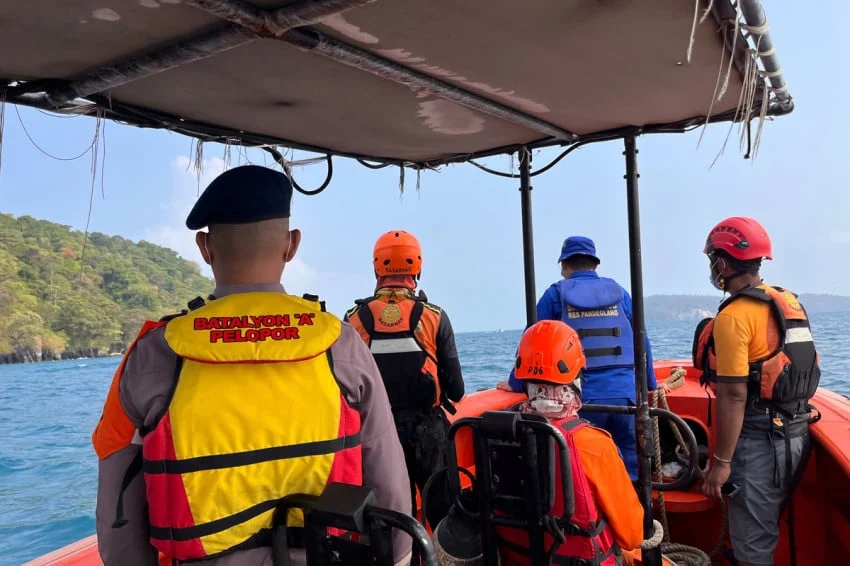
The ongoing search and rescue operations in the Sunda Strait have entered a critical phase following a breakthrough in digital tracking technology. Deputy Minister of Communication and Digital Nezar Patria announced that the final contact points for five journalists and three crew members, who went missing while covering the volcanic activity of Mount Anak Krakatau, were traced to Sebesi Island. The tracking was made possible through the analysis of International Mobile Equipment Identity (IMEI) signals emitted by the victims’ mobile devices, providing authorities with a vital geographic reference point that has redirected search efforts across the rugged maritime landscape of Banten and Lampung.
The disappearance of the media crew and vessel operators has sent shockwaves through Indonesia’s journalistic community and raised urgent questions regarding safety protocols during natural disaster reporting. As family members join search teams in the field, government agencies, telecommunications providers, and rescue coordinators are pooling resources to trace the exact movements of the missing individuals prior to the loss of all communications.
Chronology of the Disappearance and Initial Search Operations
The incident unfolded against the backdrop of heightened volcanic unrest at Mount Anak Krakatau, a notoriously volatile volcanic island situated in the Sunda Strait between the islands of Java and Sumatra. On early September 2026, a reporting team comprising five journalists and three Anak Buah Kapal (ABK)—vessel crew members—embarked on a maritime expedition to document the geological awakening and eruption phases of the volcano.
Routine check-ins from the vessel ceased abruptly, prompting concern from newsroom desks and family members when the ship failed to return by its scheduled schedule. Initial efforts to contact the crew via standard marine radio and cellular calls yielded no results, leading to the immediate mobilization of local search and rescue (SAR) teams. The operational zone spans a complex maritime area characterized by unpredictable currents, ash fall hazards, and remote islands that serve as natural barriers or potential refuges.
As days passed without visual contact or direct radio transmission, the search widened from immediate coastal waters to surrounding islands within the Sunda Strait, including Pulau Sertung and Pulau Sebesi. The psychological toll on the families of the missing personnel has been profound, highlighted by reports of relatives—such as the wife of iNews journalist Yudistiro Pranoto—actively participating in deployment briefings and accompanying rescue boats to remote outposts like Pulau Sertung to aid in the search.
Breakthrough via IMEI Signal Tracking
The recent identification of the final contact point represents a major technical milestone in the search operation. Speaking from Marina Carita Beach in Pandeglang, Banten, Deputy Minister Nezar Patria detailed how the Ministry of Communication and Digital (Kemenkomdigi) assisted the operation by leveraging telecommunications infrastructure data.
Through collaboration with national cellular operators, technical teams analyzed network logs to trace the last active data and voice signals transmitted by the devices carried on board. By isolating the specific IMEI numbers associated with the journalists and crew members, authorities determined that the final localized signal pings originated from Sebesi Island on Monday, September 7, 2026.
"The last contact was on Sebesi Island. That was the last contact where the signal broadcasted by the IMEI originated from that island or was detected from that island," Nezar stated during a press briefing.
This digital footprint was promptly handed over to the Directorate General of Infrastructure at the Ministry, which then funneled the data directly to the central SAR command center. In modern search and rescue missions, digital forensics and telecommunications tracking have become indispensable tools, particularly in vast maritime environments where visual spotting is severely hindered by weather conditions, volcanic smoke, and vast expanses of open water.
Profile of Mount Anak Krakatau and Maritime Risks
Mount Anak Krakatau, translating to the "Child of Krakatoa," is the offspring of the legendary 1883 eruption of Krakatoa. Since emerging from the sea in the 1920s, the volcano has experienced continuous growth interrupted by periodic violent eruptions, collapses, and tsunami events—most notably the catastrophic flank collapse and tsunami in December 2018.
Reporting on active volcanoes from the sea carries inherent, high-level risks. Journalists covering such phenomena often navigate close to exclusion zones to capture the scale of pyroclastic flows, ash columns, and lava activity. In the Sunda Strait, sudden weather shifts, high swells, and volcanic debris present constant hazards to small and medium-sized watercraft.
The reliance on cellular network data underscores the vulnerability of maritime communications in these zones. While major islands possess stable tower coverage, the deep channels and shadow zones around active volcanic cones often experience severe signal attenuation, making real-time tracking difficult once a vessel moves beyond line-of-sight transmitters.
Official Responses and Multi-Agency Coordination
The joint SAR operation involves a broad coalition of stakeholders, including the National Search and Rescue Agency (Basarnas), the Indonesian Navy, the Water Police (Polairud), local volunteer organizations, and telecommunications regulators. The integration of Kemenkomdigi into the operation illustrates an inter-agency approach, combining digital surveillance capabilities with traditional search grids.
Search coordinators have utilized the Sebesi Island data point to redraw operational sectors, concentrating surface sweeps, aerial drone deployments, and underwater sonar scans in the waters surrounding the island and its neighboring reefs. Authorities are investigating whether the vessel sought shelter on the island due to worsening weather or volcanic activity, or if the wreckage and drifting materials subsequently washed ashore.
Family support mechanisms have also been activated. Psychological first aid and logistical assistance are being provided to the families waiting at the command posts in Carita Beach and Pandeglang. Media organizations have rallied to support their colleagues, providing continuous updates and demanding an exhaustive search deployment.
Broader Implications for Journalist Safety and Emergency Protocols
The disappearance of the five journalists and crew members has triggered a critical reassessment of safety protocols for media personnel covering high-risk natural disasters. Industry associations and press freedom advocates are calling for stricter enforcement of standard operating procedures (SOPs) regarding maritime reporting near active geological zones.
Key areas under review include:
- Mandatory Satellite Communication: Ensuring that all vessels carrying media teams into remote or hazardous waters are equipped with reliable, independent satellite tracking devices and distress beacons rather than relying solely on terrestrial cellular networks.
- Real-time Check-in Protocols: Establishing strict, automated location-sharing routines between field journalists and their home newsrooms.
- Coordination with Geological Authorities: Enhancing pre-deployment briefings between media outlets and agencies like the Center for Volcanology and Geological Hazard Mitigation (PVMBG) to ensure clear understanding of exclusion zones and imminent eruption indicators.
As the search operation enters its next phase, the focus remains firmly on locating the missing personnel. The IMEI data retrieved from Pulau Sebesi provides a tangible thread in an otherwise complex investigation, offering hope to families, colleagues, and rescue workers racing against time in the waters of the Sunda Strait.