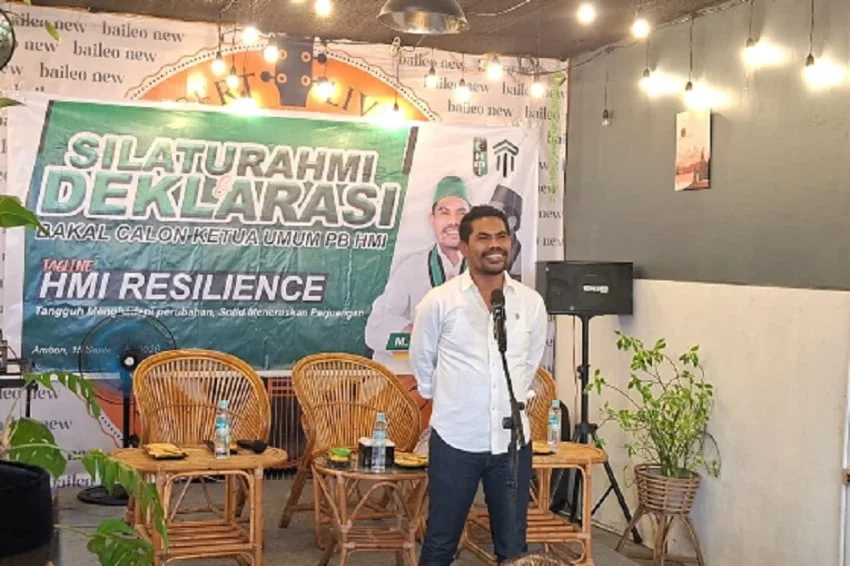
The leadership race for the executive board of Indonesia’s largest Islamic student organization has officially intensified as M Nur Latuconsina formally announced his candidacy for the General Chairperson of the Executive Board of the Himpunan Mahasiswa Islam (PB HMI) for the 2026–2028 tenure. Hailing from the Ambon branch, Latuconsina enters the high-stakes national contest carrying a comprehensive institutional renewal framework titled "HMI Resilience." This strategic vision serves as his foundational platform ahead of the upcoming 33rd HMI Congress, scheduled to take place in Bandar Lampung.
The formal declaration took place at a gathering held at the Baileo Cafe in Ambon, drawing notable attendance from regional chapter leaders, alumni, and active student members. The event marked a critical milestone in the pre-congress lobbying and consolidation phase, signaling the decentralization of national leadership aspirations away from traditional Java-centric power bases toward the eastern regions of the Indonesian archipelago.
Background Context and Strategic Vision
M Nur Latuconsina, widely known among peers as Reno, is no stranger to the national apparatus of the organization. He currently serves as the Head of the Manpower Division for the PB HMI 2024–2026 tenure. His insider perspective on the administrative and socio-economic challenges facing contemporary Indonesian youth has heavily influenced his platform.
During his declaration speech in Ambon, Reno emphasized that "HMI Resilience" is purposefully designed to transcend ordinary political rhetoric or internal electoral branding. Instead, he positions the concept as a definitive strategic blueprint aimed at modernizing the organizational machinery to effectively respond to rapid global shifts, economic uncertainties, and sociopolitical transformations in Indonesia.
The conceptual framework of HMI Resilience is anchored on three interdependent pillars: intellectual revitalization, militant struggle, and moral integrity. According to campaign insiders, these pillars were formulated following months of grassroots consultations with various regional branches, absorbing grievances regarding bureaucratic stagnation, shifting ideological engagements, and the evolving demands of the modern Indonesian labor market.
The Three Pillars of HMI Resilience
The first pillar centers on intellectual revitalization. Within this domain, Reno has proposed a comprehensive overhaul of the formal cadre training curriculum—known locally as training perkaderan. The objective is to bridge traditional classical Islamic scholarship with modern scientific methodologies and technological literacy. By upgrading the intellectual capacity of its members, the organization aims to remain relevant as a premier intellectual incubator in an era defined by artificial intelligence, automation, and shifting geopolitical landscapes.
The second pillar focuses on the ethos of struggle and socio-political responsiveness. Historically, HMI has functioned as a critical pressure group and a developmental catalyst within the Indonesian republic since its founding in Yogyakarta in 1947. Reno’s platform calls for renewed grassroots advocacy, particularly concerning labor rights, economic equity, and environmental sustainability—issues that directly impact the everyday lives of ordinary citizens.

The third pillar emphasizes moral integrity and institutional transparency. In an era where public trust in sociopolitical organizations faces constant scrutiny, the campaign stresses the urgency of internal governance reform. This involves establishing transparent financial systems, merit-based talent management within the internal hierarchy, and zero-tolerance policies toward corrupt practices or external political co-optation.
The Road to the 33engah Congress in Bandar Lampung
The declaration in Ambon initiates what is expected to be a fiercely contested electoral cycle leading up to the 33rd HMI Congress in Bandar Lampung. The Congress serves as the highest sovereign decision-making body of the association, responsible for evaluating the accountability report of the outgoing executive board, establishing broad organizational guidelines, and electing the new leadership team.
As the race progresses, observers anticipate that multiple candidates from various regional coordination bodies (Badan Koordinasi or Badko) across Sumatra, Java, Kalimantan, Sulawesi, and Eastern Indonesia will formally enter the fray. The geographic diversity of the candidate pool highlights the vast, nationwide network that HMI commands, with hundreds of active branches spanning the entire archipelago.
The selection of Bandar Lampung as the host city for the 33rd Congress brings logistical and organizational complexities, requiring rigorous coordination between the central board, local hosts, and security apparatuses. Historically, HMI congresses attract thousands of voting delegates and non-voting observers, often resulting in dynamic, high-energy, and occasionally polarized deliberations.
Implications for Student Activism and National Leadership
The emergence of candidates proposing structural reforms like HMI Resilience reflects broader trends within contemporary Indonesian student movements. Modern student organizations are increasingly pressured to move beyond traditional campus politics and ideological posturing, adapting instead to practical competency-building, digital literacy, and economic advocacy.
Given HMI’s historical role as a primary pipeline for Indonesia’s political, bureaucratic, and economic elite—having produced numerous cabinet ministers, legislators, academics, and business leaders—the outcome of the 33rd Congress carries significance that extends far beyond the internal dynamics of the student body. The strategic direction chosen by the delegates in Bandar Lampung will inevitably shape the ideological and professional orientation of a new generation of leaders entering public life.
As the campaign enters its subsequent phases, stakeholders, regional branches, and voting delegates will closely scrutinize how M Nur Latuconsina and his fellow contenders translate their theoretical manifestos into actionable agendas. The coming months will witness intense lobbying, regional debates, and policy presentations as candidates vie for the crucial support needed to secure victory at the national congress.