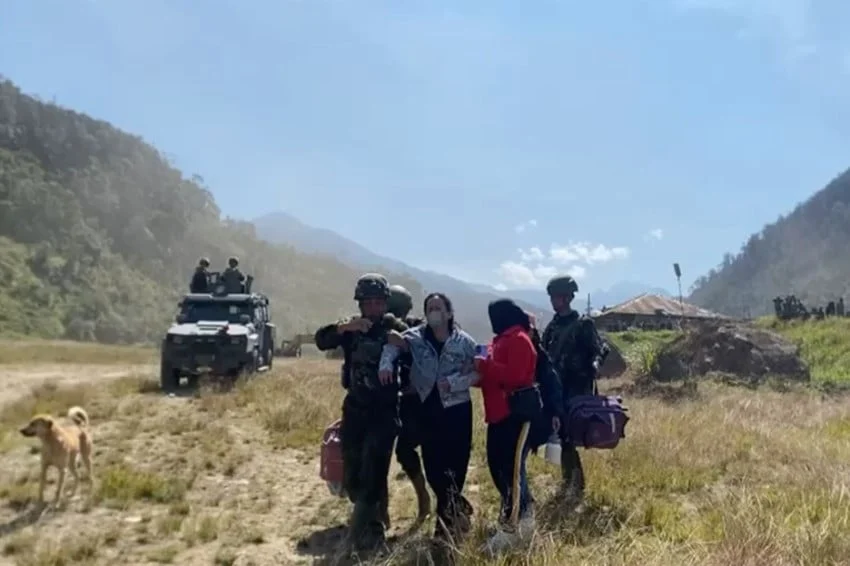
In a tense yet deeply compassionate humanitarian operation, the Commander of the Joint Operations Command of the Indonesian National Armed Forces (Pangkoops TNI Habema), Brigadier General TNI Riyanto, personally ordered an emergency aerial evacuation for Sinta Bilolo. Sinta is the grieving widow of the late Aris Sanda, an innocent civilian who fell victim to the unspeakable brutality perpetrated by the Free Papua Movement (OPM), widely designated locally as the Armed Criminal Group (KKB). The operation, executed on Thursday, September 17, 2026, involved extracting Sinta from the perilous confines of the Mbua District to the relative safety of Wamena in the mountainous region of Papua.
This decisive military intervention was necessitated by the total disruption and paralysis of overland transportation routes connecting Mbua and Wamena. Persistent security threats, coupled with infrastructural vulnerabilities and deliberate sabotage by insurgent elements, rendered land travel exceedingly dangerous for civilians, particularly those already traumatized by violence. Recognizing the acute vulnerability of Mrs. Sinta Bilolo, military authorities acted swiftly to prioritize her safety, ensuring she could traverse the treacherous terrain without falling prey to further hostility from armed separatists operating within the region.
The successful completion of this high-stakes evacuation underscores the ongoing operational challenges faced by security forces in Papua, where routine civilian movements frequently morph into complex security dilemmas. By deploying specialized military aviation assets, the TNI Habema command demonstrated its commitment not only to neutralizing insurgent threats but also to safeguarding the lives and well-being of local citizens caught in the crossfire of separatist violence.
Complex Chronology of the Evacuation Operation
The logistical execution of Sinta Bilolo’s evacuation required meticulous planning and seamless multi-stage coordination among various military aviation units stationed across Papua’s rugged interior. Given the hostile nature of the Mbua District—an area frequently utilized by armed criminal factions as a stronghold or transit route—standard ground-based rescue protocols were entirely unfeasible.
The operation commenced early Thursday morning when a tactical Bell helicopter touched down securely in Mbua under the protective watch of security personnel. Mrs. Sinta Bilolo, accompanied by two trusted companions, Haryati and Murni, boarded the aircraft amidst a heavy atmosphere of sorrow and apprehension. The Bell helicopter executed a swift tactical takeoff, lifting the trio out of the high-risk zone and transporting them to Kenyam, the administrative capital of Nduga Regency.
Upon touching down safely in Kenyam, the evacuees underwent a brief security and health assessment before transitioning to the second leg of their journey. A fixed-wing Caravan aircraft, chartered for its reliability in navigating Papua’s unpredictable mountain weather patterns, was waiting on the tarmac. Sinta, Haryati, and Murni boarded the aircraft, which then took off bound for Wamena. The entire operation—spanning rotorcraft extraction from a volatile district to fixed-wing transit into a secure regional hub—concluded without incident, ensuring the emotional and physical safety of the victims.
Background Context: The Tragic Loss of Aris Sanda
To fully understand the gravity of the evacuation mission, one must examine the dark circumstances that necessitated it. Sinta Bilolo was thrust into the harrowing role of a grieving widow following the brutal murder of her husband, Aris Sanda. Aris, who made an honest living as a public transportation (travel) driver, became the target of senseless violence when KKB militants intercepted his vehicle in the restive highlands of Papua.
Public transport drivers in Papua frequently navigate perilous routes, serving as vital lifelines connecting isolated districts to major economic centers. However, these civilian workers have increasingly become targets of intimidation, extortion, and lethal violence by armed separatist groups seeking to disrupt regional connectivity and instill widespread fear. The murder of Aris Sanda not only robbed a family of its primary breadwinner and pillar of emotional support but also sent shockwaves through the local transportation community, paralyzing regional mobility.
In the wake of her husband’s assassination, Sinta found herself isolated in Mbua, a region characterized by its forbidding geography and pervasive security threats. The psychological trauma of losing her husband, compounded by the practical impossibility of utilizing standard roadways due to active insurgent presence, created an untenable living situation. It was against this backdrop of tragedy and isolation that military authorities stepped in, recognizing that humanitarian imperatives transcended standard security boundaries.

Forensic Evidence and the Escalation of Regional Violence
The martyrdom of Aris Sanda is part of a broader, deeply troubling escalation of violence targeting civilian workers in the Papua region. Security analysts and law enforcement agencies have noted a sharp uptick in aggressive actions by the KKB, ranging from the torching of public infrastructure to targeted assassinations of non-Papuan merchants, construction workers, and transportation personnel.
In connection with the investigation into the murder of Aris Sanda and related attacks on transport workers, security forces operating in the field made a critical forensic discovery. Investigators recovered live 5.56 mm caliber bullet casings at the exact crime scene where the travel driver was gunned down. The presence of military-grade ammunition, specifically the 5.56x45mm NATO cartridge commonly utilized in assault rifles such as the M16, SS1, and related platforms, highlights the lethal capability and resupply challenges associated with these armed separatist factions.
The recovery of these shell casings has intensified efforts by the Satgas Koops TNI Habema and the National Police (Polri) to trace the provenance of the weapons and dismantle the specific KKB cells operating within the Nduga and Mbua sectors. Ballistic analysis of the recovered ammunition provides crucial evidence for ongoing criminal investigations, reinforcing the state’s resolve to bring the perpetrators of these heinous crimes to justice.
Official Statements and Humanitarian Considerations
Addressing the media following the successful conclusion of the rescue mission, Pangkoops TNI Habema Brigjen TNI Riyanto emphasized that the evacuation was fundamentally driven by humanitarian obligations. He articulated a clear institutional philosophy: while the armed forces maintain a rigorous posture against armed insurgency, their mandate inextricably includes the protection and welfare of ordinary citizens.
"This assistance was provided purely out of considerations of humanity and the safety of a family member who urgently required travel support during a period of immense personal crisis," Brigjen TNI Riyanto stated. He noted that the state bears a moral responsibility to step in when citizens are rendered helpless by criminal violence and infrastructural collapse.
Military analysts have lauded the operation as a textbook example of civil-military cooperation in a conflict zone. By prioritizing the extraction of a vulnerable civilian widow, the TNI countered hostile propaganda often propagated by separatist sympathizers, demonstrating that the state’s security apparatus remains fundamentally committed to human-centric protection rather than mere territorial control. Local community leaders in Wamena and Kenyam also expressed profound gratitude to the military command, noting that the swift and decisive action provided a measure of solace to a family shattered by senseless violence.
Broader Implications and Strategic Outlook in Papua
The emergency evacuation of Sinta Bilolo highlights the complex socio-political and security matrix defining Papua’s current landscape. The systematic targeting of civil infrastructure and transportation networks by the KKB is an intentional strategy designed to isolate remote populations, disrupt economic development, and undermine public trust in the central government. By cutting off vital arteries like the Mbua-Wamena route, insurgents attempt to create pockets of lawlessness where they can operate with impunity.
However, operations conducted by Satgas Koops TNI Habema demonstrate a shifting paradigm in counter-insurgency and internal security operations. Modern military engagement in Papua increasingly integrates kinetic security operations with robust civic action, intelligence-led policing, and immediate humanitarian response mechanisms. Protecting supply lines, securing transport corridors, and executing targeted civilian rescues are no longer viewed as secondary tasks but as core components of long-term regional stabilization.
Furthermore, the incident underscores the ongoing psychological toll borne by families residing in conflict-affected highland districts. The psychological scars left by insurgent violence often persist long after physical skirmishes have subsided, necessitating sustained psychosocial and logistical support from state institutions.
As investigations into the murder of Aris Sanda continue and security forces press forward with operations to neutralize the local KKB leadership, the successful relocation of Sinta Bilolo serves as a poignant reminder of human resilience amidst adversity. It reinforces the reality that behind every security statistic and tactical report lies a human story—one that, in this instance, found a measure of safety and compassion through the decisive intervention of the Indonesian Armed Forces.