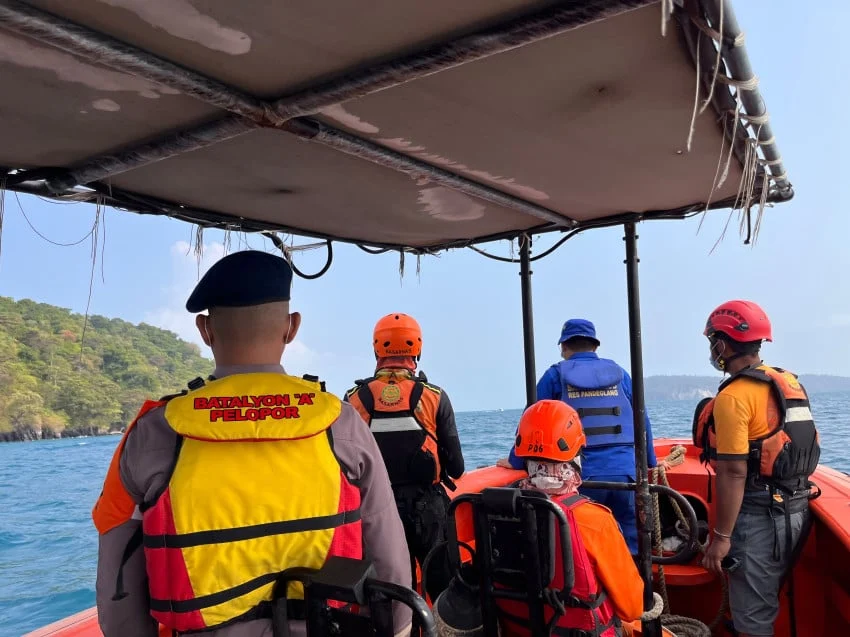
The search and rescue operation for eight individuals, including five journalists, two boat crew members, and a local guide, who went missing after their speedboat lost contact in the waters of the Sunda Strait, has been significantly reinforced. The Jakarta Search and Rescue (SAR) Office has deployed an additional rescue ship to bolster the search efforts as the operation enters a critical fourth day.
The vessel, designated as the State Search and Rescue Ship (KN SAR) 234 Antasena, was dispatched from the Basarnas Pier at Pantai Mutiara, Jakarta, heading toward the designated maritime operational zone. The deployment underscores the escalating urgency of the mission, which has drawn intense national attention and mobilization of multi-agency resources following the disappearance of the vessel near the volatile Mount Anak Krakatau region.
Escalation of Search Operations and Deployment Details
KN SAR 234 Antasena departed with a specialized team of 18 personnel on board, comprising skilled crew members and seasoned rescue operators equipped for high-risk maritime extraction and search operations. According to operational logs, the vessel was scheduled to dock at the Indah Kiat Pier in Cilegon, Banten, before immediately integrating into the broader joint SAR tactical grid deployed across the Sunda Strait.
The reinforcement aims to expand the search radius and enhance operational endurance at sea. The joint SAR team, consisting of personnel from the National Search and Rescue Agency (Basarnas), the Indonesian Navy (TNI AL), the Water and Air Police Directorate (Polairud), and local volunteers, has faced challenging oceanic conditions, including erratic currents and unpredictable weather patterns typical of the Sunda Strait corridor.
Desiana Kartika Bahari, Head of the Jakarta SAR Office, emphasized that the inclusion of KN SAR 234 Antasena is vital for maximizing the efficiency and coverage of the ongoing mission.
"We have deployed KN SAR 234 Antasena along with 18 crew members and rescue personnel as a reinforcement to strengthen the search and rescue operation currently underway," Bahari stated. "The addition of this asset is expected to support the search efforts so they can be conducted more optimally, in alignment with evolving tactical needs and situational developments in the field."
Chronology of the Incident: The Disappearance of Speedboat Arupadatu I
The incident began on Monday, September 7, 2026, when Speedboat Arupadatu I lost all communication channels with base operations. The vessel had set sail on a journalistic expedition aimed at covering the geological activity and ongoing eruption phases of Mount Anak Krakatau, a highly active volcanic island situated in the Sunda Strait between the islands of Java and Sumatra.
On board the speedboat were eight occupants: five professional journalists representing various media outlets, the vessel’s crew, and a local guide familiar with the maritime topography surrounding the archipelago. The mission was intended to document the heightened volcanic activity of Mount Anak Krakatau, which has experienced intermittent eruptions and spewed ash columns into the atmosphere, drawing significant public and media interest.
When the speedboat failed to check in at its scheduled reporting intervals and ceased all radio and cellular transmissions, maritime authorities were alerted. Initial communication checks failed, prompting the Jakarta SAR Office to declare an emergency response protocol and initiate the first phase of search operations.
Multi-Agency Mobilization and Solidarity Rallies
As the search operation entered its fourth day without definitive sightings of the missing vessel or its occupants, the wider journalistic community and civil society groups expressed deep concern. Earlier in the week, the Jakarta chapter of the Photojournalist Forum (PFI Jakarta) organized a solidarity prayer and vigil for the safe recovery of the five journalists and their traveling companions. Colleagues, family members, and press freedom advocates gathered to offer support and call for an expedited, thorough search by authorities.
The incident has reverberated profoundly throughout Indonesia’s media landscape, highlighting the inherent risks reporters face when covering natural disasters, geological hazards, and environmental phenomena. Media organizations have rallied behind the families of the missing individuals, providing logistical and psychological support while awaiting updates from the command post in Cilegon.
Tactical Challenges and Environmental Factors in the Sunda Strait
The Sunda Strait is notoriously complex from a navigational and meteorological standpoint. Connecting the Java Sea to the Indian Ocean, the strait experiences strong tidal currents, deep trenches, and sudden squalls that can severely impede search and rescue operations. Furthermore, the presence of Mount Anak Krakatau introduces compounding hazards, including potential submarine acoustic anomalies, floating volcanic debris, and localized atmospheric disturbances caused by volcanic ash emissions.
Search teams have utilized a combination of surface vessels, rigid-hull inflatable boats (RHIBs), and aerial surveillance assets to comb through designated sectors. Drift models based on prevailing wind and current data have been continuously updated to predict the possible trajectory of the missing speedboat or floating debris, focusing efforts on the waters surrounding the Krakatau archipelago and the coastal projections of Banten and Lampung.
Broader Implications for Media Safety and Disaster Reporting Protocols
The disappearance of the Arupadatu I speedboat has sparked critical discussions within the Indonesian press corps regarding safety protocols for journalists reporting on hazardous environments. Industry watchdogs and press councils have emphasized the necessity of stringent risk assessments, mandatory safety equipment, and real-time tracking systems for media personnel deployed to disaster zones, active volcanoes, and conflict areas.
While rescue operations remain the absolute priority, media institutions and regulatory bodies are expected to review standard operating procedures for environmental reporting following the conclusion of the mission. The incident serves as a stark reminder of the physical dangers journalists willingly confront to keep the public informed about critical natural events and geological transformations.
As night fell over the Sunda Strait, KN SAR 234 Antasena joined the flotilla of rescue vessels operating under the coordination of the joint command center. Search operations are scheduled to continue uninterrupted, utilizing night-vision equipment and sonar technology where applicable, as families, colleagues, and the nation await news of the missing eight.