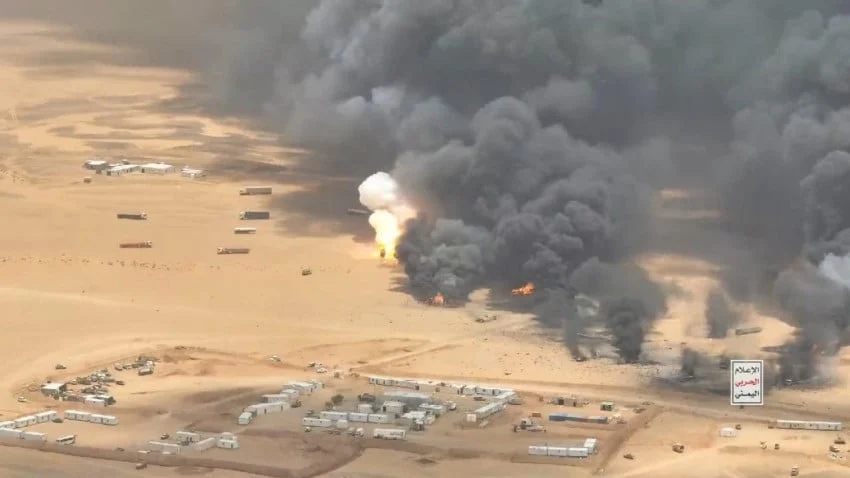
The Republic of Yemen has once again plunged into the abyss of active warfare, marking the most severe military escalation since the expiration of a United Nations-brokered truce in 2022. For years, the impoverished Arabian Peninsula nation endured what humanitarian organizations consistently categorized as the world’s worst humanitarian crisis. Now, the fragile cessation of hostilities has completely collapsed, replaced by intense combat operations involving the internationally recognized Yemeni government, pro-Saudi coalition forces, and the Iran-backed Houthi movement.
The renewed conflict is no longer a localized skirmish; it has transformed into a sweeping multi-front campaign. Fighting has intensified significantly across the strategic provinces of Taiz, al-Bayda, and al-Jawf, the latter serving as a critical gateway to the Houthi-controlled capital city of Sanaa. Simultaneously, military friction has engulfed the vital coastal regions overlooking the Red Sea, threatening international shipping lanes and amplifying geopolitical tensions across the broader Middle East.
Historical Background and the Collapse of the 2022 Truce
To understand the gravity of the current escalation, one must examine the protracted arc of the Yemeni civil war. The conflict effectively began in late 2014 when Houthi rebels swept down from their stronghold in Saada, capturing Sanaa and forcing the internationally recognized government into exile. In March 2015, a coalition of Arab states led by Saudi Arabia intervened militarily to restore the government, launching an intensive air and ground campaign.
The eight years of direct warfare resulted in a devastating human toll, claiming tens of thousands of lives, displacing millions, and decimating the nation’s infrastructure, healthcare system, and economy. A critical turning point occurred in April 2022, when the United Nations brokered a nationwide truce. Although the formal truce officially lapsed in October 2022, both sides largely maintained an uneasy status quo, characterized by a significant reduction in major combat operations, cross-border missile exchanges, and airstrikes.
However, this precarious relative peace began to unravel earlier this year. Buoyed by internal consolidation, the internationally recognized government shifted its strategic posture. Having successfully secured portions of southern Yemen—previously contested by the United Arab Emirates-backed Southern Transitional Council (STC) separatists—the government turned its full attention toward the northern territories held by the Houthi movement.
The New Phase of Combat: Sanaa and the Red Sea Geopolitics
The current military flare-up traces its immediate origins to a series of escalating incidents in July. Forces aligned with the recognized government initiated targeted operations near the Houthi-controlled international airport in Sanaa, successfully preventing an incoming aircraft originating from Iran from landing. This assertive posture triggered a cascade of retaliatory actions.
Last week, the conflict escalated sharply when Houthi forces launched a major offensive. The rebels attempted to advance westward across the rugged terrain of western Taiz and southward toward Hodeidah, with the ultimate tactical objective of seizing the strategic port city of al-Makha (Mocha) and the adjacent Bab al-Mandeb Strait.
The contest for the Bab al-Mandeb Strait has elevated the domestic Yemeni conflict onto the global stage. This maritime chokepoint handles a substantial percentage of the world’s maritime trade, connecting the Red Sea to the Gulf of Aden. The strategic value of the strait has multiplied exponentially following the effective closure or severe disruption of the Strait of Hormuz by Iran, making the Bab al-Mandeb corridor an increasingly vital artery for global energy supplies and international commerce.
Furthermore, the Houthi movement has maintained an active maritime campaign since late 2023, regularly launching anti-ship ballistic missiles, cruise missiles, and explosive-laden uncrewed surface vessels targeting international commercial shipping in the Red Sea. The current ground and naval maneuvers represent a renewed push by both the Houthi movement and pro-government forces to cement territorial dominance over these critical waterways.
Evolving Military Dynamics and the Consolidation of Anti-Houthi Forces
Military analysts note that the balance of power on the ground has shifted compared to earlier phases of the decade-long war. The forces aligned with the internationally recognized government currently possess enhanced logistical backing, improved structural organization, and more adequate resources than at any previous point during the conflict.
A crucial factor in this evolution is the internal realignment within the anti-Houthi coalition. Following the marginalization and defeat of the secessionist Southern Transitional Council in parts of the south earlier this year, the central government has worked systematically to project a unified military command structure. For years, the anti-Houthi camp suffered from deep internal fractures, conflicting agendas, and fragmented leadership, which severely undermined its military effectiveness.
"The government now possesses the capacity to administer broader swathes of territory, and the multiplicity of uncoordinated militias on the ground has decreased," explains Dr. Mahjoob Zweiri, a professor of Middle East politics at Qatar University. "With the STC largely contained or sidelined in the south, the singular primary adversary remaining for the state apparatus is the Houthi movement entrenched in Sanaa."
Despite these organizational improvements, regional experts caution against anticipating a swift or decisive military resolution. The Houthi movement remains deeply entrenched, possessing asymmetric warfare capabilities, extensive mountain fortifications, and a highly motivated ideological core.
"This is fundamentally shaping up to be a protracted war of attrition rather than a brief, decisive military campaign," observes Mohammed al-Basha, a prominent Yemeni-American senior analyst and founder of the U.S.-based risk consultancy Basha Report. "The Houthi forces possess a formidable military apparatus and will fight fiercely to defend their territorial gains rather than capitulate to government advances."
Regional and International Implications
The resurgence of full-scale warfare in Yemen carries profound implications for regional stability and international security. The conflict is no longer contained within Yemen’s borders; it is inextricably linked to broader geopolitical frictions involving Iran, Saudi Arabia, and Western maritime coalitions.
For Saudi Arabia, which shares a porous, highly vulnerable southern border with Yemen, the renewed Houthi offensive represents a direct national security challenge. Despite years of direct bilateral diplomatic engagement between Riyadh and Sanaa aimed at securing a permanent exit from the Yemeni quagmire, the resumption of ground fighting threatens to drag the kingdom back into an active military posture. Houthi cross-border drone and missile capabilities remain a persistent threat to Saudi infrastructure and energy installations.
For the international community, particularly nations dependent on secure maritime trade through the Suez Canal and the Red Sea, the escalation introduces severe economic risks. The combination of Houthi maritime operations and ground offensives near the Bab al-Mandeb Strait threatens to drive up shipping insurance premiums, force shipping lines to adopt longer and more expensive detours around the Cape of Good Hope, and destabilize global energy markets.
Outlook and Future Trajectory
As fighting persists across Taiz, al-Bayda, and the approaches to al-Jawf, diplomatic efforts spearheaded by the United Nations and regional mediators face an uphill battle. The renewed momentum on the battlefield suggests that both the internationally recognized government and the Houthi leadership currently believe they can achieve better terms through military force than at the negotiating table.
The humanitarian ramifications of this renewed violence are already beginning to mount, with local organizations reporting new waves of displacement as families flee active combat zones in central and western Yemen. Without an immediate de-escalation framework and a return to comprehensive political dialogue, Yemen risks sliding backward into the darkest days of a conflict that has already defined a generation of suffering.