In a significant stride toward achieving Indonesia’s national energy transition goals, Pertamina New & Renewable Energy (Pertamina NRE) officially inaugurated the Bioethanol Development Center in Tegineneng, Pesawaran Regency, Lampung, on Monday, September 14, 2026. This state-of-the-art facility serves as a cornerstone for the nation’s burgeoning bioethanol ecosystem, integrating research, technology, and supply chain development to reduce dependency on fossil fuels and bolster sustainable energy production. The launch represents a strategic alignment between state-owned enterprises, regional governments, and international industrial partners to cultivate a robust circular economy.
Strategic Infrastructure for Energy Independence
The Bioethanol Development Center is designed as a comprehensive hub for the entire bioethanol value chain. Rather than functioning as a standard production plant, it operates as a pilot facility capable of validating every stage of the process, from feedstock selection and advanced cultivation techniques to experimental production technologies.
John Anis, President Director of Pertamina NRE, emphasized that the center utilizes an innovative “multi-feedstock” and “multi-generation” approach. This versatility is essential for the Indonesian context, where agricultural diversity allows for various sources of biomass. By processing different raw materials and combining first-generation (1G)—typically derived from starch and sugar—with second-generation (2G) bioethanol—derived from lignocellulosic biomass—the center aims to maximize resource efficiency while minimizing competition with food security efforts.
A High-Profile Inception
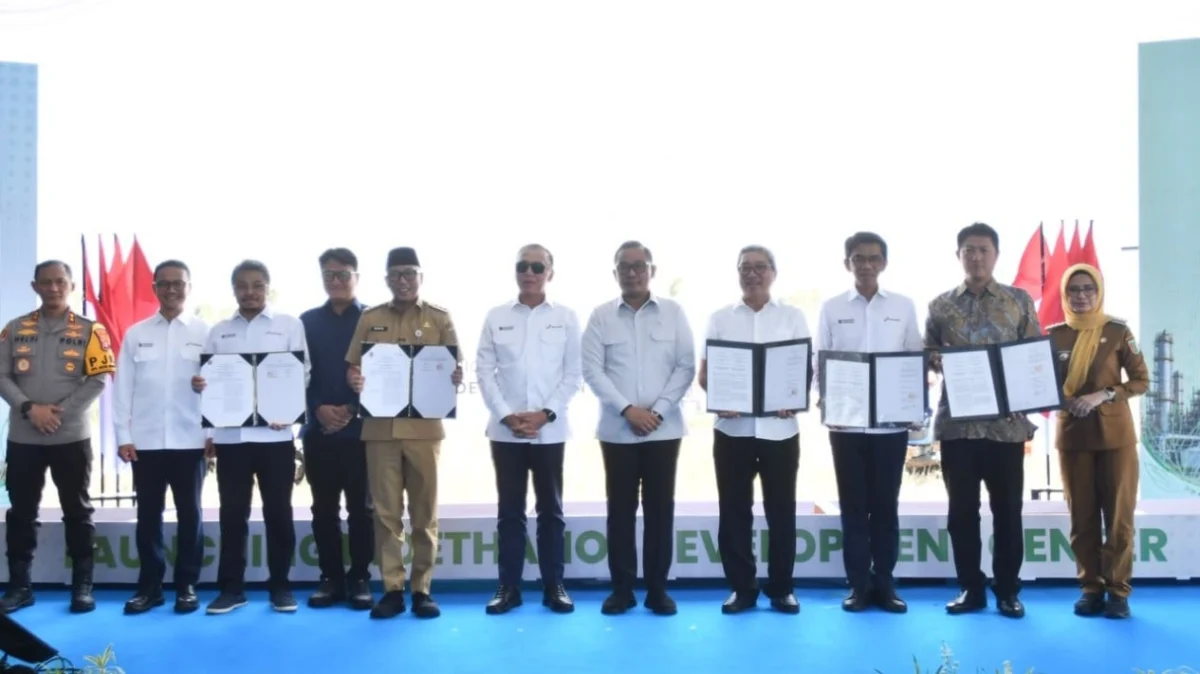
The inauguration ceremony was attended by a cohort of influential stakeholders, signaling the project’s high priority within the national agenda. Key attendees included the Deputy Minister of Investment and Downstream/Deputy Head of the Investment Coordinating Board (BKPM) Todotua Pasaribu, President Commissioner of PT Pertamina (Persero) Mochamad Iriawan, and Director of Risk Management of PT Pertamina (Persero) Ahmad Siddik Badruddin. Regional representation was provided by the Governor of Lampung, Rahmat Mirzani Djausal.
International collaboration was highlighted by the presence of leadership from Toyota Motor Manufacturing Indonesia (TMMIN) and Toyota Tsusho Indonesia (TTI), underscoring the role of the automotive industry as a primary consumer and strategic partner in the deployment of renewable fuels.
Formalized Synergies and Strategic MoUs
The event was marked by the signing of two critical Memoranda of Understanding (MoUs) that provide the institutional framework for the center’s operations. The first agreement, established between Pertamina NRE and the Provincial Government of Lampung, focuses on a tripartite objective: strengthening energy security, maintaining food security, and developing the regional agribusiness sector. Given Lampung’s status as a major agricultural hub, this partnership is designed to ensure that bioethanol production empowers local farmers rather than displacing existing food production.
The second MoU involves a consortium comprising Pertamina NRE, TMMIN, TTI, and the Research Association of Biomass Innovation for Next Generation Automobile Fuels (raBit). This partnership aims to conduct rigorous technical and commercial feasibility studies. The collaboration is particularly focused on knowledge and technology transfer, ensuring that Indonesia can eventually scale these pilot projects into large-scale commercial operations with domestic intellectual property and operational expertise.
The Economic and Environmental Rationale
The urgency behind this initiative is rooted in Indonesia’s broader commitment to net-zero emissions and the reduction of energy imports. Deputy Minister Todotua Pasaribu noted that the integration of bioethanol production into the national energy mix creates a "circular ecosystem."
"Lampung possesses a potential capacity of 430,000 kiloliters," stated Pasaribu. "Our primary strategy involves the reactivation of idle assets, synergy with plantation companies like PTPN, the development of integrated sorghum-based 1G and 2G production, and the deep-processing of cassava and corn. By converting existing plant infrastructure and focusing on biomass-based downstreaming, we can meaningfully support our national energy resilience targets."
The choice of Lampung as the site for this pilot project is geographically and economically strategic. The region’s existing infrastructure for sugarcane and cassava cultivation provides a ready supply of feedstock, reducing logistical costs and carbon footprint associated with transport.
Analyzing the Multi-Feedstock Advantage
The focus on "multi-generation" bioethanol is a critical technological pivot for Indonesia. First-generation (1G) bioethanol, while efficient, is often criticized for its potential impact on food prices. By simultaneously developing second-generation (2G) technology, which utilizes agricultural waste and non-food biomass such as corn stover or empty fruit bunches, Pertamina NRE is positioning the project to be more environmentally and socially sustainable.
The pilot facility will conduct rigorous testing on:
- Feedstock Optimization: Determining the most efficient crop varieties for specific soil types in Lampung.
- Biochemical Conversion: Refining enzyme and fermentation processes to increase yield from 2G biomass.
- Scaling Analytics: Collecting data on the commercial viability of small-scale vs. large-scale industrial biorefineries.
Challenges and Future Implications
While the launch of the Bioethanol Development Center is a significant milestone, the path toward a national bioethanol mandate is not without challenges. The economic feasibility of bioethanol remains sensitive to the fluctuating prices of global crude oil and the competitive market price of feedstock. Furthermore, the transition requires a coordinated effort to upgrade vehicle engine technologies—a process where the collaboration with Toyota becomes essential.
The involvement of the raBit research association suggests that the project is not merely focused on immediate production but also on long-term policy formulation. By creating a standardized framework for biomass procurement and processing, the government hopes to attract further private investment into the bioethanol sector.
If successful, the Lampung pilot could serve as a blueprint for similar centers in other provinces, such as East Java and Central Java, which also possess vast agricultural potential. The ultimate goal is to create a decentralized energy network that reduces the logistics burden on the national grid while providing a consistent income stream for rural agricultural communities.
Conclusion: A Foundation for Sustainability
The inauguration of the Bioethanol Development Center on September 14, 2026, marks the transition of Indonesia’s biofuel policy from theoretical planning to physical implementation. By bridging the gap between agricultural waste and high-tech automotive fuels, the initiative addresses the dual challenges of energy security and sustainable economic development.
As the facility moves into its initial operational phase, stakeholders will be monitoring the conversion efficiency and the impact on local agribusiness. With the support of the Ministry of Investment and international technical partners, Pertamina NRE has set a clear trajectory for transforming Indonesia’s abundant biomass resources into a critical component of its future energy portfolio. This development is not just an industrial advancement; it is a fundamental shift in how the nation views its agricultural heritage—not merely as a food source, but as the fuel for the next generation of Indonesian transport.