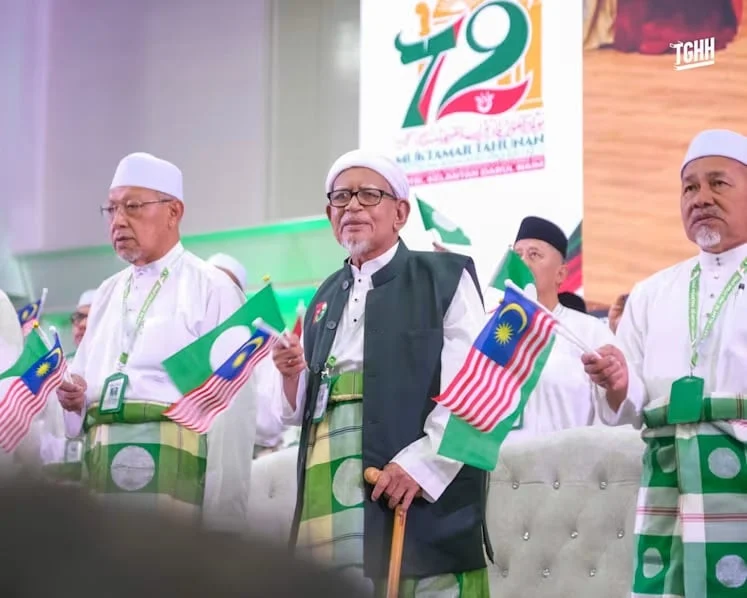
KUALA LUMPUR — A fresh political and constitutional storm has erupted in Malaysia following controversial remarks made by Abdul Hadi Awang, the president of the Malaysian Islamic Party, commonly known by its Malay acronym PAS. During the party’s annual congress held in the northeastern state of Kelantan, the veteran Islamist leader proposed that under a PAS-led federal government, non-Muslim cabinet ministers should be strictly barred from formulating government policies. Instead, their roles would be confined exclusively to overseeing the implementation of policies formulated solely by Muslim ministers.
The proposition has drawn sharp, immediate condemnation from federal lawmakers, civil society groups, and multiracial political organizations across the country. Critics argue that the proposal fundamentally undermines the secular foundation of Malaysia’s Federal Constitution, violates the principles of equal citizenship, and signals a deliberate, systematic march toward the establishment of a hardline religious theocracy. The ongoing controversy highlights the deeply polarized nature of Malaysian politics, where the steady rise of conservative Islamic nationalism championed by PAS continues to clash with the pluralistic, multi-ethnic ethos of the broader national framework.
Chronology of Recurrent Controversies
Abdul Hadi Awang’s recent statements are far from an isolated incident. They represent a recurring ideological motif that has characterized the political rhetoric of the PAS leadership over the past decade.
The historical trajectory of this policy stance dates back significantly:
- The 2013 General Election Context: More than a decade ago, ahead of the 2013 national polls, Hadi publicly articulated a similar position. Speaking to the national news agency Bernama, he asserted that while non-Muslim individuals could hold ministerial positions—specifically citing the Ministry of Works as an appropriate portfolio—the highest executive office of prime minister and all positions directly responsible for formulating core national policies must be reserved exclusively for Muslims.
- The Post-2018 Political Shifts: Following the historic 2018 general election, which saw the first-ever defeat of the long-ruling Barisan Nasional (BN) coalition, PAS increasingly doubled down on ethnoreligious mobilization. As the party consolidated its political base in the northern Malay-majority states of Kelantan, Terengganu, Kedah, and Perlis, its leadership frequently utilized religious platforms to outline its vision for an Islamic state.
- The September 5 Annual Congress: During the latest party congress in Kelantan, Hadi reignited the debate by elaborating on the division of labor within a hypothetical PAS-led cabinet. He explicitly stated that ministries dealing with core ideological governance, religious affairs, and the execution of sharia law must be handled strictly by Muslims. To illustrate where non-Muslims could participate, he cited the Ministry of Works and the Ministry of Forestry—despite the factual observation that Malaysia lacks a dedicated federal Ministry of Forestry, a minor detail that further invited public ridicule and criticism.
Political Reactions and Institutional Condemnation
The fallout from the Kelantan congress was swift, drawing severe rebukes from prominent figures within the federal government and multi-religious coalitions.
Ramkarpal Singh, the Deputy Secretary-General and head of the legal bureau of the Democratic Action Party (DAP)—a key component of Prime Minister Anwar Ibrahim’s current unity government—did not mince words in his response. Ramkarpal characterized Hadi’s proposal as inherently divisive, dangerous, and diametrically opposed to the spirit and letter of the Federal Constitution. He emphasized that the constitution guarantees equal rights, protections, and opportunities for all citizens regardless of race or religion, rendering any attempt to institutionalize second-tier cabinet status for non-Muslims legally untenable.
Simultaneously, the Malaysian Consultative Council of Buddhism, Christianity, Hinduism, Sikhism and Taoism (MCCBCHST), the premier interfaith body representing the country’s diverse non-Muslim communities, issued a stern warning. The council expressed profound constitutional concerns, arguing that Hadi’s statements are not merely rhetorical posturing, but rather a transparent indicator of a broader, sustained agenda by PAS to dismantle Malaysia’s constitutional democracy and replace it with a theological governance model. The council reminded the public that federal cabinet ministers, regardless of their portfolio, share collective responsibility under the law and must serve all Malaysians equitably without religious stratification.
Conversely, the proposal received vocal backing from the internal non-Muslim wing of PAS, highlighting a deep ideological split even among minority supporters of the party. Representatives from the PAS Supporters Congress ( DHPP) defended the party president’s remarks, arguing that they were being misinterpreted by political opponents seeking to stoke communal fears. Nevertheless, this internal defense did little to quell the broader national outrage.
Broader Political Implications and Electoral Dynamics
The timing of Hadi’s remarks carries immense strategic weight within the complex tapestry of contemporary Malaysian politics. PAS currently operates as a dominant component of the Perikatan Nasional (PN) opposition coalition, alongside the Malaysian United Indigenous Party (Bersatu). Over recent electoral cycles, particularly during the November 2022 general election and subsequent state-level polls in 2023, the PAS-led opposition experienced a massive surge in electoral support, often referred to by political analysts as the "green wave."
This Islamist surge enabled PAS to capture substantial electoral ground, expanding its footprint beyond its traditional rural strongholds into semi-urban and mixed-demographic constituencies. The party’s electoral momentum was further amplified through tactical cooperation and regional adjustments, such as interactions involving factions of Barisan Nasional in state elections like Johor and Negeri Sembilan, which created temporary setbacks for the Pakatan Harapan (PH) coalition led by Prime Minister Anwar Ibrahim.
However, the aggressive pursuit of conservative religious policies by PAS presents a formidable double-edged sword. While it successfully galvanizes the party’s core Malay-Muslim base in the peninsula, it simultaneously alienates non-Muslim voters, who make up roughly a third of Malaysia’s population, as well as moderate Muslims and the crucial electorate of the East Malaysian states of Sabah and Sarawak. In Sabah and Sarawak, where religious pluralism and cultural diversity are deeply ingrained social values, explicit rhetoric regarding restricted non-Muslim governance is met with profound apprehension and outright rejection.
Constitutional Realities vs. Ideological Aspirations
From a legal and institutional standpoint, executing the governance model proposed by Abdul Hadi Awang remains legally unfeasible under the existing Malaysian constitutional framework. The Federal Constitution of Malaysia, drafted upon independence in 1957, establishes Islam as the religion of the Federation, but it explicitly guarantees freedom of religion and equality before the law for all citizens under Article 8 and Article 11.
Furthermore, the oath of office taken by federal ministers requires them to faithfully discharge their duties without fear or favor, serving the entire nation rather than any specific religious constituency. For PAS to implement a discriminatory cabinet structure that segregates ministers based on religious credentials would require sweeping constitutional amendments—a scenario requiring a two-thirds parliamentary majority that the Islamist party and its allies currently do not possess, particularly given the vehement opposition from East Malaysian coalitions whose support is vital for any federal government.
Conclusion
The latest controversy surrounding Abdul Hadi Awang’s ministerial restriction proposal underscores the persistent ideological fault lines running through Malaysian society. As the country navigates post-pandemic economic recovery and geopolitical shifts, the friction between inclusive constitutional democracy and conservative religious nationalism remains one of the defining political narratives of the era. While PAS continues to utilize such rhetoric to solidify its base ahead of future electoral contests, the severe backlash from civil society, interfaith organizations, and federal leaders demonstrates that the defense of Malaysia’s pluralistic foundations remains a fiercely guarded priority for a vast segment of the nation.