
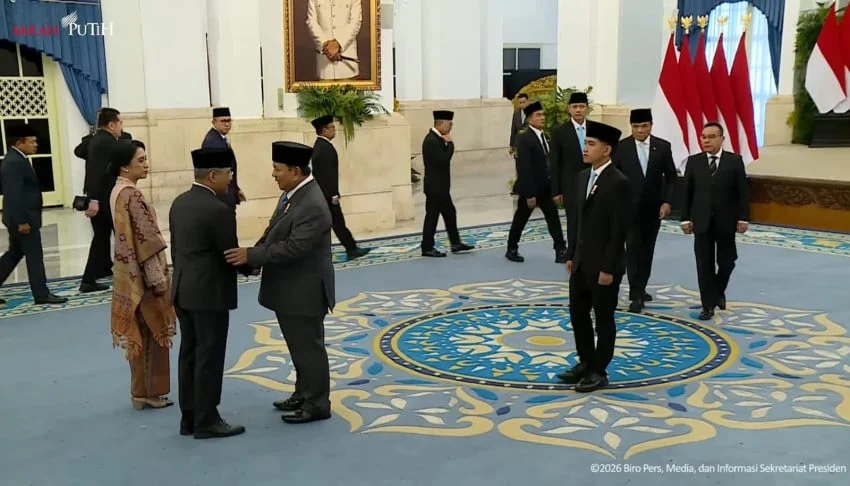
The political landscape of Indonesia experienced another significant shift as President Prabowo Subianto executed yet another structural adjustment within the executive branch, marking the seventh cabinet reshuffle since the formation of the Red and White Administration in October 2024. The most recent and high-profile transition occurred within the Ministry of Finance, where Suahasil Nazara was officially sworn in to assume the role of Minister of Finance on Monday, September 14, 2026. This abrupt leadership change saw the outgoing Finance Minister, Purbaya Yudhi Sadewa, relinquish his duties under unexpected circumstances while actively participating in a parliamentary hearing at the Regional Representative Council (DPD RI) earlier that same day.
The recurring adjustments within President Prabowo’s administration underscore a continuous administrative fine-tuning aimed at optimizing bureaucratic efficiency, economic stability, and policy execution. With the elevation of Suahasil Nazara—who previously served as the Deputy Minister of Finance—the government aims to maintain fiscal continuity while navigating domestic and international financial complexities. The persistent turnover across various strategic ministries highlights a dynamic governance model where performance metrics and strategic alignment are subjected to continuous evaluation by the highest office in the nation.
Chronology of Cabinet Restructuring: A Timeline of the Red and White Administration
Since taking the oath of office in late 2024, President Prabowo Subianto has demonstrated a willingness to alter his ministerial lineup to address emerging challenges and optimize governance. The sequence of structural modifications reflects a systematic approach to addressing both policy friction and administrative underperformance across multiple sectors.
The initial phase of cabinet instability materialized on Wednesday, February 19, 2025, when the administration announced its first major portfolio adjustment. Satryo Soemantri Brodjonegoro, who initially held the crucial portfolio of Minister of Higher Education, Science, and Technology (Mendiktisaintek), was relieved of his duties. Brian Yuliarto was swiftly appointed to succeed him, tasked with steering the nation’s academic and scientific advancement initiatives amidst rising demands for educational reform and technological integration.
A more extensive overhaul took place on Monday, September 8, 2025, when President Prabowo inducted four new ministers and one deputy minister in a single ceremony. This sweeping transition most notably impacted the economic sector, where Purbaya Yudhi Sadewa was installed as the Minister of Finance, succeeding Sri Mulyani, who had long anchored the nation’s fiscal policy. Alongside Purbaya, Mukhtarudin assumed leadership of the Ministry for the Protection of Indonesian Migrant Workers, taking over from Abdul Kadir Karding. Furthermore, Ferry Joko Yuliantono was designated as the Minister of Cooperatives, replacing Budi Arie Setiadi, while Mochamad Irfan Yusuf and Dahnil Anzar Simanjuntak were entrusted with the newly structured leadership of the Ministry of Haji and Umrah affairs as Minister and Deputy Minister, respectively.
The cadence of restructuring continued unabated just over a week later, on September 17, 2025, marked by a second wave of appointments within that month. Djamari Chaniago was brought into the security apparatus as the Coordinating Minister for Political and Security Affairs (Menko Polkam), replacing Budi Gunawan. Concurrently, high-profile figure Erick Thohir transitioned to the role of Minister of Youth and Sports, succeeding Dito Ariotedjo. This specific round of changes also extended to the deputy ministerial level, featuring the appointment of Afriansyah Noor as Deputy Minister of Manpower in place of Immanuel Ebenezer, Rohmat Marzuki as Deputy Minister of Forestry replacing Sulaiman Umar, and Farida Farichah stepping in as Deputy Minister of Cooperatives to succeed Ferry J. Juliantono.
The culmination of these rolling adjustments brought the administration to its seventh major reshuffle by September 2026, positioning Suahasil Nazara at the helm of Southeast Asia’s largest economy during a critical juncture for national development and fiscal management.
Context and Circumstances Surrounding the Finance Ministry Transition
The transition of leadership at the Ministry of Finance in September 2026 carried an unusual degree of urgency. Purbaya Yudhi Sadewa, whose tenure began on September 8, 2025, saw his relatively brief term concluded abruptly while he was engaged in an official state duty—specifically attending a working meeting at the DPD RI building in Jakarta on Monday, September 14, 2026. The sudden nature of the recall underscored the rigorous performance expectations and rapid decision-making framework maintained by the Prabowo administration regarding key economic portfolios.
Purbaya’s tenure had been characterized by efforts to stimulate domestic liquidity, manage state budget allocations amidst expansive social welfare programs, and maintain investor confidence. However, economic headwinds, shifting global commodity prices, and domestic revenue targets necessitated a recalibration of financial leadership.
To ensure seamless operational continuity, the administration turned to an institutional insider rather than an external candidate. Suahasil Nazara, possessing extensive experience within the bureaucratic apparatus and having previously worked closely with both current and former economic leadership teams as Deputy Minister of Finance, was deemed the most pragmatic choice to prevent market volatility. His deep familiarity with the state budget (APBN), tax reform initiatives, and fiscal decentralization provided an immediate stabilizing factor following the sudden departure of his predecessor.
Implications for Fiscal Policy and Economic Stability
The appointment of Suahasil Nazara as the seventh Minister of Finance under the Red and White Cabinet carries significant implications for Indonesia’s macroeconomic trajectory. Financial markets and international rating agencies closely monitor leadership transitions in Jakarta, particularly within the finance portfolio, which serves as the guardian of the nation’s fiscal discipline and debt management strategy.
Market analysts have noted that Nazara’s promotion is likely to be received favorably by the financial community due to his technocratic background and profound institutional memory. Having navigated numerous fiscal challenges during his tenure as Deputy Minister—including the post-pandemic economic recovery and subsequent global inflationary pressures—Nazara is positioned to maintain a steady hand on public expenditures.
Key areas of focus for the newly appointed Finance Minister will include:
- Securing state revenue targets through enhanced tax administration and digitalization.
- Balancing the financing requirements of President Prabowo’s flagship social programs, such as the free nutritional meal initiative, with the constitutionally mandated fiscal deficit ceiling of 3 percent of Gross Domestic Product (GDP).
- Managing sovereign debt yields and maintaining foreign exchange stability amid global monetary policy fluctuations.
- Enhancing coordination with Bank Indonesia to harmonize monetary and fiscal instruments in curbing inflation and supporting sustainable economic growth.
The predictability and continuity offered by Nazara’s elevation are expected to mitigate potential jitteriness among foreign and domestic investors who value regulatory transparency and fiscal prudence.
Official Responses and Institutional Reactions
Following the swearing-in ceremony on September 14, 2026, expressions of support and institutional alignment emerged from various stakeholders within the government and legislative bodies. President Prabowo Subianto personally delivered his congratulations and directives to the newly inaugurated minister, emphasizing the paramount importance of safeguarding state finances and ensuring that every rupiah of the state budget directly benefits the welfare of the Indonesian populace.
Leadership within the House of Representatives (DPR RI) and the DPD RI expressed readiness to collaborate with Minister Suahasil Nazara. Lawmakers underscored the necessity of open communication between the executive branch and the legislature, particularly as the government navigates ongoing budgetary discussions and legislative oversight regarding national development priorities. Business associations, including the Indonesian Chamber of Commerce and Industry (KADIN) and the Indonesian Employers Association (APINDO), similarly issued cautious yet optimistic statements, welcoming a leader with proven administrative competence to guide the national economy through the remainder of the decade.
Conclusion: A Technocratic Anchor in a Dynamic Administration
The seventh reshuffle of the Red and White Cabinet marks a defining moment for the administration of President Prabowo Subianto, illustrating a dynamic approach to executive governance where performance, adaptability, and strategic alignment are continuously tested. By positioning Suahasil Nazara at the apex of the Ministry of Finance, the government has opted for a blend of institutional continuity and technocratic expertise. As Indonesia confronts both domestic development aspirations and complex global economic currents, the stability and strategic vision of the Ministry of Finance will remain central to the nation’s overarching trajectory of sustainable growth and fiscal resilience.
