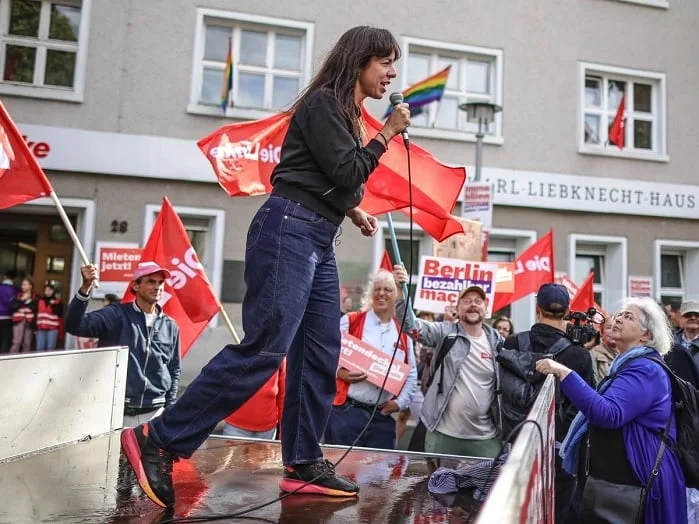
The local political landscape of Berlin experienced a historic seismic shift on Sunday as voters delivered a stunning victory to Elif Eralp, a prominent human rights activist of Turkish descent who now stands on the precipice of becoming the first mayor of the German city-state with a migrant background. Running under the banner of the democratic socialist Left Party (Die Linke), Eralp spearheaded an electoral campaign that upended conventional wisdom, galvanized disaffected urban voters, and dramatically reshaped the narrative surrounding immigration, housing affordability, and social justice in modern Germany.
A Historic Electoral Breakthrough in Berlin
The magnitude of the Left Party’s victory became apparent late Sunday evening as preliminary election results flashed across newsrooms throughout Europe. Die Linke secured an unprecedented 25.7 percent of the vote share. This extraordinary tally represents more than double the electoral support the party managed to garner during the previous municipal elections three years prior. More impressively, public opinion polls conducted as recently as the spring had placed the party languishing in the low-teens, making the late-surge one of the most remarkable comebacks in contemporary German political history.
Political analysts and election experts have attributed this rapid ascent to Eralp’s unique ability to connect directly with working-class residents, young urbanites, and marginalized communities who felt increasingly alienated by traditional center-left and center-right governing coalitions. By tapping into the immediate anxieties of everyday Berliners—chief among them the skyrocketing cost of living and the severe housing crisis—the Left Party successfully captured the socioeconomic mood of the capital.
Addressing a jubilant crowd of supporters gathered at campaign headquarters on Sunday night, an emotional Eralp expressed profound gratitude for the historic mandate entrusted to her and her party.
"Berliners, thank you—thank you for your trust," Eralp declared to roaring applause and chants from her supporters. "Together, we are making history today. From this moment on, we are going to change Berlin—together."
Emphasizing the unifying themes of her campaign, she asserted that "love and justice" had definitively triumphed over the politics of division and "hatred." Her remarks underscored a deliberate effort to position her movement as an inclusive alternative to the rising tide of nationalist and anti-immigrant sentiment that has periodically threatened to polarize European municipal politics.
The New York Connection: Drawing Inspiration from Zohran Mamdani
Throughout the final months of the campaign, political commentators, international observers, and campaign strategists frequently drew parallels between Eralp’s political trajectory and the rise of progressive leaders abroad, most notably pointing to the dynamic campaign style associated with New York progressive figures like Zohran Mamdani. Rather than shying away from these international comparisons, Eralp openly embraced them, recognizing the shared strategic playbook of organizing grassroots movements around material, bread-and-butter economic issues.
Speaking to international media outlets just days before the ballots were cast, Eralp did not hide her admiration for progressive urban populist strategies.
"I hope that what was possible in Manhattan, New York, can also materialize here in Berlin," Eralp stated. "Mamdani focuses on social demands, and that is precisely what we are doing. He also succeeded in uniting various communities—a major achievement—and that is what we are striving for as well."
Mirroring the tactical focus seen in successful progressive campaigns globally, Eralp’s political platform systematically marginalized abstract ideological debates in favor of a hyper-local focus on daily survival economics. Her policy agenda concentrated heavily on the escalating costs of urban rental housing, mounting public transportation tariffs, and the deteriorating efficiency of municipal sanitation and street cleaning services.
To execute this strategy, Eralp’s campaign team rejected passive media-driven advertising in favor of intensive, old-school grassroots mobilization. Campaign volunteers conducted exhaustive door-to-door canvassing operations across diverse Berlin neighborhoods. Crucially, the campaign refused to write off politically hostile territory, actively engaging with voters even in districts traditionally sympathetic to the anti-immigrant Alternative for Germany (AfD) party. By directly confronting voter grievances regarding neighborhood decay and economic stagnation, Eralp managed to peel away working-class votes that might otherwise have drifted toward populist right-wing factions.
At the core of her policy proposals was a direct assault on Berlin’s housing affordability crisis. Eralp campaigned on a platform advocating for strict statutory rent caps on municipally owned apartments, the establishment of a specialized government oversight agency designed to crack down on illegal rent gouging by private landlords, and the contentious revival of proposals to expropriate large corporate residential portfolios into public ownership. Through these measures, she pledged that a Left Party-led municipal administration would systematically transform Berlin back into a city accessible to working and middle-class families.
Background and Roots: A Migrant Journey Shaped by Resilience
Elif Eralp’s personal background is deeply intertwined with the modern history of Germany’s Turkish diaspora and the broader socio-political struggles of migrant communities over the past four decades. Her parents arrived in West Germany as part of the established labor migration streams from Turkey following the turbulent geopolitical upheavals of the 1980 military coup.
Born in Munich in 1981, Eralp spent her formative years navigating multiple cultural and geographic environments, growing up in the industrial hub of Dortmund and the northern port city of Hamburg, before ultimately establishing her permanent home in Berlin, where she has resided for the past sixteen years.
Her decision to pursue a career in law and public advocacy was not born in a vacuum. Eralp has frequently recounted how early encounters with systemic institutional injustice, social discrimination, and marginalization during her youth left an indelible impression on her worldview. As a primary school student in the 1990s, she directly witnessed and felt the chilling societal impact of a violent wave of extreme right-wing and neo-Nazi attacks targeting immigrant communities across reunified Germany. These formative experiences cultivated a lifelong commitment to human rights advocacy, anti-racism activism, and legal protections for vulnerable minorities.
Before rising to the forefront of Berlin municipal politics, Eralp built a solid reputation as a dedicated human rights advocate and legal scholar, utilizing her professional expertise to defend marginalized workers, asylum seekers, and tenants facing eviction. Her transition from civil society activism to frontline electoral politics was viewed by her supporters as a natural progression of her lifelong advocacy for structural social reform.
Chronology and Campaign Timeline
The path to Eralp’s historic electoral triumph was defined by strategic pivots and disciplined grassroots organizing over a grueling twelve-month electoral cycle:
- Early 2024: The Berlin chapter of Die Linke faced severe internal divisions and voter apathy, with public opinion polling registering the party hovering sluggishly in the low-teens, heavily impacted by federal-level political fatigue and local governance disputes.
- Spring 2024: Under the leadership of Elif Eralp and a renewed faction of progressive organizers, the party formally shifted its electoral strategy. The platform was systematically stripped of niche academic debates and refocused entirely on material economic security, specifically housing costs and municipal service decay.
- Summer 2024: The campaign launched its intensive door-to-door mobilization effort. Volunteers systematically blanketed outer-ring districts and traditionally conservative working-class neighborhoods, directly engaging residents on issues of rent control and public infrastructure.
- Autumn 2024: Eralp drew significant international media attention by explicitly aligning her municipal strategy with progressive urban movements globally, drawing favorable comparisons to New York-style democratic socialist organizing.
- November 2024 (Election Day): Die Linke achieved a historic breakthrough, capturing 25.7 percent of the vote share and positioning Eralp as a viable contender for the mayoral office of the city-state of Berlin.
Broader Implications and Institutional Reactions
The stunning victory of Elif Eralp and the Left Party carries profound implications not only for the internal governance of Berlin but for the broader political landscape of the Federal Republic of Germany. For decades, traditional German politics has been dominated by the center-right Christian Democratic Union (CDU) and the center-left Social Democratic Party (SPD), with the Green Party and the liberal Free Democratic Party (FDP) acting as traditional kingmakers. The emergence of a revitalized, aggressively social-democratic left capable of commanding nearly a quarter of the electorate in a major metropolitan hub signals a potential realignment in how urban centers address systemic economic inequality.
Reactions from rival political factions have been swift and varied. Moderate and conservative commentators have expressed deep apprehension regarding Eralp’s radical housing proposals, particularly her advocacy for corporate expropriation and aggressive price controls. Business federations and real estate associations have warned that such policies could severely damage investor confidence, stifle residential construction initiatives, and exacerbate the very housing shortage the administration aims to resolve.
Conversely, civil rights organizations, labor unions, and tenants’ rights advocates have hailed the election results as a long-overdue victory for social equity. Representatives from various grassroots coalitions noted that Eralp’s success proves that working-class voters are increasingly responsive to politicians who offer concrete, material solutions to the cost-of-living crisis rather than engaging in cultural wedge politics.
Furthermore, Eralp’s potential ascension to the mayoralty represents a watershed moment for political representation among Germany’s vast population of citizens with migrant heritage. Despite making up a substantial demographic percentage of the country—particularly within major urban centers like Berlin, Frankfurt, and Cologne—Germans of migrant descent have historically faced significant glass ceilings within mainstream political parties and high-office appointments. Eralp’s breakthrough challenges these institutional barriers, offering a powerful symbol of political integration and democratic participation.
As Berlin prepares for the complex coalition-building negotiations ahead, all eyes will remain fixed on Elif Eralp. Whether her administration can successfully translate an energetic grassroots campaign into workable, sustainable governance will serve as a crucial bellwether for progressive urban politics across Europe in the years to come.