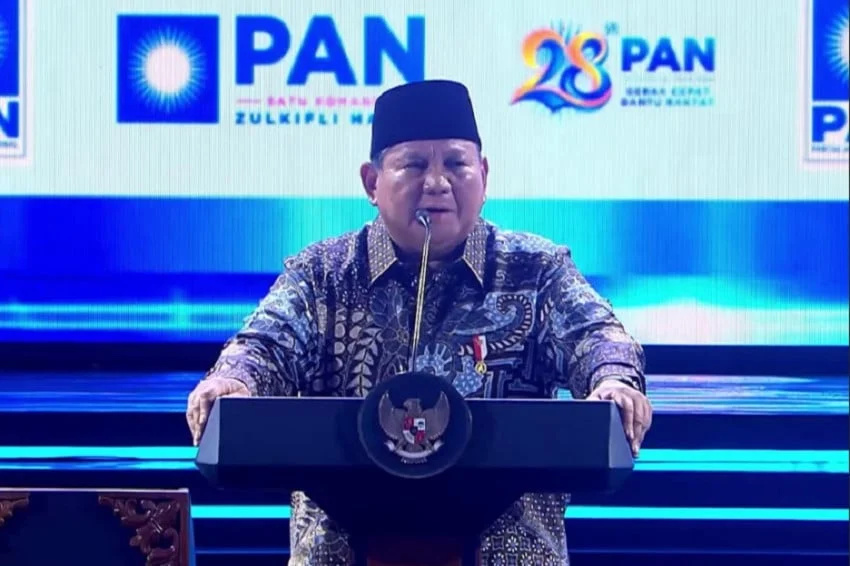
President Prabowo Subianto has candidly expressed his personal aversion to relying on pre-prepared written texts when delivering public addresses. The Indonesian head of state shared this perspective during his keynote speech at the grand celebration marking the 28th anniversary of the National Mandate Party (PAN), held at the Jakarta International Convention Center (JICC) in Senayan, Jakarta. The statement highlights a recurring theme in the President’s public engagement style: a preference for spontaneous, conversational, and direct communication over scripted political rhetoric, despite frequent advice from his communications team and political advisors.
Main Facts of the Address
The event, which brought together senior party officials, coalition partners, and thousands of loyal supporters, served as a platform for the President to reflect on political loyalty, national unity, and his distinctive communication methods. Addressing the audience gathered in the capital, Prabowo noted that despite warnings from experts regarding the risks of speaking off-the-cuff—such as potential misinterpretations or deviations from official policy stances—he finds it difficult to constrain his delivery to a teleprompter or paper script.
"Saudara sekalian, berkali-kali di manapun saya sampaikan beberapa hal, mungkin yang sudah dengar pidato-pidato saya mungkin bosan. Tapi tidak apalah. Toh saudara sudah undang saya ke sini. Benar? Salah panitia undang saya," Prabowo remarked during the evening gala, translating to an acknowledgment that while his recurring themes might sound familiar to frequent listeners, the audience ultimately invited him to speak in his authentic voice.
He further elaborated on the friction between his natural inclination and the counsel of his advisors, stating, "I am always told by my advisors and political communication experts, ‘Mr. Prabowo, do not speak without a text. You must use a script.’ But how can I? I simply prefer to speak as things are."
Background Context of the Event and PAN Anniversary
The 28th anniversary of the National Mandate Party (PAN) represents a significant milestone for one of Indonesia’s enduring political entities. Founded in the wake of the 1998 Reformation movement, PAN has evolved into a major player in the country’s legislative and executive landscapes. As a steadfast member of the current government coalition supporting the Prabowo administration, PAN’s anniversary gala was not merely a celebratory gathering, but a strategic congregation of political allies demonstrating solidarity and cohesive governance.
Prabowo’s presence at the event underscored the close political alliance between his administration and PAN leadership. Earlier in the evening, the President emphasized his comfort and gratitude at being surrounded by loyal comrades-in-arms who have stood by him through numerous political cycles. The anniversary celebration functioned as both a political pep rally and an opportunity for the ruling coalition to project stability and unified purpose heading into the latter half of the decade.
Chronology of Prabowo’s Oratorical Style
The tension between scripted diplomacy and unscripted populism has characterized Prabowo Subianto’s political career spanning decades. From his tenure as a high-ranking military officer through his multiple presidential campaigns and eventual ascension to the presidency, his public speaking evolution has been closely monitored by political analysts.
During his electoral campaigns, speechwriters and campaign managers frequently attempted to structure his messaging to appeal to broad demographics and minimize controversial soundbites. However, public rallies consistently revealed a tendency for the candidate to abandon prepared notes, pacing the stage and engaging directly with the crowd in an impassioned, conversational dialect.
Following his inauguration, expectations regarding state protocol suggested a transition toward more formal, scripted addresses typical of heads of state. Yet, as demonstrated at the PAN anniversary, President Prabowo has largely retained his preference for direct dialogue, utilizing formal events to articulate policy visions through personal anecdotes and unvarnished idioms rather than rigid bureaucratic prose.
Reactions from Political Observers and Communications Experts
The President’s public admission has sparked diverse reactions among political analysts, communication scholars, and members of the public.
Communication experts point out a dual-edged sword inherent in unscripted presidential speeches. On one hand, spontaneous delivery fosters a high degree of authenticity, relatability, and emotional connection with the electorate. In an era where political cynicism is prevalent, voters often respond positively to leaders who appear genuine and unfiltered. This conversational approach can break down formal barriers between the palace and the public, creating a sense of shared community.
On the other hand, media and policy analysts caution that spontaneous rhetoric carries inherent risks for a sitting head of state. Off-the-cuff remarks can occasionally be misinterpreted by financial markets, diplomatic partners, or legislative opponents, potentially complicating foreign policy positions or domestic economic strategies. Statecraft traditionally relies on precision and pre-vetted phrasing to ensure national consistency and predictability.
Despite these institutional concerns, political insiders suggest that Prabowo’s inner circle has largely learned to manage and adapt to his style. Rather than forcing a complete shift away from unscripted remarks, advisors increasingly focus on preemptive message alignment, ensuring that the core policy pillars are well-internalized by the President so that whether he uses a text or speaks freely, the foundational message remains aligned with national administration goals.
Broader Impact and Policy Implications
The implications of President Prabowo’s communication preferences extend beyond stylistic debates into the broader domain of governance and political culture in contemporary Indonesia.
First, it signals a shift in political branding within the executive branch. Modern Indonesian leadership is increasingly evaluated not just on administrative competence and policy outcomes, but on personal charisma and direct accessibility. By openly acknowledging his resistance to scripted parameters, Prabowo reinforces his persona as a straightforward, resolute leader who prioritizes substance and direct connection over polished artifice.
Second, this communicative approach influences how government policies are disseminated to the public. When the President articulates a vision in his own words, it often translates into clearer, more populist idioms that resonate deeply with grassroots supporters, albeit sometimes requiring subsequent clarification from government spokespersons or ministries to delineate specific policy implementation frameworks.
As the Prabowo administration continues to navigate complex domestic economic challenges, international diplomatic negotiations, and legislative agendas, the President’s distinct rhetorical style will undoubtedly remain a defining characteristic of his tenure. Whether addressing political allies at a party anniversary or delivering formal national addresses, the balance between strategic message discipline and authentic, unscripted expression will continue to shape the political narrative of modern Indonesia.