
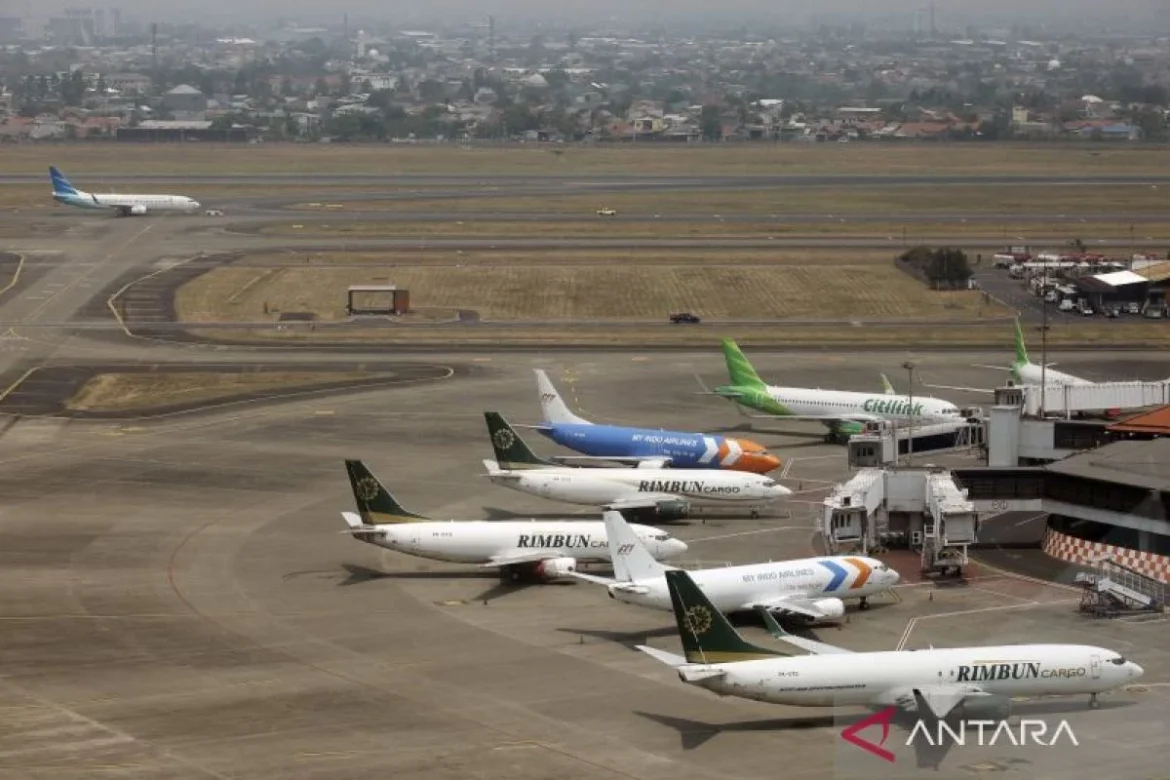
The ongoing eruption of Mount Anak Krakatau in early September 2026 has triggered widespread disruptions across Indonesia’s aviation network, grounding thousands of flights and affecting hundreds of thousands of passengers. While volcanic eruptions are frequently associated with localized ashfall and ground-level respiratory hazards, the crisis has underscored a more insidious danger: the catastrophic risks that microscopic volcanic glass and mineral particles pose to modern commercial jet aircraft. With ash plumes reaching altitudes of up to 50,000 feet over Sumatra and drifting across the densely populated islands of Java and Sumatra—including the capital city of Jakarta—aviation authorities have been forced to implement sweeping temporary closures of multiple regional airports.
The disruption highlights the complex vulnerabilities of contemporary air travel to geological hazards. Unlike conventional weather phenomena such as rain, fog, or standard cloud cover, volcanic ash is a highly abrasive, chemically aggressive substance that can incapacitate aircraft engines miles away from the erupting vent. As transportation ministries, airlines, and meteorological agencies scramble to manage the unfolding crisis, the situation has reignited global discussions regarding flight safety protocols, predictive ash-tracking technology, and the delicate balance between maintaining economic connectivity and ensuring absolute passenger safety.
Chronology of the September 2026 Eruption and Initial Aviation Response
The escalation began in the first week of September 2026, when Mount Anak Krakatau—situated in the Sunda Strait between Java and Sumatra—unleashed a series of powerful explosive eruptions. The sudden surge in seismic activity propelled dense columns of ash, gas, and fragmented rock high into the stratosphere. Driven by high-altitude seasonal winds, the plumes rapidly expanded over the Sunda Strait, blanketing parts of southern Sumatra and western Java.
By September 6, 2026, satellite tracking and pilot reports confirmed that the primary ash cloud had attained a staggering altitude of approximately 50,000 feet on the Sumatran side, placing it directly within the typical cruising altitudes of commercial long-haul and regional aircraft. The fallout was immediate and severe. More than 1,500 flights were abruptly canceled, delayed, or heavily rerouted, stranding an estimated 170,000 passengers across numerous domestic and international hubs.
Major facilities, including key transport nodes in Java and Sumatra, enacted emergency suspensions of airside operations. Notably, the ripple effects extended beyond the immediate blast zone; airports such as Juanda International Airport reported dozens of cancellations as airlines grounded fleets to prevent aircraft from inadvertently penetrating the drifting hazard zones. Concurrently, regional authorities issued public health advisories, prompting residents in Jakarta and surrounding areas to seek protective face masks as fine particulate matter descended upon urban centers.
The Physics of Peril: Why Volcanic Ash Is Not Ordinary Dust
To understand why a seemingly distant cloud of smoke and dust can bring multi-billion-dollar airline operations to a grinding halt, aviation experts emphasize that volcanic ash shares very little in common with ordinary atmospheric dust or sand.
According to guidelines and historical analyses published by the United States Geological Survey (USGS), volcanic ash consists of jagged, pulverized rock, minerals, and volcanic glass fragments measuring less than two millimeters in diameter. Because these particles are microscopically sharp and exceptionally hard, they possess intense abrasive properties. Furthermore, due to their fine granular nature and the explosive force of volcanic plumes, these particles can remain suspended in the atmosphere for days, traveling hundreds of miles from the erupting caldera.
When an aircraft encounters an ash cloud, the consequences are immediate and multifaceted. The abrasive nature of the ash acts like a high-speed sandblaster against the forward-facing surfaces of the aircraft. Windshields, landing light covers, and pitot tubes—the critical instruments used to measure airspeed—can become heavily pitted and frosted within seconds. This severe degradation of exterior glass drastically reduces pilot visibility, often forcing flight crews to rely entirely on automated instrument systems under high-stress conditions. Moreover, fine particles can infiltrate microscopic gaps in the fuselage, contaminating avionics bays, clogging air-conditioning packs, and wearing down exterior paint and control surface hinges.
The Thermal Trap: Engine Ingestion and the Risk of Flameout
While exterior abrasion presents significant operational hurdles, the most critical hazard lies within the aircraft’s propulsion system. Jet engines operate at internal turbine temperatures that far exceed the melting point of volcanic ash—typically ranging from 1,400 to 2,000 degrees Celsius, whereas silicate minerals found in ash typically melt at temperatures between 800 and 1,200 degrees Celsius.
When a commercial jetliner flies through a volcanic ash cloud, the engines continuously ingest thousands of cubic feet of air per second, inadvertently swallowing millions of microscopic ash particles. Upon entering the scorching combustion chambers and high-pressure turbine sections of the jet engine, the solid silicate minerals melt into a viscous, glowing liquid.
As this molten glass flows backward into the cooler turbine stator and rotor stages—where temperatures drop significantly—it rapidly solidifies. This glassy encrustation chokes the narrow cooling channels and alters the aerodynamic profile of the turbine blades. The resulting disruption of airflow within the engine causes a dramatic loss of thrust, compressor stalls, and, in severe cases, a complete "flameout," where the combustion process is extinguished entirely.
Historical aviation precedent underscores the lethal potential of this thermal trap. One of the most infamous incidents occurred in June 1982, when a British Airways Boeing 747-200 accidentally flew into an unmapped ash cloud generated by the eruption of Mount Galunggung in West Java, Indonesia. All four engines simultaneously flamed out as the glassy deposits choked the powerplants, causing the aircraft to glide helplessly downward from a cruising altitude of 37,000 feet. The flight crew managed to restart three of the four engines only after descending to a perilous altitude of around 13,000 feet, ultimately executing a safe emergency landing at Halim Perdanakusuma Airport in Jakarta, despite having a windscreen so abraded that the pilots had to peer through small side windows to land.
Data compiled by the USGS illustrates that this hazard is far from an isolated anomaly. Out of 129 documented global encounters between commercial aircraft and volcanic ash clouds recorded up through 2009, approximately 79 resulted in varying degrees of structural or mechanical damage to the airframes and engines. Most alarmingly, nine of those documented encounters involved the complete failure and shutdown of multiple engines while the aircraft were airborne.
The Illusion of Altitude and the Challenge of Detection
A common misconception among the traveling public is that aircraft can easily circumvent volcanic hazards simply by flying above or around the visible plume. However, meteorologists and aviation authorities note that volcanic ash clouds do not behave like ordinary weather systems.
During explosive events like the 2026 Anak Krakatau eruption, powerful updrafts and upper-level wind shears disperse volcanic material across multiple atmospheric layers simultaneously. Because ash plumes can ascend well into the stratosphere—reaching heights of 50,000 feet or more—they frequently occupy the exact cruising altitudes utilized by modern commercial airliners. Consequently, simple vertical adjustments are rarely a guaranteed escape route. Flight dispatchers and air traffic controllers must analyze complex, real-time meteorological data regarding wind vectors, ash density, and geographic dispersion before clearing any flight path.
Compounding this challenge is the fact that volcanic ash clouds are notoriously difficult to detect visually, particularly during nighttime operations or when mixed with standard meteorological clouds. Unlike dense storm cells that register clearly on onboard weather radar, fine ash clouds often appear transparent or indistinguishable from regular water vapor to human eyes and standard radar systems.
This invisibility factor explains why aviation authorities frequently maintain strict ground stops and airspace closures even when conditions directly above an airfield appear relatively clear. Modern aviation relies heavily on a coordinated network of Volcanic Ash Advisory Centers (VAACs), satellite remote sensing, ground-based volcanological observatories, and pilot pilot-reports (PIREPs) to map invisible hazards and establish enforceable no-fly zones.
Economic, Logistical, and Public Health Implications
The grounding of over 1,500 flights and the disruption of 170,000 passenger journeys during the early September 2026 eruption cycle has placed severe logistical strain on Indonesia’s tourism, logistics, and corporate travel sectors. Airlines face substantial financial losses stemming from unscheduled flight cancellations, extended aircraft routing, and the necessity of providing passenger accommodations, refunds, and rebooking services.
Furthermore, engineering teams face intensive post-event inspections. Aircraft that have operated near affected airspace must undergo rigorous maintenance protocols. Technicians are required to perform borescope inspections of jet engines to check for internal silicate buildup, replace pitted windshields, clean blocked pitot-static systems, and check control actuators for abrasive wear. Even minor exposure to low-concentration ash and sulfur dioxide aerosols can accelerate component degradation, necessitating premature overhauls and driving up long-term operational maintenance costs for carriers.
On the ground, the widespread ashfall has triggered secondary socioeconomic consequences. In urban centers like Jakarta and regional towns across western Java and southern Sumatra, local governments have distributed health warnings regarding the respiratory risks posed by fine silicate dust. Inhaling volcanic ash can severely aggravate pre-existing respiratory conditions such as asthma, bronchitis, and chronic obstructive pulmonary disease (COPD), leading to a surge in local clinic visits and driving a brisk commercial market for protective face masks. Additionally, motorists have been advised to follow strict vehicle maintenance procedures—including immediate air filter replacements and careful washing techniques—to prevent abrasive ash from damaging automotive paintwork and internal combustion engines.
Prioritizing Safety in the Shadow of Geological Volatility
The 2026 eruption of Mount Anak Krakatau serves as a stark reminder of the inherent vulnerabilities shared by human infrastructure living in the Pacific Ring of Fire. Indonesia, an archipelago comprising over 17,000 islands situated along highly active tectonic subduction zones, regularly contends with volcanic hazards that intersect directly with major international and domestic aviation corridors.
While the immediate economic toll of canceled flights and stranded travelers is undeniably disruptive, aviation regulators maintain that preventive closures and route diversions remain the only scientifically sound response to volcanic threats. The catastrophic potential of engine flameouts and structural compromise dictates an uncompromising commitment to safety over schedule adherence.
As monitoring technologies improve and international coordination between volcanologists and aviation authorities tightens, the global aviation industry continues to adapt to the persistent, unpredictable nature of geological threats. For now, the temporary grounding of flights in response to the Anak Krakatau activity underscores an enduring aviation tenet: when the earth below violently reshapes the sky above, patience and precaution remain the ultimate safeguards of human life.
