
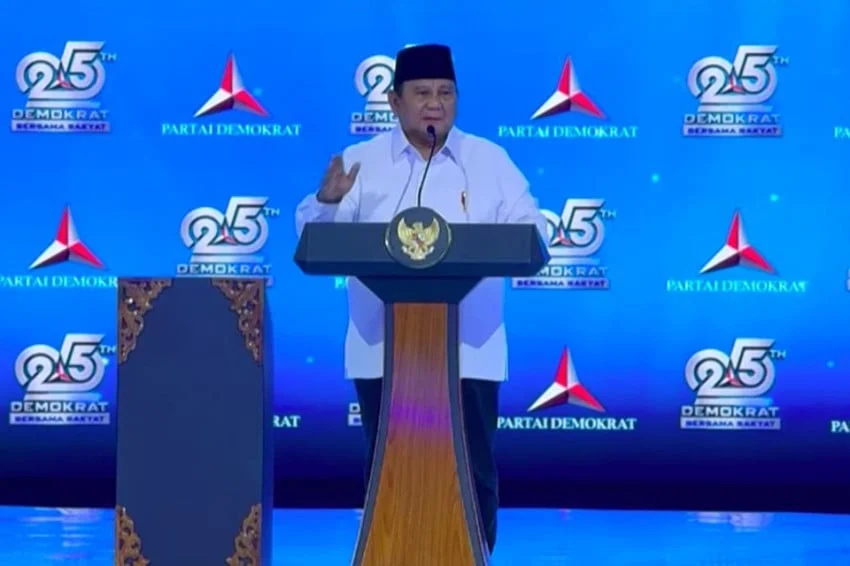
The Indonesia Arena in Jakarta transformed into a center of political convergence on Wednesday evening, September 9, 2026, as President Prabowo Subianto joined thousands of attendees to commemorate the 25th anniversary of the Democratic Party. The event, which carried significant symbolic weight, also served as a dual celebration for the 77th birthday of the party’s founder and the sixth President of the Republic of Indonesia, Susilo Bambang Yudhoyono (SBY). Amidst the festive atmosphere, the highlight of the evening was a rare and candid moment of reflection shared by President Prabowo regarding his formative years alongside SBY at the Indonesian Military Academy (Akmil).
A Shared History: The Magelang Connection
President Prabowo’s address to the audience centered on his deep-rooted personal history with SBY, dating back to their time as cadets in Magelang. The two leaders, both towering figures in the history of the Indonesian military and the current political landscape, entered the Academy together in 1970. However, their paths through the rigorous training programs of the era diverged.
Prabowo, in a moment of self-deprecating humor that drew applause from the attendees, remarked on their differing trajectories. "I was in the same batch as Pak SBY at the Military Academy. We entered together. But we graduated in different years," Prabowo noted. The President went on to characterize SBY’s performance during their formative years as exemplary. "From the beginning, it was clear that Pak SBY was the best cadet. As for Prabowo Subianto, I was the cadet who was still capable of being improved," he added with a smile.
This anecdote serves as a reminder of the historical bonds that often underlie the contemporary political coalition currently governing Indonesia. While their careers took different paths—with SBY serving as the country’s leader from 2004 to 2014 and Prabowo assuming the presidency in 2024—the shared institutional background at the Akmil continues to provide a foundation for mutual respect between the two men.
Chronology of the Democratic Party’s Quarter-Century Journey
The Democratic Party, founded on September 9, 2001, has undergone a significant evolution over the past 25 years. The celebration at the Indonesia Arena served as a retrospective of the party’s milestones and its transition through various political cycles.
- 2001: Formation of the Democratic Party, providing a new platform for political reform in the post-Soeharto era.
- 2004: A landmark year in Indonesian democracy as Susilo Bambang Yudhoyono won the first direct presidential election, signaling the party’s rise to the national stage.
- 2004–2014: The "Decade of the Democrats," characterized by significant economic growth, stabilization of democracy, and Indonesia’s integration into the G20.
- 2014–2024: The party spent a decade as a constructive opposition, focusing on building its internal infrastructure and transitioning leadership to the younger generation.
- 2024–2026: The party entered a period of renewed executive influence, aligning with the administration of President Prabowo Subianto to support national development goals.
The event held on Wednesday was not merely a birthday celebration; it was a demonstration of the party’s durability in a volatile political market. By reaching its 25th year, the Democratic Party has cemented its status as a permanent fixture in the Indonesian legislative and executive landscape.
Political Context and Strategic Alliances
The presence of President Prabowo at the 25th anniversary of the Democratic Party is highly significant. Since the inauguration of the current administration, the Democratic Party has been a key partner in the governing coalition. The presence of Agus Harimurti Yudhoyono (AHY), the current chairman of the party and a key minister in the Prabowo administration, underscores the alignment between the two parties.
Political analysts suggest that the camaraderie displayed by President Prabowo serves to solidify the unity of the "Indonesia Maju" coalition. By acknowledging his past with SBY, Prabowo effectively bridged the gap between his own political identity and the foundational values of the Democratic Party. This is crucial for maintaining legislative stability, as the Democratic Party holds a significant number of seats in the House of Representatives (DPR RI), which is essential for the government to push through its ambitious policy agenda, including infrastructure projects, economic reforms, and the continuation of the Nusantara Capital City (IKN) development.
Official Responses and Internal Reflections
Beyond the ceremonial aspects, the event provided a platform for party leadership to reaffirm their commitment to the country. AHY, in his address, emphasized the importance of the party’s "jati diri" (identity) and the need to remain grounded in the face of political power.
"We want to reaffirm the values and the identity of the party’s struggle," AHY noted in response to public discourse regarding the limits of power. He stressed that the Democratic Party’s participation in government is not for the sake of power itself, but to ensure that the aspirations of the people—particularly those related to social welfare and economic justice—are realized.
The party’s leadership underscored that the 25th anniversary is a moment for introspection. They highlighted that while the party has experienced both the heights of executive power and the challenges of the opposition, its core principles of nationalism and religiousness remain unchanged.
Data-Driven Analysis of the Democratic Party’s Impact
The Democratic Party’s longevity can be attributed to its ability to capture the moderate vote. Statistical analysis of the last four general elections shows that the party has maintained a consistent voter base, particularly among the middle class and urban populations.
- Voter Demographics: The party consistently polls strongly among voters aged 25–45, a demographic that aligns with its current push for younger, more dynamic leadership.
- Legislative Performance: The party has been instrumental in sponsoring key legislation related to bureaucratic reform and social security, reflecting its long-term policy priorities.
- Economic Stance: Under SBY’s influence, the party remains a staunch proponent of market-oriented economic policies balanced with social safety nets, a stance that has been broadly compatible with the current administration’s "Prabowo-Gibran" economic platform.
Broader Implications for Indonesian Politics
The optics of the Wednesday night event suggest a high level of institutional harmony. By publicly honoring the history of his relationship with the party’s founder, President Prabowo is signaling to the political establishment that the current coalition is built on personal trust and shared history, not just transactional convenience.
This stability is vital as Indonesia navigates the global economic headwinds projected for the latter half of the decade. The cooperation between the Democratic Party and the Prabowo administration ensures that the government can focus on long-term initiatives such as the revitalization of the national food security program and the expansion of the "Free Nutritious Meals" initiative, which is a centerpiece of the Prabowo-Gibran campaign promises.
Moreover, the celebration serves to insulate the party from the internal fragmentation that has historically plagued other political organizations. By linking the party’s identity so closely to the legacy of SBY and the current support for Prabowo, the Democratic Party has managed to maintain a unified front, which is a competitive advantage in the lead-up to the next regional and national election cycles.
Future Outlook
As the Democratic Party moves into its second quarter-century, the challenges remain substantial. The shift toward a digital-first political communication strategy, spearheaded by the party’s younger cadres, indicates an awareness of the changing demographics of the Indonesian electorate. The party’s ability to maintain its relevance will depend on its capacity to integrate the "old guard’s" experience—represented by figures like SBY—with the agility and technological savvy required by the modern generation of voters.
President Prabowo’s presence and his warm acknowledgment of his shared history with SBY have effectively "blessed" the party’s current direction. The event in Jakarta was not just a historical reflection but a forward-looking statement of intent. As both the President and the Democratic Party look toward the remaining years of the current administration, the alignment of their interests suggests a period of continuity and collaborative governance.
In conclusion, the 25th anniversary of the Democratic Party was a milestone event that successfully merged historical nostalgia with contemporary political strategy. By highlighting his own journey from a "cadet who could be improved" to the President of the Republic, Prabowo Subianto reinforced the narrative of growth and development—a theme that the Democratic Party is keen to adopt as it moves into the next phase of its political existence. The evening at the Indonesia Arena stood as a testament to the resilience of Indonesia’s political institutions and the enduring power of historical connections in shaping the nation’s future.
