
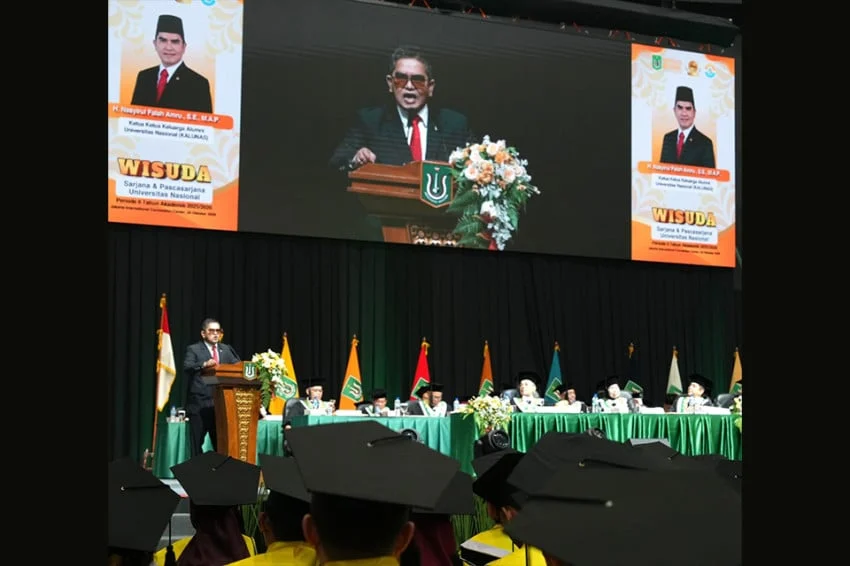
JAKARTA — In a passionate address highlighting the transformative power of higher education and institutional legacy, Nasyirul Falah Amru, Chairman of the Family of Alumni of Universitas Nasional, commonly known as Kalunas, delivered a compelling vision for the future of one of Indonesia’s oldest and most prestigious private higher education institutions. Speaking before thousands of graduates, faculty members, and high-ranking state officials at the Jakarta Convention Center, Kalunas Chairman Nasyirul Falah Amru—widely recognized by his peers and the public as Gus Falah—publicly expressed his strong aspiration that Universitas Nasional (Unas) will soon produce a President of the Republic of Indonesia.
The momentous declaration was made during the official commencement ceremony for the graduation of Universitas Nasional Period II for the Academic Year 2025/2026. The high-profile event drew significant attention not only due to the academic milestone achieved by the graduating cohort but also because of the presence of several prominent national political figures, cabinet ministers, and institutional leaders. As Unas continues to cement its reputation as a historic incubator for national thought and political leadership, the call for an alumnus to ascend to the nation’s highest office serves as both a challenge to the student body and a testament to the university’s enduring role in shaping Indonesia’s sociopolitical landscape.
A Journey from Humble Beginnings to National Legislation
To contextualize his ambitious vision for the graduating class, Gus Falah reflected upon his own personal and academic journey as a student at Universitas Nasional decades prior. He recalled the starkly different economic and living conditions he faced during his undergraduate years in 1994, painting a vivid picture of student life characterized by determination and limited personal resources.
"Dulu 1994, ketika saya kuliah saya membawa tas yang isinya hanya sikat gigi, dua buku dan handuk," Gus Falah stated, sharing how his modest luggage consisted of little more than a toothbrush, two books, and a towel. Despite these humble beginnings and the economic constraints of the era, he credits the exceptional educational environment provided by Universitas Nasional with equipping him for a life of public service and civic duty.
"Tapi dari pendidikan Unas yang luar biasa, Alhamdulillah sudah jadi anggota DPR RI, baru tiga periode," he continued, expressing profound gratitude for the institution that molded him. Having successfully served three consecutive terms as a member of the House of Representatives (DPR RI) representing the Indonesian electorate, Gus Falah utilized his personal trajectory as living proof that an education rooted in Unas can propel individuals into the highest echelons of national governance and policymaking.
Building upon this personal narrative, he argued that the university has advanced significantly since his student days, boasting vastly superior infrastructure, advanced academic facilities, and a distinguished faculty of professors and researchers. Given these enhanced institutional capabilities, Gus Falah asserted that it is not merely a distant dream, but a logical expectation, for future leaders—including a future Head of State—to emerge from the ranks of Unas alumni. "Maka saya berharap dari Universitas ini, lahir Presiden Republik Indonesia," he declared firmly, charging the newly minted graduates with the immense responsibility of carrying the torch of leadership forward.
Academic Rigor Balanced with Moral and Ethical Foundation
Beyond political aspirations, Gus Falah’s address heavily emphasized the philosophical foundation upon which Universitas Nasional operates. Often referred to historically as the campus of struggle (kampus perjuangan), Unas was founded during the turbulent revolutionary era of the Indonesian independence movement. This historical identity heavily influences its modern academic framework.
According to Gus Falah, the educational processes at Unas are intentionally designed to transcend traditional pedagogical boundaries. The curriculum and campus life do not merely focus on cognitive development or the acquisition of intellectual intelligence and technical competencies. Instead, a core pillar of the university’s philosophy is the holistic cultivation of human capital.
"Tapi, pendidikan di Unas juga fokus pada pembentukan karakter, moral, dan integritas akhlak," Gus Falah explained, emphasizing that character building, moral fortitude, and ethical integrity are paramount. In an era marked by rapid globalization, technological disruption, and complex socio-economic challenges, the demand for leaders with unyielding moral compasses has never been more critical. He concluded his address with an inspiring charge to the graduates: "Saya berharap para wisudawan dan wisudawati ini melenting serta berguna bagi nusa dan bangsa," expressing his fervent hope that the graduates will soar to great heights and dedicate their acquired knowledge to the service of the motherland and the Indonesian nation.
High-Profile Attendance Underscores Institutional Prestige
The graduation ceremony itself was a grand affair that underscored the strategic importance and national standing of Universitas Nasional. The event was graced by the presence of prominent government officials, reflecting the strong institutional ties between academia and the state apparatus.
Among the distinguished guests seated on the dais was the Rector of Universitas Nasional, El Amry Bermawi Putera, who presided over the academic senate meeting and formally conferred degrees upon the graduates. The presence of Rector El Amry Bermawi Putera highlighted the university’s ongoing commitment to academic excellence, institutional accreditation, and the continuous enhancement of educational standards to meet global benchmarks.
Adding significant gravitas to the ceremony were two high-ranking members of the current national executive branch. Agus Harimurti Yudhoyono (AHY), serving in his capacity as the Coordinating Minister for Infrastructure and Regional Development, attended the event, bringing a vital perspective on national infrastructure planning, regional economic growth, and the future demands placed upon young professionals in engineering, spatial planning, and public policy. Furthermore, the presence of the Deputy Minister of Manpower, Afriansyah Noor, highlighted the critical nexus between higher education outcomes and national labor market dynamics, workforce readiness, and employment policies in an evolving economic landscape.
The convergence of such high-level state officials at a single university commencement signals a broader recognition of Universitas Nasional as a vital partner in national development. It reinforces the expectation that graduates from institutions like Unas are not merely entering the workforce to secure personal employment, but are expected to actively contribute to solving complex structural challenges facing Indonesia as it pursues its long-term national development goals.
Background and Context of Universitas Nasional
Founded on July 15, 1949, Universitas Nasional holds the prestigious distinction of being the oldest private university in Jakarta and the second-oldest private university in Indonesia. Established by a group of prominent Indonesian intellectuals and nationalist figures associated with the Yayasan Memajukan Ilmu dan Kebudayaan (Foundation for the Advancement of Science and Culture), Unas was born out of a profound desire to provide accessible, high-quality higher education to a newly independent nation striving to build its sovereign institutions.
Throughout its multi-decade history, Unas has weathered numerous political and economic transitions, remaining a resilient bastion of intellectual freedom, critical discourse, and patriotic service. Its alumni network spans generations of lawmakers, diplomats, scientists, cultural figures, journalists, and corporate leaders who have shaped the trajectory of modern Indonesia.
In recent years, the university has actively modernized its infrastructure, expanded its international academic partnerships, and integrated digital technologies into its pedagogy. Initiatives such as academic collaborations and financial literacy programs—exemplified by recent institutional partnerships involving major financial entities like MNC Sekuritas and prominent investors like Lo Kheng Hong—demonstrate Unas’s proactive approach to bridging the gap between theoretical academic learning and practical, real-world economic engagement.
Broader Implications and Socio-Political Impact
The public articulation of the desire for a Unas alumnus to assume the presidency carries broader implications for the sociopolitical dynamics of Indonesian higher education. In Indonesia, universities have historically served as epicenters of political awakening and leadership incubation. From the nationalist student movements of the pre-independence era to the Reformasi movement of 1998, academic institutions have consistently provided the intellectual firepower and moral leadership required to guide the nation through critical junctures.
By publicly setting the ambition for the presidency, Kalunas and its leadership are signaling a shift from passive institutional pride to proactive leadership pipeline development. This vision challenges both the university administration and its student body to elevate their standards of governance education, public speaking, critical policy analysis, and civic engagement.
Furthermore, in an era where public skepticism toward political institutions occasionally surfaces, the emphasis placed by leaders like Gus Falah on "character, moral, and integrity" serves as a timely reminder that political power must be tethered to ethical accountability. For the graduates stepping out of the Jakarta Convention Center and into a competitive globalized world, the challenge is twofold: to achieve professional excellence in their respective fields, whether in technology, business, public administration, or the arts, and to maintain the uncompromising ethical standards championed by their alma mater.
As Universitas Nasional looks toward its upcoming academic cycles and future institutional milestones, the challenge issued by the Kalunas Chairman will undoubtedly linger as a guiding beacon. Whether a future President of the Republic of Indonesia will indeed walk the halls of Unas as an alumnus remains to be seen in the unfolding chapters of Indonesian history, but the institutional ambition has been definitively set, and the groundwork has been laid for a new generation of leaders prepared to answer the call of the nation.
