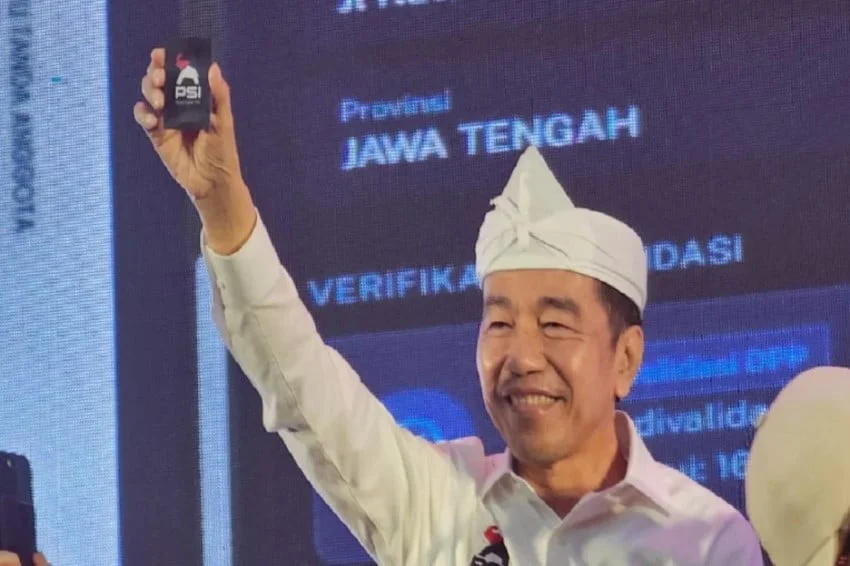
The political landscape of Indonesia experienced a notable ripple following a direct confirmation by the country’s seventh president, Joko Widodo, commonly known as Jokowi. After months of speculation, public curiosity, and persistent rumors regarding his post-presidential political alignment, Jokowi openly admitted that he has officially held a membership card (Kartu Tanda Anggota – KTA) for the Indonesian Solidarity Party (Partai Solidaritas Indonesia – PSI) for approximately one year. This revelation, which places the timeline of his formal affiliation back to October 2025, has triggered widespread discussions among political observers, analysts, and party strategists across the archipelago.
The disclosure sheds light on a relationship that has long been whispered about within Jakarta’s political circles. While Jokowi’s ideological alignment and close rapport with PSI leaders—including his youngest son, Kaesang Pangarep, who serves as the party’s general chair—have been apparent for years, his explicit status as a registered card-carrying member had previously remained shrouded in ambiguity. The timing and manner of the confession have prompted deep dives from political analysts eager to decode the strategic motivations behind the former president’s delayed transparency.
Chronology of Affiliation and Delayed Revelation
To understand the weight of Jokowi’s recent admission, one must trace the timeline of his interactions with PSI and his transition out of the presidential office. Following the conclusion of his second and final presidential term in October 2024, political analysts closely watched to see whether the veteran statesman would join an established major political vehicle, establish his own political movement, or maintain a non-partisan stance.
Throughout late 2024 and much of 2025, public appearances alongside PSI figures fueled speculation. However, formal confirmation of a party card remained elusive. According to the recent disclosure, Jokowi officially integrated into the party ranks in October 2025. Yet, the existence of the membership card was kept out of the public spotlight for a full year, finally coming to light through a combination of public displays and subsequent media inquiries in late September 2026.
This pattern of delayed disclosure has drawn commentary from various observers. Ray Rangkuti, a prominent political analyst from the Indonesian Public Perspective (LPI), did not hesitate to draw parallels to other administrative controversies that have surrounded the political family in recent years. In a candid assessment, Rangkuti remarked on the secretive nature surrounding certain documentation matters associated with the family, comparing the delayed revelation of the PSI membership card to past public discussions regarding academic credentials and equivalency documents. While critical of the initial opacity, Rangkuti emphasized that the eventual unveiling comes as little surprise to those who closely monitor the strategic maneuvers of the former head of state.
Analytical Perspectives: Why Now?
The decision to transition from a quiet affiliation to an open acknowledgment of PSI membership has raised questions regarding the underlying strategic calculus. Political analysts have dissected the move, identifying several primary drivers that likely compelled Jokowi to drop the veil of ambiguity.
Communication Channels with Established Parties
The first major factor points to the evolving dynamics between Jokowi and other prominent political parties within the national coalition and opposition blocs. According to Rangkuti, informal and formal communication channels between Jokowi and traditional major political parties have grown increasingly constrained. Over time, these entities appear to have reached a threshold where they expect adherence to strict internal party mechanisms. For major parties with deep-rooted institutional hierarchies, accommodating a figure of Jokowi’s stature requires navigating complex organizational structures, including adherence to Articles of Association and By-Laws (AD/ART). As traditional avenues for backroom influence or seamless integration narrowed, the appeal of aligning with a smaller, highly aligned party like PSI became more pronounced.
Consolidating Total Support for PSI’s Electoral Ambitions
A second critical driver involves the strategic necessity of clarity for electoral growth. Operating in the shadows or maintaining an ambiguous stance offers flexibility, but it ultimately caps the potential to mobilize absolute loyalty and momentum. By openly claiming his PSI membership, Jokowi provides a definitive signal to his loyal base, volunteers, and sympathizers. This total commitment is viewed as a necessary catalyst to boost the electoral prospects and national visibility of PSI, a party that has steadily positioned itself as a progressive, youth-oriented political force but has historically struggled to consistently clear parliamentary thresholds in national legislative elections.
Broader Implications for Indonesian Party Politics
Jokowi’s open embrace of PSI carries profound implications for the future architecture of Indonesian political parties. For PSI, securing a figure of Jokowi’s immense residual popularity and national influence is a double-edged sword. On one hand, it provides an immediate surge in media attention, institutional credibility among certain voter segments, and organizational magnetism. It transforms the party from a regional or niche player into a focal point of national political intrigue.
On the other hand, heavy reliance on a single towering figure risks overshadowing the party’s institutional identity. Critics within the broader political spectrum may argue that such associations stunt the organic growth of internal party democracy, transforming ideologically driven organizations into vehicles centered around specific political dynasties or prominent personalities. Furthermore, it complicates PSI’s relations with other political parties, particularly those within the current governing coalition who may view the overt consolidation of power around the former president and his inner circle as a competitive threat.
Public and Political Reactions
The revelation has generated mixed reactions across the national political spectrum. Supporters of PSI have welcomed the acknowledgment, viewing it as a natural validation of a shared vision for national development, modernization, and youth empowerment. For years, the party’s platform has closely mirrored the infrastructure-heavy and economic development rhetoric championed during Jokowi’s decade-long presidency. Having the architect of those policies openly holding their membership card solidifies their brand identity.
Conversely, critics and opposition figures have seized upon the delayed revelation to question the transparency of political elites. The narrative of "secret memberships" reinforces existing criticisms regarding how political alliances are forged behind closed doors in Indonesia, away from the immediate scrutiny of the general electorate. Transparency advocates argue that political affiliations of former heads of state should be transparently declared to avoid potential conflicts of interest, particularly when dealing with governance, policy continuity, and legislative lobbying.
The Road Ahead: PSI’s Electoral Strategy Post-2026
As Indonesia looks toward the horizon of future regional and national electoral cycles, the open alignment between Jokowi and PSI sets a new baseline for strategic planning. The party is expected to leverage its high-profile member to expand its grassroots network, attract donor confidence, and recruit dynamic candidates for upcoming legislative contests.
At the same time, Jokowi’s active participation within party structures will likely face continuous scrutiny from both supporters and detractors. Whether this open partnership will be sufficient to propel PSI into a major legislative powerhouse remains one of the most compelling questions in modern Indonesian politics. What is certain, however, is that the era of quiet affiliations has ended, and the political chess pieces for the post-presidential chapter of Joko Widodo are now visibly and firmly positioned on the board.