
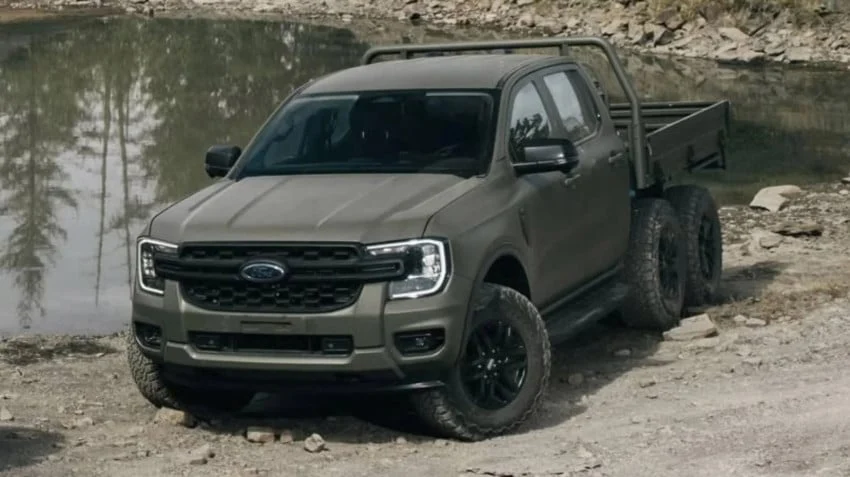
The global defense landscape is witnessing a fascinating convergence of commercial automotive engineering and military-grade tactical requirements. In a strategic maneuver that bridges the gap between mass-produced civilian trucks and rugged battlefield utility vehicles, a powerful industrial triumvirate has emerged to pitch a militarized variant of the popular pickup truck. Ford, operating in close collaboration with General Dynamics Land Systems UK (GDLS UK) and renowned engineering consultancy Ricardo, has officially put forward a compelling proposal to the British Ministry of Defence. At the heart of this high-stakes pitch is the Ford Ranger Super Duty, specifically re-engineered to meet the demanding parameters of the British Army’s Light Mobility Vehicle (LMV) program.
This ambitious procurement initiative represents a generational shift in how the United Kingdom equips its armed forces for modern expeditionary warfare, peacekeeping missions, and domestic security operations. The joint venture’s submission is not merely a cosmetic modification of a standard dealership vehicle; it is a comprehensive, purpose-built tactical platform available in both conventional 4×4 and advanced 6×6 configurations. Most notably, the development of a specialized six-wheeled prototype based directly on the newly minted Ranger Super Duty platform highlights the extreme engineering lengths to which the partnership is willing to go to secure this lucrative defense contract. As legacy military fleets age and face obsolescence, the entry of a commercial giant like Ford into the defense sector signals a broader industry trend toward commercial-off-the-shelf (COTS) solutions adapted for specialized military use.
Background Context of the British Army Fleet Overhaul
To fully understand the significance of the Ford, GDLS UK, and Ricardo proposal, one must examine the operational state of the British Army’s current light utility fleet. For decades, the backbone of tactical transport, liaison duties, and light logistical support across the British Armed Forces has relied heavily on iconic vehicles such as the Land Rover Defender and the stalwart Steyr-Puch Pinzgauer. While these vehicles earned legendary reputations for mechanical simplicity and go-anywhere capability during an era defined by conventional conflicts and colonial-style policing, the nature of modern warfare has fundamentally changed.
Contemporary military operations demand higher payloads, advanced ballistic and blast protection, sophisticated electronic architecture to support modern battlefield management systems, and significantly higher levels of reliability and crew comfort. The legacy Land Rover Defender variants currently in service—many of which have undergone multiple mid-life updates and extensive operational deployments in hostile environments like Iraq and Afghanistan—are now approaching the absolute limits of their structural fatigue lives and technological relevance. Similarly, the Steyr-Puch Pinzgauer fleet, while uniquely capable in extreme off-road terrain, suffers from mounting maintenance burdens, scarcity of specialized replacement parts, and an inability to integrate modern digital command-and-control systems seamlessly.
Recognizing this capability gap, the United Kingdom’s Ministry of Defence (MoD) established the Light Mobility Vehicle (LMV) procurement framework. This program is a vital component of a broader modernization strategy designed to ensure that British service personnel are equipped with agile, highly mobile, and easily supportable assets capable of operating in diverse global theaters, from the Arctic circle to arid desert environments. The stakes for participating defense contractors are extraordinarily high, as winning the LMV tender secures a multi-decade relationship with one of Europe’s premier military forces and establishes a powerful reference point for international defense exports.
Procurement Timeline and Financial Scope
The financial magnitude of the British Army’s fleet modernization initiative cannot be overstated. The overarching modernization effort is anchored by a massive defense funding allocation valued at approximately £4.8 billion. Within this broader budgetary framework, the Light Mobility Vehicle program specifically targets the acquisition of up to 2,500 new light utility vehicles. These platforms are intended to completely supplant the aging Land Rover Defender and Steyr-Puch Pinzgauer fleets across all branches of the British Armed Forces by the target completion year of 2030.
The procurement schedule is structured with rigorous milestones designed to test the limits of competing vehicle designs before a final production contract is awarded. Following the initial expression of interest and detailed proposal submissions, the formal evaluation phase is scheduled to take place between October 2026 and January 2027. During this critical window, military evaluators, technical experts from the Defence Equipment and Support (DE&S) agency, and active-duty soldiers will subject the competing prototypes to grueling automotive and tactical trials. These tests will evaluate mobility over extreme terrain, ease of maintenance under field conditions, payload capacity, electromagnetic compatibility, and structural durability.
Following the conclusion of the evaluation phase in early 2027, the MoD is expected to select a preferred bidder, paving the way for low-rate initial production, extensive testing of production-standard units, and a phased rollout leading up to the 2030 deadline. For Ford and its industrial partners, the timeline provides a structured runway to refine the Ranger Super Duty 4×4 and 6×6 prototypes, ensuring that mass-production readiness aligns precisely with the military’s fielding schedule.
The Competitive Landscape
Entering the LMV competition is no trivial matter, as the Ford-GDLS UK-Ricardo alliance faces formidable opposition from deeply entrenched defense contractors and established automotive players vying for the lucrative £4.8 billion modernization pie. Among the primary competitors is the veteran-heavy Land Rover Defender Wolf Series II, a modern iteration that attempts to leverage the deep historical affinity and institutional familiarity that the British Army holds for the Land Rover brand. Proponents of the Wolf Series II argue that maintaining brand continuity reduces training overhead and simplifies logistical integration with existing infrastructure.
In addition to Land Rover derivatives, the competition features robust rivalries from other major automotive conglomerates. General Motors (GM), through its specialized defense division, has signaled active interest, leveraging its extensive portfolio of global truck architectures and proven military adaptations such as the Infantry Squad Vehicle (ISV) developed for the United States Army. Furthermore, Ineos Automotive—maker of the rugged Grenadier SUV, which was expressly designed to fill the philosophical void left by the discontinuation of the original Land Rover Defender—represents another potent domestic and international challenger.
To stand out in such a crowded and competitive field, the Ford Ranger Super Duty consortium has adopted a multifaceted strategy emphasizing commercial scalability, modern digital integration, and multi-configuration flexibility. By offering both a standard 4×4 variant and an extraordinary 6×6 version, the team aims to cover a wider spectrum of military requirements—from standard command-and-control liaison tasks to heavy weapon platforms, casualty evacuation, and specialized logistical support roles.
Engineering the Military Ranger Super Duty: 4×4 and 6×6 Configurations
The technical foundation of the proposal rests upon the Ford Ranger Super Duty, a heavy-duty commercial truck platform designed from the ground up for grueling work environments. By taking this robust commercial baseline, the engineering team has bypassed the immense financial costs and protracted development timelines associated with designing a tactical vehicle entirely from a blank sheet of paper. Instead, they have applied specialized military hardening, suspension upgrades, powertrain enhancements, and structural reinforcement to a proven, globally supported chassis.
The standard 4×4 variant offers exceptional payload capacity and towing capabilities, serving as a reliable workhorse for troop transport, command duties, and light supply runs. However, the crown jewel of the proposal is undeniably the 6×6 prototype. The integration of a third driven axle fundamentally transforms the vehicle’s operational envelope. By distributing vehicle weight across six wheels instead of four, the 6×6 configuration drastically reduces ground pressure, enabling the truck to traverse extremely soft soils, deep mud, fine sand, and snow-covered terrain where conventional four-wheel-drive vehicles might bog down.
Furthermore, the extended chassis and dual-rear-axle setup significantly expand the usable cargo bed area and increase the maximum gross vehicle weight rating (GVWR). This additional capacity is vital for modern military operations, allowing the vehicle to carry heavy communication suites, electronic warfare equipment, extra fuel and water supplies, or specialized mission modules without compromising mobility or exceeding safety margins. Ricardo, renowned for its powertrain engineering and systems integration expertise, has worked closely with Ford to ensure that the heavy-duty diesel engines and transmission systems are optimized for the demanding duty cycles and varied fuel qualities encountered in global military deployments.
Official Responses and Industry Perspectives
While the formal evaluation trials are still months away from commencing, representatives from the participating corporate entities have expressed immense confidence in the joint proposal, highlighting the strategic alignment between commercial industrial capacity and sovereign defense requirements. General Dynamics Land Systems UK, a company with a stellar reputation for delivering tracked and wheeled armored fighting vehicles to the British Army, has taken a leading role in framing the narrative around the collaboration.
According to statements released by GDLS UK, the tripartite partnership represents a uniquely balanced solution that is thoroughly tested, easily scalable, and remarkably cost-effective. Company executives emphasize that by utilizing a heavily produced commercial vehicle as the baseline, the MoD can insulate itself from the exorbitant research and development costs typically associated with bespoke military vehicle programs. This commercial-off-the-shelf approach drastically streamlines the supply chain, ensuring that spare parts are readily available globally and that maintenance procedures align with standard automotive repair practices, thereby reducing the burden on military technicians.
Moreover, defense analysts have pointed out that a successful selection of the Ford Ranger Super Duty by the British Army could catalyze significant export opportunities. Allied nations operating within NATO and global partner states frequently seek cost-effective, easily maintainable utility vehicles that benefit from established global dealership and service networks. If the UK adopts the platform, it could create a standardized logistics footprint across multiple international jurisdictions, enhancing coalition interoperability.
Broader Economic and Strategic Implications
The decision facing the British Ministry of Defence transcends mere automotive procurement; it carries profound implications for domestic manufacturing, taxpayer value, and long-term national security resilience. With defense budgets under constant public scrutiny, government officials are under immense pressure to maximize the purchasing power of every pound allocated from the public purse. The Ford-GDLS UK-Ricardo proposal is explicitly tailored to address this economic reality by promising high value for UK taxpayers.
Because Ford maintains a substantial industrial and commercial footprint in the United Kingdom, and given that engineering partners like Ricardo and GDLS UK operate extensive facilities within the country, the program holds the potential to sustain and create skilled engineering and manufacturing jobs domestically. Proponents argue that investing in a modified commercial platform allows for localized assembly, custom outfitting, and rapid turnaround on maintenance contracts, directly supporting the UK’s industrial base.
From a strategic standpoint, the integration of commercial technologies into military fleets reflects a broader evolution in defense acquisition policy known as "spiral development" and commercial adaptation. Modern commercial trucks like the Ford Ranger are already equipped with advanced driver assistance systems, sophisticated telematics, high-capacity electrical charging architectures, and ergonomic cabins designed to reduce operator fatigue over long missions. By harnessing these commercial innovations, modern militaries can field capabilities much faster than traditional defense procurement cycles would otherwise permit.
As the countdown to the October 2026 evaluation window ticks forward, all eyes will be on the proving grounds where the Ford Ranger Super Duty 4×4 and 6×6 will lock horns with rival contenders. The outcome of these rigorous trials will not only dictate the physical appearance of the British Army’s transport fleet for the next several decades but will also serve as a landmark case study in the viability of commercial platforms operating at the sharp end of military capability.
