
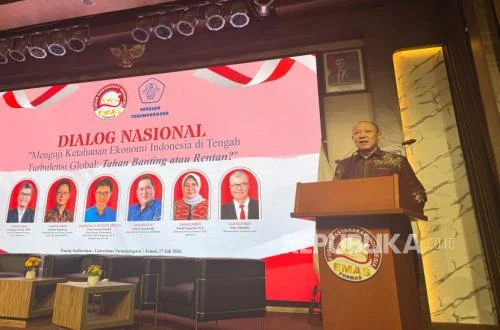
REPUBLIKA.CO.ID, JAKARTA – The Forum Masyarakat Indonesia Emas (Formas), or the Golden Indonesia Community Forum, convened a pivotal National Dialogue to formulate concrete policy recommendations for the government to navigate escalating global uncertainties. The significant event took place at the Universitas Tarumanagara campus in Jakarta on Friday evening, July 17, 2026, bringing together a diverse group of economists, academics, business leaders, and policymakers to critically examine the nation’s economic fortitude.
Setting the Stage: Global Headwinds and Domestic Resilience
The dialogue, titled "Menguji Ketahanan Ekonomi Indonesia di Tengah Turbulensi Global: Tahan Banting atau Rentan?" (Assessing Indonesia’s Economic Resilience Amidst Global Turbulence: Resilient or Vulnerable?), underscored the urgent need for proactive strategies in a rapidly shifting international landscape. Serian Wijatno, who serves as both the Chairman of the Dialogue Committee and the Chairman of the Formas Expert Council, emphasized the critical nature of the current global environment. In his opening remarks, delivered to the media in Jakarta on Saturday, July 18, 2026, Wijatno likened Indonesia’s economic situation to a ship braving a storm on the high seas. This evocative metaphor captured the multifaceted challenges stemming from persistent geopolitical conflicts, disruptive technological advancements, and the pervasive weakening of global purchasing power.
Wijatno’s analogy resonated deeply with the audience, reflecting a widespread recognition of the unprecedented pressures facing economies worldwide. He quoted a timeless adage, stating, "A calm sea never made a skilled sailor," implying that the current global challenges, though formidable, present an invaluable opportunity for Indonesia to prove and strengthen its economic resilience. This sentiment set the tone for a dialogue designed not merely for academic discourse but for the generation of actionable, clear, and realistic policy recommendations that policymakers could immediately implement. The stated goal was to move beyond theoretical discussions and contribute directly to tangible national economic stability and growth.
Formas’ Mandate and the Dialogue’s Genesis
Formas, whose name itself signifies a long-term vision for a prosperous "Golden Indonesia," positioned this National Dialogue as a critical intervention in a period marked by significant economic instability. The organization, a non-governmental entity dedicated to fostering a robust and sustainable future for Indonesia, regularly engages in public discourse and policy advocacy. Its primary mission revolves around identifying national challenges, proposing innovative solutions, and facilitating multi-stakeholder collaboration to achieve the nation’s developmental aspirations.
Yohanes Handojo Budhisedjati, the General Chairman of Formas, elaborated on the rationale behind this initiative. In his introductory remarks, he explained that the dialogue was a direct response to the "economic instability" and inflationary pressures that had begun to trigger recessionary tendencies across various domestic sectors. The global economy, still grappling with the lingering effects of the COVID-19 pandemic, had entered a new phase characterized by supply chain disruptions, energy crises, and heightened geopolitical tensions. These factors, combined with aggressive monetary tightening by major central banks worldwide, had created a challenging environment for emerging economies like Indonesia.
Formas recognized that while Indonesia had demonstrated commendable resilience in the immediate aftermath of the pandemic, the prolonged nature of these global turbulences necessitated a deeper, more comprehensive assessment of its economic foundations. The forum aimed to bridge the gap between academic theory and practical policy-making, ensuring that the government received well-researched, evidence-based guidance to navigate the complex economic landscape of 2026 and beyond.
A Gathering of Minds: Speakers and Participants
The National Dialogue attracted a distinguished panel of speakers and prominent attendees, underscoring the gravity and urgency of the topics discussed. The expert panel featured some of Indonesia’s most respected economic minds:
- Piter Abdullah: A renowned economist, often sought for his insights into monetary policy and financial markets. His contributions typically focus on macro-economic stability and the impact of global financial trends on domestic economies.
- Hendri Saparini: Known for her expertise in development economics and her critical perspectives on economic policy, particularly regarding state-owned enterprises and resource management.
- Anthony Budiawan: A vocal analyst on fiscal policy, government spending, and the broader investment climate, frequently providing incisive critiques and alternative policy suggestions.
- Wijayanto Samirin: An expert with a strong background in public policy and business strategy, often offering practical solutions for improving competitiveness and fostering sustainable growth.
The presence of these diverse perspectives ensured a multi-faceted analysis of Indonesia’s economic challenges. Further lending gravitas to the event was the attendance of Dr. Ir. Ahmad Sudiro, M.M., M.T., I.P.U., the Rector of Universitas Tarumanagara, highlighting the crucial role of academic institutions in fostering intellectual discourse for national development. In addition to the official speakers, the forum was enriched by the participation of numerous national business figures and leading academics, fostering a dynamic environment for idea exchange and consensus building. This convergence of thought leaders from various sectors – academia, business, and policy analysis – was instrumental in creating a holistic understanding of the issues at hand.
The Economic Barometer: Navigating Turbulence
Serian Wijatno’s "ship in a storm" analogy was not merely rhetorical; it served as a powerful call to action, urging participants to confront the harsh realities of the global economic climate. Geopolitical conflicts, such as the ongoing ripple effects of the Russia-Ukraine war and tensions in the Middle East, continued to disrupt global supply chains, drive up commodity prices, and create investment uncertainty. Meanwhile, rapid technological disruptions, particularly the acceleration of artificial intelligence (AI) and automation, presented both immense opportunities and significant challenges, demanding a skilled workforce and adaptable economic structures. Concurrently, persistent inflationary pressures and rising interest rates in developed economies had led to a noticeable weakening of global purchasing power, impacting export-oriented nations like Indonesia.
These interconnected challenges underscore the core question of the dialogue: Is Indonesia’s economy genuinely "tahan banting" (resilient and able to withstand shocks) or "rentan" (vulnerable to external pressures)? The discussions aimed to delve into the structural strengths and weaknesses of the Indonesian economy, identifying areas where policies could be reinforced to build greater resilience. This included examining the robustness of its financial sector, the diversification of its export markets, the stability of its domestic consumption, and the adaptability of its labor force.
Indonesia’s Economic Posture: Data and Challenges
Leading up to 2026, Indonesia had largely demonstrated remarkable economic stability despite global headwinds. Post-pandemic recovery saw robust GDP growth, often supported by commodity price booms. For instance, in the years preceding 2026, Indonesia’s GDP growth consistently hovered around 5%, outperforming many peers in Southeast Asia and globally. Inflation, while present, had been managed relatively well compared to Western economies, thanks to a combination of prudent monetary policy by Bank Indonesia and targeted fiscal interventions by the government. The rupiah had shown relative stability, and foreign direct investment (FDI) remained attractive, drawn by Indonesia’s large domestic market and rich natural resources.
However, the dialogue acknowledged several underlying challenges that could undermine this stability if left unaddressed. These included:
- Supply Chain Resilience: Despite efforts to localize production, Indonesia remained susceptible to global supply chain shocks, particularly for critical industrial inputs. Diversifying sourcing and strengthening domestic manufacturing capabilities were identified as key areas for improvement.
- Energy and Food Security: Volatility in global energy and food prices posed significant risks to domestic inflation and household purchasing power. Strategies for enhancing renewable energy adoption and boosting domestic agricultural productivity were crucial.
- Digital Transformation Gap: While digital adoption was growing rapidly, disparities in digital literacy and infrastructure, especially in rural areas, needed to be addressed to fully harness the potential of the digital economy.
- Human Capital Development: Ensuring a skilled workforce capable of thriving in an increasingly technology-driven global economy remained a priority. Investment in education, vocational training, and reskilling programs was essential.
- Fiscal Prudence and Debt Management: While government debt-to-GDP ratios were manageable, sustained fiscal discipline was necessary to create headroom for counter-cyclical policies during future downturns.
- Inequality and Poverty Reduction: Despite overall economic growth, persistent income inequality and regional disparities required targeted interventions to ensure inclusive growth and prevent social unrest.
The discussion also touched upon the importance of maintaining a favorable investment climate, streamlining bureaucratic processes, and ensuring legal certainty to attract sustained domestic and foreign capital. The speakers presented data and analytical frameworks to illustrate these points, offering a granular view of Indonesia’s economic health.
Crafting Concrete Policy Recommendations
The central objective of the Formas National Dialogue was to move beyond abstract analysis and generate practical, implementable policy recommendations. Serian Wijatno reiterated that the forum was "designed critically to produce economic policy recommendations that are realistic, clear, and can be concretely followed up by policymakers, not just become academic discourse or ordinary theoretical discussions." This emphasis on practicality was a recurring theme throughout the sessions.
While specific recommendations were still being formulated post-dialogue, the discussions pointed towards several key areas for policy intervention:
- Macroeconomic Stability: Recommendations likely included fine-tuning monetary and fiscal policies to manage inflation without stifling growth, enhancing foreign exchange reserves, and maintaining a healthy balance of payments.
- Structural Reforms: Proposals for improving ease of doing business, labor market flexibility, and regulatory efficiency were anticipated to attract more investment and boost productivity.
- Diversification of Trade and Investment: Strategies for reducing reliance on a few key export markets and diversifying foreign investment sources to mitigate geopolitical risks.
- Digital Economy Acceleration: Policies to support the growth of startups, improve digital infrastructure, and enhance digital literacy across the population.
- Green Economy Initiatives: Recommendations for accelerating the transition to renewable energy, promoting sustainable resource management, and developing green industries to align with global environmental goals and create new economic opportunities.
- Social Safety Nets and Human Development: Strengthening social protection programs, investing in education and healthcare, and vocational training to build a resilient and adaptable workforce.
- Regional Development: Policies aimed at reducing inter-regional disparities, fostering growth in lagging areas, and improving infrastructure connectivity across the archipelago.
The expert panelists, drawing from their deep knowledge and experience, engaged in rigorous debates and collaborative sessions to refine these potential policy directions. The goal was to present a consolidated report to the government, offering a comprehensive roadmap for navigating the economic turbulences ahead.
Broader Implications for National Policy and "Indonesia Emas"
The Formas National Dialogue represents a crucial example of civil society’s role in shaping national policy. By providing an independent platform for expert analysis and stakeholder consultation, Formas contributes significantly to the robustness and legitimacy of policy formulation. Such initiatives are vital for democratic governance, ensuring that government decisions are informed by diverse perspectives and rigorous evidence.
The concept of "Indonesia Emas" (Golden Indonesia) — a vision for Indonesia to become a developed, prosperous, and equitable nation by 2045, coinciding with its centenary of independence — serves as the overarching framework for Formas’ activities. Economic resilience is not merely about surviving crises; it is about building a foundation that can propel the nation towards this ambitious goal. The recommendations emerging from this dialogue are expected to directly contribute to the pillars of "Indonesia Emas," including human development, science and technology, economic sustainability, and good governance.
The dialogue also underscored the importance of collaboration between the government, private sector, academia, and civil society. No single entity can effectively address the complex challenges posed by global turbulence. A synchronized, multi-pronged approach, informed by the insights gathered from forums like the Formas National Dialogue, is essential for sustainable national development.
The Road Ahead: Collaborative Action for Sustained Growth
As the global economy continues its unpredictable trajectory, the insights and recommendations generated by the Formas National Dialogue will serve as a vital resource for Indonesian policymakers. The discussions highlighted that true economic resilience is not static; it requires continuous adaptation, foresight, and a willingness to implement bold, often challenging, reforms. The "ship in a storm" metaphor implies that while the journey may be rough, a skilled crew and a well-charted course can lead to safe harbors and even stronger vessels.
The challenge now lies in the effective translation of these recommendations into concrete government actions. The Formas initiative is a testament to the collective commitment of various stakeholders to ensure that Indonesia not only withstands the current global turbulence but emerges from it stronger, more resilient, and firmly on the path towards achieving its vision of a Golden Indonesia. The dialogue has set a clear precedent for proactive engagement, demonstrating that through critical analysis and collaborative action, the nation can indeed navigate the stormy seas of the global economy and chart a course towards sustained prosperity.
