
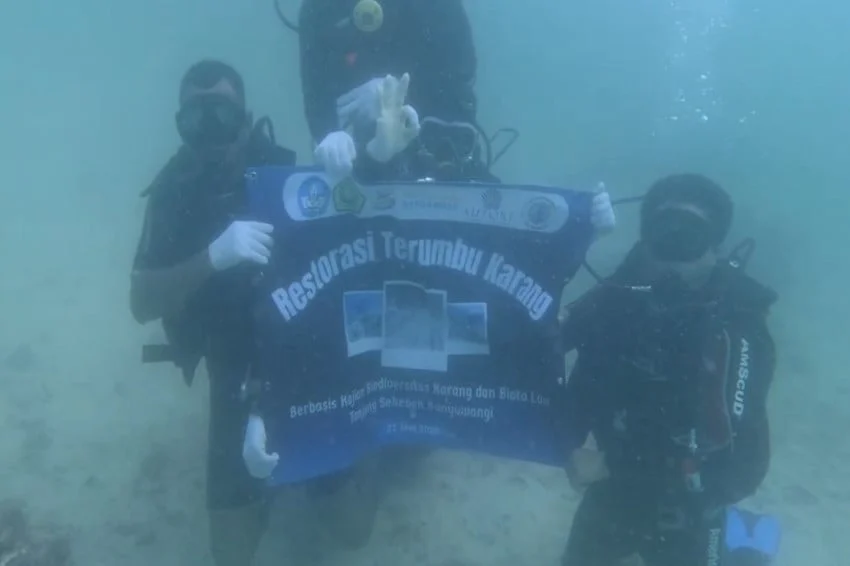
Two months after the strategic planting of 750 coral seedlings in the waters of Tanjung Sekeben, Banyuwangi, an ambitious marine ecosystem recovery effort, spearheaded by the Faculty of Mathematics and Natural Sciences (FMIPA) of Universitas Jember (UNEJ), is now yielding tangible positive environmental impacts. This crucial project, aimed at reversing the severe degradation of local coral reefs, marks a significant milestone in regional conservation, with early monitoring indicating a robust survival rate among the newly planted corals and a noticeable return of marine biodiversity to the restoration site.
The initiative, a collaborative undertaking under the university’s Community Service program, is led by Ratna Dewi Syarifah from FMIPA UNEJ. It benefits from a vital partnership with PT Autore Pearl Culture, an Australian-owned foreign investment company specializing in pearl cultivation, and the Banyuwangi Naval Base (LANAL Banyuwangi). This multi-stakeholder alliance reflects a comprehensive approach to tackling environmental challenges that extend beyond academic research to include corporate social responsibility and national security interests. The initial coral planting event took place on May 21, 2026, targeting areas heavily damaged by environmentally destructive fishing practices.
A Critical Response to Ecological Degradation
The genesis of this restoration program stems from a profound concern over the deteriorating condition of coral reefs in Tanjung Sekeben. Historically, these waters were renowned for their vibrant marine ecosystems, boasting a rich diversity of coral species and an abundance of fish. However, this ecological richness has been severely compromised by the illicit and destructive activities of irresponsible individuals employing methods such as potassium cyanide fishing and the use of fish bombs. These practices, while yielding short-term gains for perpetrators, inflict catastrophic and often irreversible damage on the delicate marine environment, leading to the widespread destruction of coral structures and the decimation of fish populations.
Coral reefs, often referred to as the "rainforests of the sea," are among the most biodiverse ecosystems on Earth, supporting an estimated 25% of all marine species. They play an indispensable role in maintaining the health of the ocean, acting as natural breakwaters that protect coastlines from erosion and storm surges, serving as vital breeding grounds and nurseries for countless fish species, and contributing significantly to global carbon sequestration. For coastal communities, healthy coral reefs are direct lifelines, supporting fisheries, attracting tourism, and providing cultural value. Indonesia, situated at the heart of the Coral Triangle – a global epicenter of marine biodiversity – holds immense responsibility for safeguarding these invaluable resources. The damage observed in Tanjung Sekeben, therefore, represents not just a local environmental problem but a threat to regional ecological stability and the livelihoods dependent on it.
The Collaborative Framework: Science, Industry, and Security
The success witnessed in Tanjung Sekeben is largely attributable to the synergistic collaboration between the three key partners. UNEJ’s FMIPA brings scientific expertise, guiding the selection of coral species suitable for restoration, developing appropriate planting techniques, and implementing rigorous monitoring protocols. Their academic rigor ensures that the project is not only effective but also contributes valuable data to the broader field of marine conservation science. Ratna Dewi Syarifah, the project lead, emphasized the scientific foundation underpinning their approach. "Our team meticulously selected resilient coral species and employed methods designed for optimal survival and growth in the specific conditions of Tanjung Sekeben," she stated. "The early results are incredibly encouraging, validating our scientific methodology and reinforcing the importance of sustained, data-driven conservation efforts."
PT Autore Pearl Culture’s involvement underscores a growing trend of corporate entities integrating environmental stewardship into their core operations. As a company that relies on pristine marine environments for its pearl cultivation, PT Autore has a vested interest in the health of the surrounding waters. Their contribution extends beyond financial support, encompassing logistical assistance, local knowledge, and an understanding of the practical challenges of operating in a marine setting. A representative from PT Autore Pearl Culture highlighted their commitment: "Our business thrives on healthy oceans. Participating in this restoration project is a natural extension of our commitment to sustainability and our corporate social responsibility. We believe in investing in the ecosystems that sustain us and the communities that host us."
The participation of LANAL Banyuwangi provides a critical layer of security and enforcement. Destructive fishing practices often occur under the cover of darkness or in remote areas, making prevention and deterrence challenging. The presence and support of the naval base ensure a safer environment for restoration activities and send a clear message that illegal fishing will not be tolerated. Their involvement is also crucial for community engagement, helping to educate local populations about the importance of marine protection and the consequences of illegal activities. "Protecting our maritime territory and its resources is a core mission of the Indonesian Navy," affirmed a spokesperson from LANAL Banyuwangi. "Our collaboration in this project not only secures the restoration efforts but also strengthens our resolve to combat illegal, unreported, and unregulated fishing that threatens our national marine heritage."
Chronology of Hope and Recovery
The project’s timeline illustrates a methodical approach to restoration:
- Prior to May 2026: Extensive surveys were conducted by the UNEJ team to assess the extent of coral degradation in Tanjung Sekeben. These assessments identified specific areas requiring intervention and determined the most suitable coral species for propagation, often using fragments from healthy donor colonies nearby or from resilient species known to thrive in similar conditions. Community outreach and engagement sessions were also initiated to garner local support and educate residents about the project’s objectives.
- May 21, 2026: The official coral planting event took place. Under the guidance of UNEJ scientists and with the active participation of divers from all three collaborating entities, approximately 750 coral seedlings were carefully attached to various substrates on the seabed. This process typically involves securing coral fragments, often called "nubbins," to artificial structures or directly to stable rock formations, giving them a foundation to grow and colonize.
- May – July 2026 (Two Months Post-Planting): A systematic and continuous monitoring program was initiated. This involved regular underwater inspections by dive teams to check the health of the planted corals, measure their growth, and assess the overall survival rate. Data collected included visual observations of coral color, presence of algae or sediment, and signs of disease or predation. Crucially, observations also extended to the return of marine life, documenting the presence of fish, invertebrates, and other organisms that indicate a recovering ecosystem.
- Current Findings (July 2026): The two-month post-planting assessment revealed highly encouraging results. The survival rate of the 750 coral seedlings has been recorded as "good," exceeding typical expectations for initial restoration phases. This high survival rate suggests the chosen methodology, species, and site selection were appropriate. Furthermore, divers have reported a discernible increase in the diversity and abundance of marine biota around the restored areas, indicating that the new coral structures are already beginning to function as micro-habitats, attracting small fish, crustaceans, and other reef-associated organisms. This early return of biodiversity is a powerful indicator of ecosystem recovery.
The Science Behind Coral Restoration
Coral restoration, while a complex endeavor, typically relies on several key scientific principles. The most common method, fragmentation, involves taking small pieces (fragments) from healthy "donor" coral colonies and growing them in nurseries before out-planting them onto degraded reefs. These fragments, often attached to artificial substrates like metal frames, concrete discs, or even directly to stable rocks using marine epoxy, are given a head start in a controlled environment or directly placed where they can grow. The success of this method hinges on selecting resilient coral species, ensuring proper attachment, and providing a stable, pollution-free environment.
The "survival rate" mentioned in the article is a crucial metric. A high survival rate in the initial months is a strong predictor of long-term success. Factors influencing this rate include water quality, temperature stability, light availability, absence of predators, and crucially, the lack of human disturbance. The return of "marine biodiversity" signifies that the newly established coral colonies are beginning to provide the structural complexity and food sources necessary to support a wider array of marine life, recreating the intricate food webs characteristic of healthy reefs.
Broader Impact and Future Implications
The promising results from Tanjung Sekeben carry significant implications for both local and broader marine conservation efforts:
- Ecological Revival: The immediate ecological impact is the halting and reversal of degradation in specific areas. As the corals grow, they will contribute to increased structural complexity, providing more shelter and feeding grounds for fish and invertebrates. This will lead to a richer, more resilient ecosystem, capable of supporting larger fish populations and greater species diversity. Over time, these restored patches can serve as sources for natural recolonization of adjacent degraded areas.
- Socio-Economic Benefits: For the local communities of Banyuwangi, particularly those dependent on fishing, a healthier reef means more abundant and sustainable fish stocks. This directly translates to improved livelihoods and food security. Furthermore, a thriving marine ecosystem can boost eco-tourism, attracting divers and snorkelers who seek vibrant underwater landscapes, thereby creating new economic opportunities for local residents through guiding services, accommodation, and related businesses. This shift from destructive practices to sustainable engagement with the marine environment is critical for long-term prosperity.
- Policy and Enforcement: The project serves as a powerful testament to the urgent need for stricter enforcement against destructive fishing practices. The success of restoration efforts will be severely undermined if the root causes of degradation—illegal bomb and potassium fishing—are not eradicated. This initiative could galvanize local authorities to increase surveillance, implement more effective deterrents, and educate communities about the legal and ecological consequences of such actions. It highlights the need for a holistic approach that combines restoration with prevention.
- Scientific Advancement and Replicability: The data collected from Tanjung Sekeben will contribute valuable insights into the most effective coral restoration techniques for Indonesian waters. This knowledge can be shared and replicated in other degraded areas across the archipelago, offering a scalable model for marine conservation. The partnership model itself – involving academia, industry, and government – can serve as a blueprint for future large-scale environmental projects.
- Community Empowerment and Education: A key long-term implication is the potential for increased community engagement and awareness. Witnessing the positive transformation of their local marine environment can empower residents to become stewards of their natural heritage, actively participating in monitoring, reporting illegal activities, and adopting sustainable fishing practices. Educational programs linked to the project can foster a deeper understanding of marine ecology and the importance of conservation among the younger generation.
The initial success of the Tanjung Sekeben coral restoration project is more than just a scientific achievement; it is a beacon of hope for marine conservation in Indonesia. It demonstrates that with dedicated effort, scientific expertise, multi-sector collaboration, and sustained commitment, it is possible to heal damaged ecosystems and restore the invaluable natural heritage of our oceans. As the project continues to evolve, the eyes of environmentalists and local communities alike will remain fixed on Banyuwangi, eager to witness the full recovery of its once-thriving underwater paradise.
