
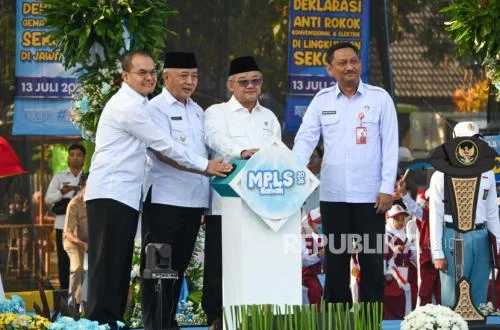
Minister of Primary and Secondary Education (Mendikdasmen) Abdul Mu’ti has officially underscored the critical and strategic positions held by school principals and teachers in the national pursuit of the "Quality Education for All" (Pendidikan Bermutu untuk Semua) vision. Speaking during a recent briefing in Jakarta, the Minister emphasized that the caliber of the national education system is fundamentally anchored in the daily interactions between educators and students. According to Mu’ti, the government’s ambitious goals for human resource development cannot be achieved without the active and inspired participation of those on the front lines of the classroom.
The Minister framed education not merely as a public service but as a profound constitutional mandate. He pointed out that the 1945 Constitution of Indonesia explicitly states that the primary objective of the nation’s founding is to "intellectualize the life of the nation." Article 31 of the Constitution further reinforces this by declaring that every citizen has the right to an education. Mu’ti argued that for the citizenry to become truly intelligent and competitive on a global stage, they must have access to high-quality teaching and learning environments, which are facilitated primarily by school leaders and teaching staff.
Alignment with National Strategic Goals and Asta Cita
The "Quality Education for All" vision is not an isolated policy but a core component of the broader national strategy under President Prabowo Subianto’s administration. It aligns directly with the "Asta Cita"—the eight main aspirations of the current government—which prioritizes the development of superior Indonesian human resources. The administration views education as the primary engine for social mobility and economic prosperity, aiming to prepare the "Golden Indonesia 2045" generation.
To transition these high-level visions into reality, the Ministry of Primary and Secondary Education (Kemendikdasmen) has identified four foundational pillars of infrastructure that will drive the transformation of the educational landscape. These pillars consist of physical infrastructure, pedagogical infrastructure, cultural infrastructure, and legal infrastructure. By focusing on these four areas, the Ministry aims to create a comprehensive ecosystem that supports both the teacher and the learner.
The Four Pillars of Educational Transformation
The first pillar, physical infrastructure, involves the physical environment where learning occurs. The government is committed to a large-scale school revitalization program, particularly targeting schools in rural and underdeveloped regions (3T areas—foremost, outermost, and disadvantaged). This includes the construction of new school units and the rehabilitation of existing structures that no longer meet safety or functional standards. Beyond bricks and mortar, physical infrastructure now includes digital tools. The Ministry is expanding the distribution of Interactive Flat Panels (IFPs) to modernize classrooms, allowing for a more engaging and tech-driven learning experience.
The second pillar, pedagogical infrastructure, focuses on the "how" of teaching. This involves a massive investment in the quality of the teaching force. The government has launched various scholarship programs, competency training modules, and initiatives to improve teacher welfare. Minister Mu’ti has frequently stated that a teacher who is well-compensated and well-trained is more likely to inspire students. Pedagogical transformation also includes the refinement of curricula to ensure they remain relevant to the demands of the 21st-century job market.
The third pillar is cultural infrastructure. This addresses the environment and values within the school system. The Ministry is introducing programs such as "7 Kebiasaan Anak Indonesia Hebat" (7 Habits of Great Indonesian Children) and "Pagi Ceria" (Cheerful Morning) to foster a positive school culture. These programs are designed to build character, discipline, and emotional intelligence among students, ensuring that education produces not just smart individuals, but citizens of high integrity.
The fourth pillar, legal infrastructure, involves the harmonization of regulations. The Ministry is working to simplify and synchronize various education-related laws and local government regulations. This is intended to eliminate bureaucratic hurdles that often prevent schools from accessing funds or implementing new programs. A robust legal framework ensures that the "Quality Education for All" initiative is sustainable and protected across different political cycles.
Supporting Data and National Context
The push for "Quality Education for All" comes at a time when Indonesia is striving to improve its standing in international education benchmarks. According to the 2022 Programme for International Student Assessment (PISA) results, Indonesian students have faced challenges in reading, mathematics, and science scores, which remain below the OECD average. The Minister’s focus on "quality" is a direct response to these findings, moving the conversation from mere "access to education" to "quality of learning outcomes."
Furthermore, Indonesia’s commitment to education is reflected in its state budget (APBN), which mandates that 20% of total government spending be allocated to education. For the 2025 fiscal year, this allocation is expected to continue supporting the revitalization of tens of thousands of classrooms across the archipelago. Data from the Ministry shows that while enrollment rates in primary schools are high, the quality gap between urban centers like Jakarta and remote provinces remains a significant hurdle. The "Quality Education for All" vision specifically aims to bridge this divide.
In terms of the teaching workforce, Indonesia employs over 3.3 million teachers. However, a significant portion of this workforce is approaching retirement age, or currently lacks formal certification. The pedagogical infrastructure pillar is designed to address this by accelerating the Teacher Professional Education (PPG) program, which aims to certify hundreds of thousands of teachers annually to ensure they meet national standards and receive the professional allowances they deserve.
Chronology of the Educational Reform Initiative
The current emphasis on the role of principals and teachers follows a series of strategic meetings and policy reviews held since the inauguration of the new cabinet.
- October 2024: Following the transition of power, the Ministry of Education was restructured into three separate entities to allow for more focused management: the Ministry of Primary and Secondary Education, the Ministry of Higher Education, Science, and Technology, and the Ministry of Culture.
- Early November 2024: Minister Abdul Mu’ti began a series of "roadshows" to various regions, meeting with local education boards and teacher unions (such as PGRI) to gather grassroots feedback on the challenges of the Kurikulum Merdeka (Independent Curriculum).
- Mid-November 2024: The Ministry officially introduced the "Four Pillars" framework during a national coordination meeting in Jakarta. This was the first time the specific focus on "Legal Infrastructure" was highlighted as a top priority.
- Late November 2024: The Minister delivered the speech emphasizing teachers as the "spearhead" of the nation, reinforcing that the Ministry’s role is to provide the "tools" (infrastructure), while the educators provide the "inspiration."
Official Responses and Stakeholder Reactions
The Minister’s statements have garnered significant attention from various education stakeholders. The Indonesian Teachers Association (PGRI) has expressed cautious optimism regarding the focus on teacher welfare and pedagogical support. A spokesperson for PGRI noted that while the vision is commendable, the success of the program will depend on the speed of implementation, particularly regarding the disbursement of teacher allowances and the reduction of administrative burdens on school principals.
Local government officials have also reacted to the call for collaboration. Several governors have pledged to align their provincial education budgets with the Ministry’s four-pillar strategy. "We recognize that the central government cannot do this alone," said a representative from the Association of Indonesian Provincial Governments (APPSI). "The revitalization of physical school buildings in remote areas requires a strong synergy between the APBN (state budget) and APBD (regional budget)."
Education analysts have pointed out that the focus on "Character Education" through the 7 Habits program is a necessary evolution. Dr. Anies Baswedan, a former education minister and academic, has previously noted that the "human component" of education—the relationship between teacher and student—is the most difficult but most important part of the system to fix. Mu’ti’s recent comments suggest a return to this "human-centric" approach.
Broader Impact and Future Implications
The long-term implications of the "Quality Education for All" vision are profound. If successful, the transformation of the four pillars could lead to a more equitable distribution of talent across Indonesia. By improving school quality in rural areas, the government hopes to reduce the "brain drain" to urban centers and stimulate local economies through a more skilled regional workforce.
Moreover, the emphasis on digital infrastructure, specifically the Interactive Flat Panels and digital learning platforms, is expected to prepare Indonesian students for a global economy that is increasingly reliant on technology and artificial intelligence. By integrating these tools early in primary and secondary education, the Ministry is laying the groundwork for a digitally literate population.
However, the Minister was careful to remind the public that technology is only a tool. The ultimate success of the nation lies in the hands of the individuals in the classroom. "The role of bapak-bapak and ibu-ibu (teachers and principals) is greater than my role as a minister," Mu’ti stated. "Because it is you who are present in the classroom. It is you who can inspire. It is you who will give birth to the future ministers of this country."
As Indonesia moves toward its 2045 centennial, the effectiveness of these educational reforms will be a primary determinant of whether the country can transition from a middle-income economy to a high-income, developed nation. The Ministry’s current trajectory suggests a shift toward a more holistic, infrastructure-backed, and teacher-focused strategy that seeks to fulfill the constitutional promise of a "smart" and "educated" Indonesia for every citizen, regardless of their geographic or socio-economic background.
