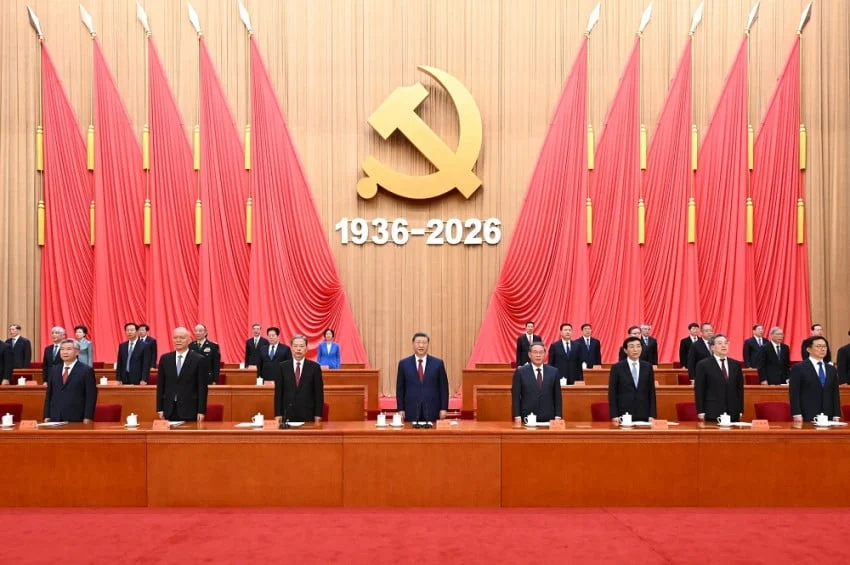
BEIJING — In a significant departure from traditional political sequencing, the top leadership of the Chinese Communist Party (CCP) is convening for a high-stakes, closed-door political gathering in Beijing. While historical precedent dictates that mid-cycle plenums of the Central Committee primarily focus on sweeping macroeconomic blueprints and long-term financial targets, this assembly is charting a radically different course. The core agenda is centered squarely on internal party governance, rigorous institutional discipline, and an intensified campaign of ideological alignment.
Running from October 26 to October 29, the fifth plenary session of the current Central Committee brings together the nation’s political elite to deliberate on mechanisms of self-correction and administrative oversight. Rather than unveiling the latest industrial quotas or gross domestic product growth metrics, the deliberations underscore a growing realization within the upper echelons of the party: that effective governance of the world’s second-largest economy is inextricably linked to absolute control, unwavering loyalty, and the eradication of internal corruption within the massive apparatus of the CCP.
This strategic pivot comes at a critical juncture for Beijing. As the administration of Chinese President Xi Jinping prepares for crucial political transitions and navigates a complex global economic landscape, the leadership is aggressively reinforcing its internal bulwarks. By prioritizing party discipline over fiscal mapping during this specific legislative window, the leadership is signaling that institutional integrity and ideological purity are the absolute prerequisites for achieving the nation’s broader geopolitical and developmental ambitions.
The Chronological Shift: Reordering the Five-Year Planning Cycle
To understand the weight of the current plenary session, one must examine the meticulously structured timeline of Chinese political cycles. Typically, the Central Committee of the Chinese Communist Party convenes for seven distinct plenary sessions over the course of a five-year leadership cycle. Each plenum carries a distinct portfolio of responsibilities, ranging from personnel adjustments and economic overhauls to judicial reforms and cultural development.
In standard political geography, the fifth plenum of a cycle is traditionally reserved for unveiling the foundational framework of the upcoming Five-Year Plan—the master blueprint that dictates China’s industrial policy, infrastructural investments, and socioeconomic targets. However, the current political calendar has witnessed a notable deviation from this established norm.
The fourth plenum, which convened in October 2025, broke with traditional expectations by adopting foundational recommendations for the 15th Five-Year Plan, covering the crucial window from 2026 to 2030. By shifting the economic blueprint forward, the party cleared the slate for the subsequent gathering. Consequently, the current fifth plenum is freed from the immediate pressures of macroeconomic target-setting, allowing the Politburo to direct its undivided attention toward organizational hygiene, bureaucratic efficiency, and the systematic tightening of party rules.
This procedural adjustment was officially confirmed during a high-level Politbiro meeting held on September 21. During that gathering, the elite political body formally announced that a comprehensive draft decision regarding the strengthening of internal party governance would be submitted directly to the upcoming fifth plenum for deliberation and eventual ratification.
Institutional Governance and the Mechanics of Power Consolidation
At the heart of the current plenary discussions is the concept of comprehensive party governance, a pillar of Xi Jinping’s political doctrine. Within the sprawling hierarchy of the Chinese state, the CCP operates as the ultimate engine of power, policy, and execution. With tens of millions of members spread across every tier of government, state-owned enterprises, and civil society institutions, maintaining ideological coherence and administrative discipline is a monumental task.
Political analysts note that the agenda extends far beyond basic bureaucratic management. It represents an ongoing effort to translate sweeping political directives from the top leadership into concrete, enforceable policies at the regional and local levels. Hou Yichao, an independent researcher specializing in Chinese political economy, emphasizes the vital bridging function that plenums serve. According to Hou, these sessions are not merely symbolic; they act as legislative and operational conduits that transform abstract ideological goals into actionable mandates for provincial leaders, municipal administrators, and party cadres.
Furthermore, this institutional tightening must be viewed through the lens of generational political planning. With major leadership perquisites and perestroika-style perromations slated for the 2027 party congress, the current administration is utilizing the intervening windows to ensure that all administrative levers remain firmly under centralized control. By codifying stricter behavioral norms and operational standards, Beijing is actively constructing a prophylactic barrier against factionalism, policy drift, and bureaucratic inertia.
The Ongoing Anti-Corruption Campaign: A Permanent Pillar of Statecraft
No analysis of contemporary Chinese politics is complete without examining the omnipresent anti-corruption campaign, which forms the sharp edge of the party’s self-governance agenda. Launched in earnest over a decade ago, the sweeping anti-graft drive has resulted in the investigation, demotion, or imprisonment of hundreds of thousands of officials, ranging from low-level local bureaucrats to high-ranking "tigers"—elite members of the political and military establishment.
While early phases of the campaign focused heavily on high-profile removals to signal a clean break from past tolerance of illicit enrichment, the current iteration has evolved into a deeply institutionalized system of permanent surveillance. The deliberations in Beijing this week reflect a strategic shift from punitive measures to preventative architecture. The leadership is actively designing mechanisms that close structural loopholes, mandate digital transparency in asset declarations, and institutionalize ideological education within every branch of government.
Chong Ja Ian, an associate professor at the National University of Singapore (NUS) who closely monitors Chinese elite politics, points out that the relentless focus on discipline underscores a fundamental anxiety within the leadership. "When the party’s overarching priority shifts so visibly toward internal rectification, it reveals an acute awareness that bureaucratic compliance cannot be taken for granted," Chong observes. "Maintaining absolute authority requires continuous, systemic maintenance of the political apparatus."
This institutional scrutiny is particularly vital as China confronts multifaceted economic headwinds, including property sector stabilization, local government debt restructuring, and shifting global trade dynamics. In times of economic transition, the central leadership relies on absolute fidelity from local cadres to implement complex fiscal and industrial interventions without domestic friction or localized resistance.
Broader Implications and Global Reactions
The outcomes of this plenary session carry profound implications for both domestic stability and international perceptions of China’s political trajectory. For domestic stakeholders—including private enterprises, state-owned entities, and ordinary citizens—the reinforced emphasis on party discipline signals a predictable, albeit intensely controlled, operating environment. Compliance with central directives remains the ultimate currency of success within the Chinese system.
Externally, foreign governments and multinational corporations monitor these closed-door meetings for insights into Beijing’s long-term administrative reliability. While western observers frequently analyze Chinese political plenums through the prism of economic forecasts, the singular focus on internal governance highlights a different set of priorities. It demonstrates that for the Chinese Communist Party, regime security, ideological unity, and administrative control remain the foundational prerequisites upon which all other national achievements are built.
As the four-day session draws to its conclusion, the official communiques released by state media will be meticulously parsed by global markets and diplomatic corps alike. The resulting documents will not offer the standard tabular data of financial growth or infrastructural expansion; instead, they will provide the definitive textual roadmap for how the world’s most influential political party intends to police its own ranks, manage its vast bureaucracy, and project unified strength into the next critical phase of its governance cycle.