
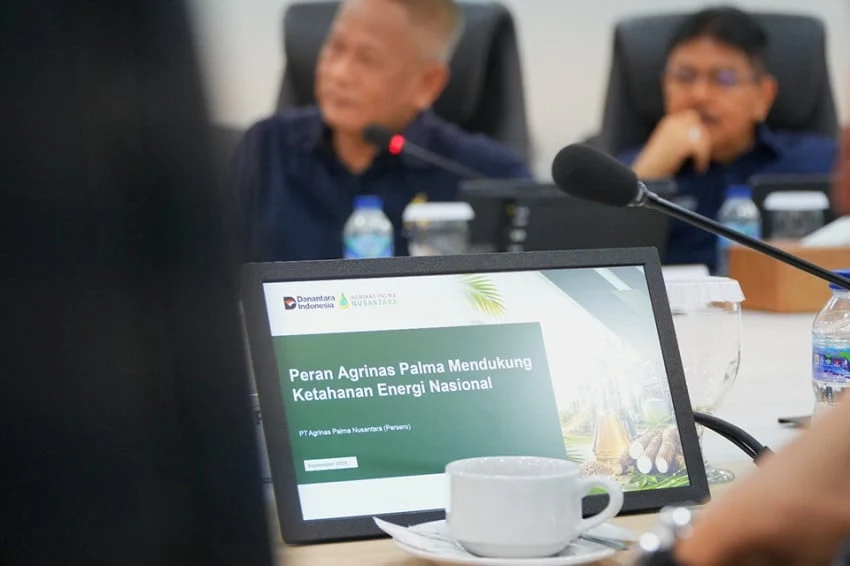
PT Agrinas Palma Nusantara (Persero), alongside PT Pertamina (Persero) and PT Pertamina Power Indonesia, has convened with Deputy Minister of Investment and Downstreaming/Deputy Head of the Investment Coordinating Board (BKPM) Todotua Pasaribu in Jakarta to deliberate on the significant expansion of an integrated bioenergy development cooperation. The high-level strategic meeting, held on Thursday, September 10, marks a pivotal milestone in Indonesia’s ongoing transition toward energy independence, sustainable green infrastructure, and national energy security.
The comprehensive collaboration encompasses a full end-to-end framework spanning the entire bioenergy value chain. This integration includes the reliable upstream provision of sustainable raw materials, advanced processing facilities, robust energy infrastructure, integrated logistics and distribution networks, and guaranteed market off-take arrangements for the final products. By aligning the core competencies of key state-owned enterprises (SOEs) under the strategic guidance of the Ministry of Investment, the initiative seeks to eliminate logistical bottlenecks, optimize operational efficiency, and accelerate the commercialization of renewable fuels across the Indonesian archipelago.
Core Strategic Pillars of the Upstream-to-Downstream Partnership
During the strategic discussions in Jakarta, the leadership of PT Agrinas Palma Nusantara (Persero) emphasized the vast operational potential held by the company, including extensive land banks, managed plantations, advanced production facilities, and a secure pipeline of agricultural raw materials. Mohammad Abdul Ghani, President Director of PT Agrinas Palma Nusantara (Persero), stated that these physical and operational assets are uniquely positioned to synergize seamlessly with Pertamina’s world-class capabilities in energy development, refining technology, and broad market distribution.
Agrinas Palma has committed to anchoring the upstream segment of this partnership by strictly enforcing sustainable agricultural practices and guaranteeing the long-term, uninterrupted availability of biological feedstocks. "This collaboration is strategically designed to form a fully integrated bioenergy ecosystem, stretching cleanly from managed plantations and processing facilities to supporting infrastructure and guaranteed product off-take," said Mohammad Abdul Ghani during the briefing.
The integration of these vital sectors is expected to mitigate supply chain volatilities that have historically impacted the biofuel industry. By securing feedstock directly from managed domestic plantations, the partnership insulates national biodiesel production from international commodity price shocks, ensuring predictable pricing and steady supply volumes for domestic industrial and public consumption. Furthermore, the involvement of Pertamina Power Indonesia brings specialized technical expertise in renewable power generation, carbon management, and green infrastructure development, bridging the gap between raw agricultural output and refined commercial energy products.
Chronology and Milestones of the Bioenergy Expansion
The discussions between the state-owned enterprises and the Ministry of Investment represent the culmination of months of preliminary planning, feasibility assessments, and inter-agency coordination aimed at bolstering Indonesia’s downstream processing mandate.
The timeline of this strategic push began earlier in the fiscal year, as the government intensified its focus on import substitution and renewable energy targets to fulfill international carbon reduction commitments under the Paris Agreement. In the preceding months, technical teams from Agrinas Palma and Pertamina conducted joint audits of potential processing sites, logistical routes, and feedstock yields across key agricultural hubs in Sumatra and Kalimantan.
The high-level meeting on September 10 served as the formal policy alignment phase, where key stakeholders presented consolidated feasibility studies to Deputy Minister Todotua Pasaribu. The Deputy Minister’s office evaluated the strategic alignment of the project with national downstreaming priorities, which seek to maximize the domestic economic value of natural resources rather than exporting raw commodities. Following this crucial governmental review, the participating entities established a joint task force mandated to finalize commercial agreements, environmental impact assessments, and infrastructural financing schemes by the end of the fourth quarter.
The Flagship Reaktivasi of Bayas Biofuels as a Catalyst
A central priority dominating the agenda between the SOE executives and the Ministry of Investment is the strategic reaktivation of the Bayas Biofuels Plant, situated in Indragiri Hulu Regency within Riau Province. This monumental industrial facility boasts a massive production capacity of approximately 600,000 metric tons of Fatty Acid Methyl Ester (FAME) per annum.
The revival of the Bayas Biofuels facility is designated as the foundational pilot project for the broader integrated bioenergy collaboration. By bringing this dormant plant back to full operational capacity, the consortium aims to immediately inject substantial volumes of locally produced biodiesel into the national supply chain.
According to Mohammad Abdul Ghani, the reactivation of the Bayas Biofuels Plant is intentionally structured to become the premier source of FAME supplied directly and entirely by a consortium of state-owned enterprises. This milestone holds immense symbolic and practical significance, as it marks a decisive shift toward strengthening the direct footprint of the Indonesian government in the foundational tiers of the green fuel supply chain. By controlling the asset from raw material input through to refined FAME output, the state can more effectively manage national energy reserves, stabilize retail and industrial fuel prices, and guarantee compliance with national biodiesel blending mandates, such as the progressive B35 and upcoming B40 programs.

Socio-Economic Implications: Employment and Regional Development
Beyond its direct contributions to the energy sector, the large-scale development of an integrated bioenergy ecosystem carries profound socio-economic implications for regional development and employment generation across Indonesia.
Recent economic projections and industry analyses indicate that the systematic expansion of the national bioenergy sector possesses the remarkable capacity to create up to 150,000 new jobs across various skill levels. These employment opportunities will not be concentrated solely in urban manufacturing centers but will be broadly distributed across rural agrarian communities, particularly in provinces heavily reliant on plantation economies such as Riau, Jambi, North Sumatra, and parts of Kalimantan.
The upstream components—ranging from sustainable plantation management, harvesting, and localized transport—will absorb a significant portion of the rural workforce, thereby elevating local household incomes and stimulating regional economies. Simultaneously, the midstream and downstream segments, encompassing the operation of high-tech processing complexes like the Bayas facility, chemical refinement plants, laboratory testing, and heavy logistics management, will demand specialized technical personnel, engineers, plant operators, and administrative professionals.
Deputy Minister Todotua Pasaribu underscored that the Ministry of Investment views downstreaming not merely as an industrial strategy for export enhancement, but as a comprehensive engine for equitable wealth distribution and poverty alleviation. By embedding sustainable energy production directly within traditional agricultural regions, the government aims to stem rural-urban migration, foster regional industrial clusters, and transfer advanced technological skills to local labor pools.
Strategic Alignment with National Energy Independence Goals
The partnership between Agrinas Palma Nusantara, Pertamina, and Pertamina Power Indonesia operates as a vital pillar supporting Indonesia’s overarching grand strategy for structural economic transformation and national energy sovereignty.
As global geopolitical tensions continue to introduce unpredictable fluctuations into international crude oil markets, Indonesia’s heavy historical reliance on imported fossil fuels has exposed its fiscal stability to external vulnerabilities. The systematic transition toward domestically sourced, agriculturally derived bioenergy provides an effective structural hedge against these external shocks.
By scaling up the production of FAME and advanced biofuels, Indonesia can significantly reduce its dependence on foreign petroleum imports, thereby improving its current account balance and conserving vital foreign exchange reserves. Furthermore, this initiative directly supports Indonesia’s enhanced Nationally Determined Contribution (NDC) targets and the long-term national commitment to achieving Net Zero Emissions (NZE) by 2060 or sooner.
The integration of agricultural waste streams and sustainable palm oil derivatives into the national fuel mix demonstrates a balanced approach to economic development that harmonizes agricultural productivity with environmental stewardship. The strict sustainability protocols enforced across the Agrinas-Pertamina supply chain ensure that land use changes are managed responsibly, protecting high-conservation-value areas while maximizing the yield efficiency of existing agricultural estates.
Future Outlook and Next Steps for the Consortium
With the conclusion of the high-level policy discussions in Jakarta, the collaborating entities are swiftly transitioning from conceptual planning to operational execution. The immediate roadmap requires the finalization of legal frameworks, shareholder agreements, and investment structures necessary to mobilize capital expenditure for the Bayas Biofuels plant overhaul.
Technical teams from Pertamina and Agrinas Palma are currently stationed at the Indragiri Hulu site in Riau to conduct exhaustive engineering assessments of the existing machinery, electrical grids, and waste management systems. Procurement processes for upgraded processing technology and environmental mitigation equipment are slated to commence shortly, with plant modernization efforts expected to ramp up over the coming months.
As Indonesia positions itself as a regional leader in the global green economy, the integrated bioenergy initiative spearheaded by Agrinas Palma, Pertamina, and the Ministry of Investment serves as a blueprint for effective inter-agency collaboration. By leveraging state assets to build a self-sustaining, secure, and environmentally responsible energy architecture, the nation is laying a durable foundation for sustainable prosperity, energy independence, and industrial resilience for decades to come.
