
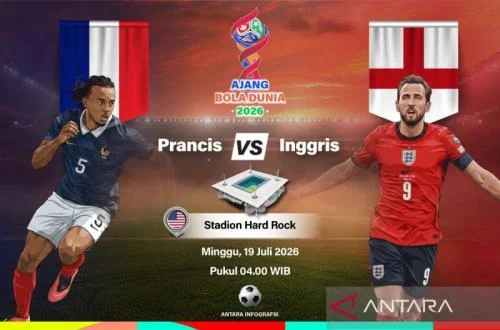
Miami, United States – The stage is set for a compelling encounter as France prepares to face England in the 2026 FIFA World Cup third-place play-off. The highly anticipated match will take place at the iconic Hard Rock Stadium in Miami on Sunday, July 19, with kick-off scheduled for 04:00 AM Western Indonesia Time (WIB). While both European giants arrive in Florida nursing the sting of semi-final defeats, the historical rivalry and the prestige of a bronze medal promise a fiercely contested battle. Les Bleus enter the fixture with a notable psychological advantage, having historically outperformed their cross-Channel adversaries in direct confrontations.
The statistical ledger, meticulously maintained by FIFA, reveals a consistent trend favoring the French national team. Since their inaugural meeting in 1966, France and England have locked horns on nine separate occasions. Of these nine contests, France has emerged victorious in five, showcasing a clear historical dominance. In contrast, England has secured three wins, with only one match concluding in a draw, further solidifying France’s statistical upper hand heading into Sunday’s pivotal clash. This historical context adds an intriguing layer to what is already expected to be a high-stakes encounter, as both nations seek to conclude their World Cup campaigns on a positive note.
A Deep-Rooted Rivalry: Beyond the Football Pitch
The sporting rivalry between France and England is not merely confined to the football field; it is a modern extension of centuries of geopolitical and cultural interplay. From the Norman Conquest to the Napoleonic Wars, and through two World Wars, the relationship between these two powerful European nations has been defined by periods of intense competition and reluctant cooperation. This historical backdrop imbues every sporting contest with an added layer of significance, transforming friendly matches into contests of national pride and major tournament encounters into epic sagas. For fans on both sides of the Channel, a victory over the other is not just a win; it is a reaffirmation of national identity and sporting prowess.
In football, this rivalry has blossomed, particularly in the latter half of the 20th century and into the 21st, as both nations developed into global footballing powerhouses. France, with its flair and tactical sophistication, and England, with its traditional grit and passionate support, have often produced memorable encounters. The 2026 World Cup third-place play-off is another chapter in this rich history, offering both teams a chance to etch their names into the annals of this enduring rivalry, albeit for the consolation of third place.
The Path to Miami: A Tale of Two Semi-Final Heartbreaks
Both France and England arrived in the 2026 FIFA World Cup with immense expectations, touted as pre-tournament favorites given their consistent performances in recent major competitions. France, as the defending champions from 2022 (or a recent finalist), and England, with their deep squad and tactical evolution, were widely anticipated to meet in the final. Their respective journeys through the group stages and knockout rounds were largely dominant, marked by stellar individual performances and cohesive team play, further fueling hopes of ultimate glory.
France’s hypothetical semi-final defeat, perhaps a narrow loss to a formidable South American or another European rival after an extended period of dominance, would have been particularly crushing. Having tasted the ultimate success, the failure to reach consecutive finals would sting deeply. Imagine a scenario where a late goal or a penalty shootout heartbreak denied Les Bleus their chance at a historic back-to-back triumph. The emotional toll on a squad accustomed to winning would be significant, making the third-place match a test of their mental fortitude and resilience.
Similarly, England’s semi-final exit would represent another chapter in their long quest for a major international trophy since 1966. Having perhaps navigated a challenging draw and overcome strong opponents, only to falter at the penultimate hurdle, would undoubtedly leave a profound sense of disappointment among players, staff, and the fervent English fanbase. A hypothetical defeat, possibly against a technically superior side or due to a moment of individual error, would reignite familiar questions about their ability to perform under the most intense pressure. For Gareth Southgate, or his successor, and his squad, the third-place match becomes an opportunity to demonstrate character and finish the tournament with dignity, salvaging some pride from a campaign that promised so much more.
Head-to-Head Analysis: France’s Enduring Edge Since 1966
The head-to-head record between France and England since 1966 offers a fascinating chronicle of their evolving footballing fortunes. While England held the early advantage, France has steadily asserted its dominance in more recent decades, particularly as French football experienced a renaissance.
-
Early Encounters and World Cup Clashes (Pre-2000s):
The earliest recorded World Cup meetings favored England. The first came in the 1966 World Cup group stage, famously won by England, 2-0, a significant result on their path to lifting the trophy on home soil. Goals from Roger Hunt secured the victory in a match that set the tone for England’s eventual triumph. Another World Cup encounter occurred in 1982, where England again triumphed, winning 3-1 in the group stage, with Bryan Robson notably scoring one of the fastest goals in World Cup history at the time. These early victories cemented England’s status as the superior footballing nation in the minds of many. However, these victories represent a bygone era, preceding France’s golden generation. -
A Shift in Momentum: France’s Ascendancy (2000s Onwards):
The turn of the millennium witnessed a significant shift. As France produced a golden generation of players, culminating in their 1998 World Cup and Euro 2000 victories, their head-to-head record against England began to improve dramatically. They started winning more regularly, often displaying a blend of technical brilliance and tactical acumen that England sometimes struggled to match. This period saw France establish itself as a perennial contender on the international stage, a status they have largely maintained. -
Key Matches in Detail:
- Euro 2012 Group Stage (1-1 Draw): This encounter at the Donbass Arena in Ukraine was a cagey affair. Joleon Lescott gave England the lead with a header, but Samir Nasri equalized for France with a powerful long-range shot. The draw reflected the cautious approaches of both teams, each keen to avoid defeat in their opening group game of a major tournament. It underscored the growing parity between the two nations, albeit with France often perceived as having more individual brilliance.
- 2015 Friendly (England 2-0 France): Played at Wembley, this friendly match saw England secure a relatively comfortable 2-0 victory. Goals from Dele Alli and Wayne Rooney provided the goals. While a friendly, the result offered a brief moment of English ascendancy and a morale boost, demonstrating that they could indeed overcome their rivals, even if the stakes were not as high as a competitive fixture. This match is often cited by English fans as a rare recent highlight against Les Bleus.
- 2022 World Cup Quarter-final (France 2-1 England): This was arguably the most significant recent clash. In a dramatic quarter-final in Qatar, France edged out England 2-1. Aurelien Tchouameni opened the scoring for France, but Harry Kane equalized from the penalty spot. Olivier Giroud then put France ahead again, and despite a second penalty awarded to England, Kane shockingly blazed his effort over the bar, sealing England’s fate. This match was a brutal lesson for England and a testament to France’s big-game mentality, reaffirming their psychological edge in high-pressure World Cup scenarios. It stands as the most recent competitive meeting and a stark reminder of France’s ability to deliver when it matters most.
The 2026 World Cup Stage: Hard Rock Stadium, Miami
The choice of Hard Rock Stadium in Miami as the venue for the third-place play-off adds another layer of intrigue to the contest. Miami, a vibrant, multicultural hub renowned for its stunning beaches, bustling nightlife, and passionate sports fans, is an ideal host city for a major World Cup fixture. The Hard Rock Stadium itself is a state-of-the-art facility, capable of accommodating over 65,000 spectators, and is well-versed in hosting high-profile sporting events, including Super Bowls and international football friendlies.
For the players, competing in Miami offers a unique experience. The warm, humid climate will be a factor, demanding peak physical conditioning. For fans, Miami provides an unparalleled atmosphere, combining the thrill of World Cup football with the allure of a popular tourist destination. The presence of significant French and English expatriate communities, alongside a strong global football fanbase, guarantees a vibrant and electric atmosphere, with supporters from both nations traveling in droves to cheer on their teams. The city’s energy will undoubtedly contribute to the spectacle, ensuring that even a consolation match feels like a grand occasion.
Managerial Perspectives and Player Motivations
Despite the disappointment of missing out on the final, both national teams and their coaching staff will approach the third-place play-off with seriousness and a clear objective: to finish the tournament with a victory and a bronze medal.
-
Coaches’ Drive for Consolidation:
For Didier Deschamps, or his potential successor for France, the message will be clear: pride, professionalism, and performance. Even if the ultimate prize eluded them, securing third place demonstrates resilience and maintains the team’s standing among the world’s elite. It also offers an opportunity to experiment tactically or give minutes to squad players who might not have featured prominently, providing valuable experience for future tournaments. A hypothetical quote from the French coach might be, "While the sting of the semi-final defeat is still fresh, we are professionals. We owe it to ourselves, to our nation, and to our fans to finish this World Cup strong. Third place is not the final, but it is a testament to our quality and character."For England’s manager, the motivation will be equally strong, if not more so, given the prolonged wait for silverware. A third-place finish would represent England’s best World Cup performance since 1966 (or perhaps equal to 1990 if they secured 4th then), a significant achievement that could build momentum for future campaigns. It’s an opportunity to end a challenging tournament on a high, restoring some confidence and demonstrating progress. The English coach might articulate, "We are incredibly disappointed not to be in the final, but this game is about pride and showing what we’re made of. We want to go home with a medal, and we want to deliver a performance that reflects the talent and spirit within this squad."
-
Player Ambitions: Ending on a High:
For the players, the motivation will be multifaceted. For veteran players, it could be a final World Cup appearance, and leaving with a medal, regardless of its color, is a cherished achievement. For younger players, it’s a chance to make a statement, to gain invaluable big-game experience, and to prove their worth on the global stage. There’s also the personal satisfaction of contributing to a positive team outcome. Individual accolades, such as the Golden Boot or Golden Ball, might still be within reach for some players, adding another layer of motivation. Furthermore, the chance to overcome a direct rival like England or France always provides an extra spark, transforming the match into more than just a consolation prize.
Strategic Outlook for the Match
The tactical approach to a third-place play-off can often differ from a semi-final or final. With the immense pressure of reaching the ultimate game lifted, teams sometimes play with more freedom, leading to more open and entertaining encounters.
France, with its wealth of attacking talent, might be inclined to play a more expressive, free-flowing game. Their dynamic forwards and creative midfielders could exploit any defensive lapses. Given their historical edge and recent success against England, they might approach the game with a greater sense of confidence, aiming to assert their dominance early.
England, on the other hand, might focus on a disciplined defensive structure combined with quick transitions and set-piece prowess, which have been hallmarks of their play. They will be keen to avoid another defeat to France and will view this as an opportunity for tactical redemption. The desire to avenge the 2022 quarter-final loss will also be a potent motivator, potentially leading to a more aggressive and determined performance. Both teams might also utilize their deeper squad players, providing fresh legs and new tactical options, which could lead to unpredictable formations and player matchups.
Implications Beyond the Pitch
The outcome of the third-place play-off extends far beyond the final whistle, carrying significant implications for both federations, players, and their respective footballing futures.
-
FIFA Ranking Points and Seeding:
Securing third place over fourth has tangible benefits in terms of FIFA World Ranking points. A higher ranking can influence future tournament seedings, potentially leading to more favorable draws in subsequent World Cups or continental championships. This subtle advantage can be crucial in the long-term strategic planning of national federations. -
Financial Rewards:
There is a considerable financial difference between finishing third and fourth at the World Cup. FIFA awards significant prize money based on tournament performance, and the additional millions for a bronze medal can be reinvested into youth development programs, infrastructure improvements, or other national football initiatives. -
Psychological Impact and Future Prospects:
Perhaps most importantly, finishing third provides a psychological boost. It demonstrates resilience and the ability to bounce back from disappointment. For France, it reinforces their status as a consistently top-tier nation. For England, it could signify progress and a strong foundation for the UEFA Euro 2028 campaign and the next World Cup cycle. A positive ending can galvanize the squad, maintain fan optimism, and ease any managerial pressure. Conversely, a fourth-place finish might leave a lingering sense of unfulfilled potential, potentially leading to more critical introspection. -
Legacy and Records:
Every World Cup match contributes to the national team’s legacy. A bronze medal adds to the trophy cabinet and history books, distinguishing the team from those who finished just outside the podium. For individual players, it’s a tangible recognition of their efforts and a memory they will carry throughout their careers.
As the two titans prepare to clash in Miami, the 2026 World Cup third-place play-off promises not just a battle for a bronze medal, but a continuation of one of international football’s most compelling rivalries. With France holding the historical edge but England eager for redemption, the Hard Rock Stadium is set to witness a captivating conclusion to their respective World Cup journeys, a contest driven by pride, passion, and the desire to end on a winning note.
