
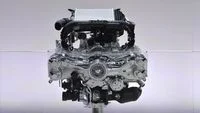
Japanese automaker Subaru Corporation has officially confirmed that it is actively developing a highly anticipated, next-generation internal combustion boxer engine aimed at significantly improving fuel efficiency and reducing carbon emissions. This strategic announcement follows initial public previews of the proprietary powertrain technology held in October, signaling the brand’s long-term commitment to traditional engine architectures even as the global automotive industry undergoes a massive transition toward electrification.
The newly engineered powerplant is specifically designed to serve as a versatile foundation for both conventional gasoline-powered vehicles and upcoming hybrid electric models destined for key international markets, with a primary focus on the United States. Despite sweeping industry shifts toward Battery Electric Vehicles (BEVs), Subaru’s executive leadership has remained steadfast in preserving the mechanical layout that has defined the brand’s identity for decades.
The Enduring Legacy of the Boxer Engine
The horizontally opposed engine, universally known as the boxer engine, has been a cornerstone of Subaru’s engineering philosophy since the introduction of the layout in the late 1960s. Unlike traditional inline or V-type engines where the pistons move upward and downward or at an angled V-formation, a boxer engine features pistons that lie flat and move horizontally inward and outward against each other, resembling a boxer throwing punches.
This unique opposing movement creates a naturally balanced mechanical state. The lateral motion inherently cancels out primary and secondary engine vibrations, which drastically reduces the need for heavy balancing shafts. Consequently, the layout delivers lower center of gravity characteristics, significantly enhancing vehicle stability, cornering dynamics, and overall handling precision. When combined with Subaru’s trademark Symmetrical All-Wheel Drive (AWD) system, the boxer engine has long provided a distinct driving signature that resonates deeply with enthusiasts and everyday consumers alike. Today, virtually every internal combustion vehicle produced by Subaru utilizes a boxer engine, save for specific models sourced through original equipment manufacturer (OEM) supply agreements with third-party partners.
Addressing the Efficiency Gap: Overcoming Thermal Limitations
Despite its undeniable dynamic advantages, the traditional boxer engine architecture has historically struggled to match the fuel efficiency figures of competing inline configurations. Market comparisons highlight this disparity clearly. For instance, the Subaru Levorg equipped with a 1.8-liter turbocharged engine achieves an average fuel economy of roughly 13.8 kilometers per liter. In contrast, comparable competitors utilizing inline engines—such as the Honda Civic powered by a 1.5-liter turbocharged engine—routinely achieve approximately 15.7 kilometers per liter under similar driving conditions.
Engineers explain that this efficiency lag stems from fundamental geometric constraints. Because the engine must fit neatly within the transverse engine bay while accommodating symmetrical drivetrain components, the width of the engine bay dictates strict physical limits. As a result, boxer engines traditionally adopt a "short-stroke" configuration, where the piston stroke length is relatively short compared to the cylinder bore diameter.
While this configuration is exceptionally well-suited for generating high-end power at elevated revolutions per minute (RPM), it creates a wider surface area within the combustion chamber. A larger surface area inevitably leads to higher thermal energy loss through the cylinder walls, lowering overall thermal efficiency. Currently, standard Subaru boxer engines achieve a thermal efficiency rating of roughly 40 percent, which aligns with industry averages but falls short of the ultra-high efficiency benchmarks set by modern hybrid-focused inline engines.
To bridge this efficiency gap without abandoning the iconic platform, Subaru’s engineering teams are heavily leaning on advanced turbocharging and fluid-dynamics technologies refined over decades of motorsport and passenger car development. The intake systems on the next-generation engines are being completely redesigned to optimize tumble and swirl air flows inside the combustion chambers. Simultaneously, higher-pressure turbochargers are integrated to force denser air charges into the cylinders, ensuring a leaner, more complete air-fuel mixture.
Subaru engineers have noted that pushing this redesigned architecture to its current mechanical limits could theoretically elevate thermal efficiency to approximately 45 percent. However, achieving an even higher threshold—such as 50 percent efficiency—would likely require decoupling the engine from direct wheel drive entirely, transforming it into a dedicated stationary generator for range-extended hybrid applications. For the time being, however, the automaker has ruled out a pure generator configuration, opting instead for a versatile system where the next-generation engine directly drives the wheels while seamlessly integrating with hybrid motor systems.
Strategic Pivots Amid Shifting Market Demands
The decision to double down on an advanced internal combustion and hybrid-compatible boxer engine aligns closely with recent market dynamics, particularly in North America. Over the past year, demand growth for purely battery-electric vehicles in the United States has experienced a noticeable slowdown, constrained by infrastructure gaps, pricing pressures, and evolving consumer preferences. Conversely, consumer appetite for hybrid electric vehicles (HEVs) has surged dramatically, prompting legacy automakers to recalibrate their medium-term product strategies.
Subaru’s global sales trajectory underscores the urgency of refreshing its powertrain portfolio. After reaching an all-time corporate sales record of approximately 1.06 million units during the 2017 fiscal year, the brand’s global volume has stagnated, hovering around the 900,000-unit mark annually over recent years. By introducing flexible powertrain options that cater directly to the rising demand for efficient hybrids in the U.S. and other core territories, Subaru hopes to revitalize its sales momentum.
External Validation from Global Competitors
Interestingly, Subaru is not alone in recognizing the hidden potential of the horizontally opposed layout in the modern era of electrification. Major Chinese automotive conglomerates have begun exploring the boxer engine concept for advanced plug-in hybrid electric vehicle (PHEV) applications. Automakers such as BYD have invested in developing proprietary boxer engines, deploying a 2.0-liter turbocharged variant within luxury plug-in hybrid offerings under their premium Yangwang brand. Meanwhile, other major Chinese players including Chery and Geely are reportedly conducting advanced research into similar configurations.
The adoption of the boxer layout by aggressive new-energy vehicle manufacturers has served as external validation for Subaru’s engineering choices. Company executives have openly acknowledged that seeing competitors invest in the architecture reinforces their belief in the long-term viability of the design.
As regulatory pressures mount and consumers demand greener yet practical mobility solutions, Subaru’s multi-billion-dollar bet on a cleaner, highly efficient boxer engine represents a calculated defense of its engineering heritage. By successfully merging its signature mechanical identity with cutting-edge thermal optimization and hybrid integration, the Japanese manufacturer aims to secure a competitive foothold in a rapidly evolving global automotive market.
