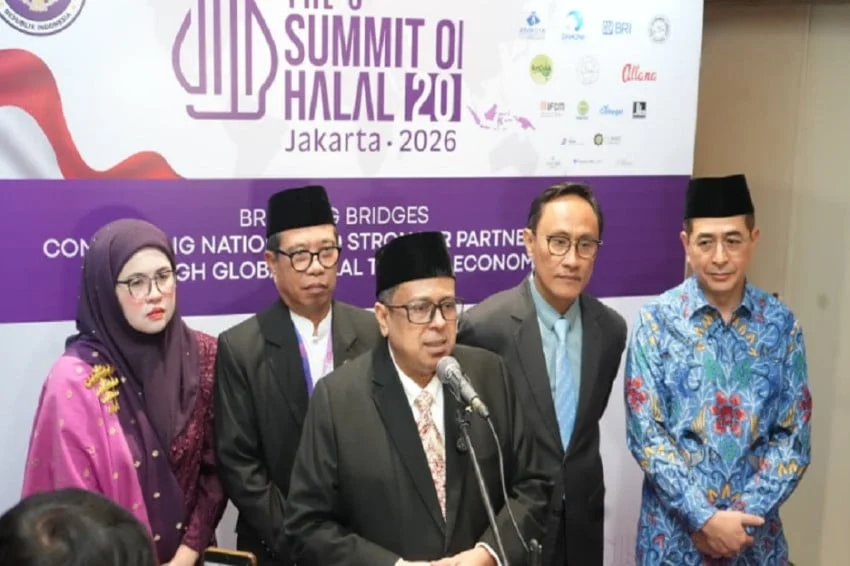
The Halal industry has transcended its traditional boundaries, evolving from a niche religious observance into a multi-trillion-dollar global economic powerhouse. Recognizing this shift, the Halal Product Assurance Organizing Agency (BPJPH) of Indonesia recently convened the 5th Summit of Halal 20 (H20) in Jakarta. The high-profile international forum brought together delegates from 48 nations, representing a pivotal moment in the standardization and global synchronization of halal certification, trade, and economic cooperation.
Under the theme “Bridging Bridges: Connecting Nations & Stronger Partnerships through Global Halal Trade & Economy,” the summit served as a strategic platform to address the fragmentation currently present in the global halal market. By gathering 450 participants—including government ministers, regulatory authorities, and industry leaders—the event aimed to dismantle trade barriers and foster a more inclusive, integrated global halal ecosystem.
A Strategic Gathering of Global Stakeholders
The significance of the 5th H20 Summit was underscored by the presence of high-ranking Indonesian officials, signaling the government’s commitment to positioning Indonesia as the global hub for the halal economy. Notable attendees included the Coordinating Minister for Human Development and Culture, Pratikno; the Minister of Creative Economy, Teuku Riefky Harsya; and the Minister of Micro, Small, and Medium Enterprises (MSMEs), Maman Abdurrahman. The presence of the Special Envoy to the President for MSMEs, Creative Economy, and Digital Affairs, Ahmad Ridha Sabana, highlighted the government’s focus on integrating small-scale producers into the international supply chain.
International participation was equally robust, reflecting the geopolitical importance of halal trade. The summit hosted the Deputy Prime Minister of Malaysia, Dato’ Seri Ahmad Zahid bin Hamidi, and the Minister of Food and Drug Safety from the Republic of Korea, Yu-Kyoung Oh. Furthermore, the inclusion of leaders such as the Chair of B57+ Asia Pacific, Arsjad Rasjid, along with various ambassadors and international halal certification bodies, transformed the summit into a multilateral diplomatic arena for economic policy alignment.
The Evolution of the H20 Forum: A Chronological Context
The H20 forum has grown significantly since its inception. Originally conceived as a dialogue platform during Indonesia’s G20 presidency, it has matured into an independent, permanent fixture in the global economic calendar.
- 2022: The inaugural H20 was launched as a side event of the G20, aiming to harmonize halal standards among the world’s largest economies.
- 2023-2024: Subsequent summits focused on technical aspects, such as the mutual recognition of halal certification bodies and the digitization of traceability systems.
- 2026 (The 5th Summit): The current iteration marks a shift from discussion to active implementation, focusing on “Bridging Bridges.” The objective is no longer merely to discuss standards but to build the physical and digital infrastructure that allows a halal-certified product in Indonesia to be instantly recognized and accepted in South Korea, the Middle East, and beyond.
The Economic Imperative: Why Global Standardization Matters
The global halal market is projected to reach unprecedented valuations by the end of the decade. According to the State of the Global Islamic Economy (SGIE) Report, the Muslim population is growing at a rate faster than the global average, with spending on halal-certified products—spanning food, pharmaceuticals, cosmetics, and tourism—estimated to exceed $3 trillion annually.
However, the lack of a single, universally accepted halal standard remains a significant non-tariff trade barrier. Currently, different countries and certification bodies maintain varying criteria for what constitutes “halal.” This inconsistency forces businesses to navigate a complex web of certifications to export their goods, which disproportionately affects MSMEs.
By pushing for a unified regulatory framework, the H20 summit addresses the "cost of compliance." When certification processes are harmonized, the time and financial resources required for SMEs to enter foreign markets are drastically reduced. This democratization of the halal market is a core pillar of the Indonesian government’s strategy to bolster its own export economy while facilitating broader global trade.
Official Responses and Strategic Directions
During the proceedings, representatives emphasized that halal certification is increasingly viewed as a hallmark of quality and hygiene, extending its appeal beyond the Muslim consumer base to the ethical-conscious consumer market.
Minister Maman Abdurrahman highlighted the role of MSMEs, noting that for small businesses, the challenge is not just producing quality goods, but gaining the international trust required for cross-border trade. He stated that the government’s efforts to simplify the certification process through BPJPH are not just about religious compliance but about enhancing the global competitiveness of Indonesian products.
Conversely, international partners like the Republic of Korea underscored the growing interest in halal markets from non-Muslim-majority nations. Minister Yu-Kyoung Oh’s participation highlights that the halal economy is now a strategic priority for nations seeking to diversify their export destinations and tap into the robust purchasing power of the global Muslim demographic. The cooperation between Indonesia and South Korea, particularly in food safety standards, serves as a model for how non-traditional halal players can integrate into the supply chain.
Challenges and Future Implications
Despite the optimism expressed at the summit, the path toward a truly integrated global halal ecosystem is fraught with technical and political challenges.
- Regulatory Sovereignty: Every nation has its own domestic laws regarding food safety and religious practice. Aligning these with an international standard requires significant political will and the potential amendment of national laws.
- Digital Traceability: As the world moves toward blockchain and IoT, the challenge lies in creating a unified digital ledger that can track the halal status of a product from "farm to fork." The summit discussions touched upon the necessity of technological cooperation to ensure that certification data remains tamper-proof.
- Mutual Recognition Agreements (MRAs): The ultimate goal of the H20 is the expansion of MRAs. While Indonesia has made strides in signing agreements with various countries, the summit serves as a reminder that these bilateral deals need to be scaled into a multilateral framework to be truly effective.
The Broader Impact on Global Trade
The implications of the 5th H20 Summit extend far beyond the immediate economic gains. By creating a unified halal trade zone, the participating nations are essentially creating a new economic bloc. This bloc prioritizes supply chain transparency, ethical production, and shared standards.
For Indonesia, the success of this summit solidifies its role as a leader in the global Islamic economy. As the country with the world’s largest Muslim population, Indonesia is uniquely positioned to define the narrative of the halal industry. The focus on “connecting nations” is a clear signal that the government aims to move away from protectionist policies and toward a model of global partnership.
Moreover, the emphasis on the creative economy and digital assets suggests that the definition of "halal" is expanding. It is no longer just about meat processing or food ingredients; it now encompasses halal-friendly tourism, digital finance, and creative content. The inclusion of the Minister of Creative Economy in the summit discussions points to a future where Indonesia’s creative exports—such as fashion, design, and media—are marketed with a “halal-friendly” certification, opening up new avenues for growth.
Conclusion: A Foundation for the Future
The 5th Summit of Halal 20 has successfully set the agenda for the next phase of the global halal industry. By bringing together 48 nations, the summit has provided the momentum necessary to move from fragmented, local regulations to a cohesive, global standard.
As the delegates return to their respective countries, the real test will be the implementation of the “Bridging Bridges” initiative. The success of the H20 will ultimately be measured by the increase in cross-border halal trade volume and the ease with which MSMEs can navigate international markets. With Indonesia at the helm, the global halal economy is entering a period of unprecedented professionalization and integration, setting the stage for a more interconnected and prosperous future for all stakeholders involved in the global halal supply chain. The Jakarta summit has proven that the halal economy is no longer a peripheral concern, but a central driver of international trade and cooperation in the 21st century.