
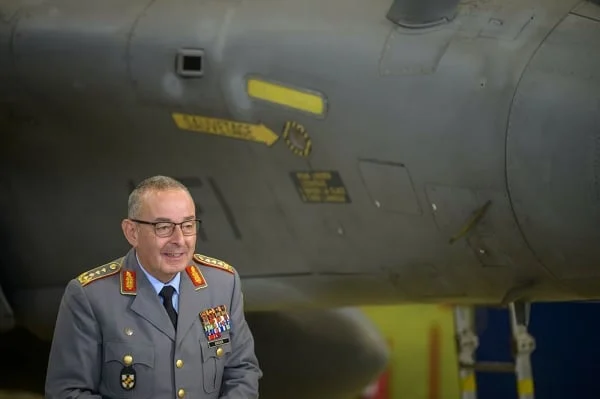
BERLIN — In a decisive move underscoring the shifting geopolitical gravity of European security, German General Carsten Breuer has been elected as the next chair of the NATO Military Committee. The appointment, finalized during the alliance’s annual military committee conference in Copenhagen on Saturday, places one of Germany’s most prominent military strategists at the helm of the organization’s highest military authority. Breuer, who currently serves as the Inspector General of the Bundeswehr, will succeed Italian Navy Admiral Giuseppe Cavo Dragone. His prestigious three-year term is officially scheduled to commence in the summer of 2027.
The selection of General Breuer occurs at a critical historical juncture for the North Atlantic Treaty Organization. As member states accelerate efforts to overhaul their armed forces and establish a credible deterrent against mounting eastern threats—predominantly driven by the protracted conflict in Ukraine and broader regional tensions with Russia—Breuer’s appointment signals a profound institutional acknowledgment of Berlin’s growing military and strategic footprint within the transatlantic alliance.
The Road to Copenhagen: The Election and Transition Process
The process leading to General Breuer’s appointment involved intensive deliberations among the chiefs of defense of NATO’s member nations. Meeting in the Danish capital, military leadership evaluated candidates capable of steering the alliance through an era marked by complex conventional threats, rapid technological evolution, and the imperative of enhanced force readiness.
The NATO Military Committee serves as the primary forum for consensus-building among the military leadership of all member countries. It functions as the direct conduit of military advice to the North Atlantic Council and the Nuclear Planning Group, translating political mandates into strategic military directives. By choosing Breuer, the alliance has opted for a leader deeply entrenched in modern defense transformation, crisis management, and large-scale military restructuring.
Admiral Giuseppe Cavo Dragone, the incumbent chair, will hand over the responsibilities to Breuer in mid-2027. This transition window provides the German military chief ample time to complete his ongoing domestic modernization initiatives while preparing for the immense multilateral responsibilities of coordinating the defense policies and operational doctrines of 32 allied nations.
Profile of a Modern Strategist: Who is General Carsten Breuer?
Carsten Breuer’s trajectory within the Bundeswehr has been defined by crisis response, operational pragmatism, and institutional reform. Before ascending to the role of Inspector General in 2023—the highest-ranking military position in the German armed forces—Breuer commanded widespread national respect for his leadership during civilian-military operations.
Notably, Breuer headed Germany’s nationwide Corona Crisis Task Force from late 2021 to early 2022, where he coordinated the logistical deployment of the military to assist civil health authorities. This high-visibility assignment showcased his capacity for cross-sector coordination and crisis management under intense public scrutiny.
Following his tenure on the pandemic task force, Breuer was appointed to lead the newly established Territorial Command of the Bundeswehr, a structural innovation designed to optimize domestic security and allied reinforcement logistics. His elevation to Inspector General in 2023 placed him directly at the center of the "Zeitenwende"—Chancellor Olaf Scholz’s historic policy pronouncement following Russia’s invasion of Ukraine, which promised a massive financial and structural injection into Germany’s neglected military apparatus.
Strategic Focus: Confronting the Russian Threat and Rebuilding the Bundeswehr
Breuer’s appointment is inextricably linked to the strategic pivot required by the return of large-scale conventional warfare to the European continent. Since assuming the role of Inspector General, Breuer has been the principal architect of Germany’s military realignment, shifting the Bundeswehr’s core mission from international crisis management and peacekeeping operations back toward national and collective territorial defense under NATO’s Article 5.

Under his guidance, the German military has embarked on a painful yet necessary journey to reverse decades of underinvestment. The fallout from the war in Ukraine exposed critical readiness gaps within the German armed forces, ranging from depleted ammunition stocks and maintenance backlogs to deficiencies in digital communications and heavy armor. Breuer has consistently advocated for a cultural and operational shift within the military, emphasizing warfighting readiness, personnel recruitment, and the accelerated procurement of modern defense hardware.
Official Reactions and Political Implications
The announcement of Breuer’s appointment drew swift praise from Berlin’s political establishment, reflecting a bipartisan consensus on the necessity of assuming greater international leadership responsibilities.
German Defense Minister Boris Pistorius welcomed the decision with explicit enthusiasm, framing it as a testament to Germany’s renewed reliability within the alliance. "The election of General Breuer to this critical position is a clear recognition of the diverse steps Germany has taken to strengthen the alliance," Pistorius stated. He emphasized that the appointment reflects trust in Breuer’s personal competence and validates Berlin’s broader trajectory in defense policy.
International analysts note that Breuer’s selection marks a symbolic departure from historical reservations regarding Germany’s military assertiveness. For decades, post-World War II political culture dictated a reluctant stance on international military leadership. However, the security paradigm shift catalyzed by Russian aggression has forced a recalibration, positioning Germany not merely as a geographic pivot point for allied logistics, but as an active guarantor of European security.
Economic Context: Germany’s Ascendant Military Spending
Breuer’s elevation to the NATO Military Committee also mirrors Germany’s changing economic commitments to defense. For years, Washington and other NATO partners repeatedly criticized Berlin for failing to meet the alliance’s benchmark of allocating 2% of Gross Domestic Product (GDP) to defense.
Recent economic and budgetary data published by defense institutes and financial publications, such as Handelsblatt, highlight a dramatic reversal of this trend. Driven by the €100 billion special defense fund established in the wake of the 2022 invasion, Germany now ranks first among European NATO members in absolute military expenditure, with estimates placing total defense-related commitments at approximately €125 billion ($143 billion).
This financial mobilization has allowed German defense officials to assume increasingly prominent roles within NATO’s upper echelons. Beyond Breuer’s upcoming chairmanship, German officers and strategic planners occupy critical command posts across European defense architecture, steering doctrine, procurement harmonization, and joint exercises.
Broader Impact and the Future of NATO Architecture
As Breuer prepares to step into his new role in 2027, the geopolitical landscape facing NATO remains volatile. The alliance is grappling with complex security matrices that extend beyond the eastern flank, encompassing cyber warfare, hybrid threats, maritime security in the Indo-Pacific, and the enduring uncertainties of transatlantic burden-sharing.
The chair of the Military Committee plays a pivotal role in bridging the gap between political ambitions and military reality. Breuer’s background in both domestic civil-military coordination and high-level defense restructuring equips him to navigate these multidimensional challenges. His leadership will be instrumental in ensuring that European NATO members successfully transition from short-term emergency assistance to sustainable, long-term force generation.
Ultimately, Carsten Breuer’s appointment signifies more than a personal career milestone for a career soldier. It represents a watershed moment for European defense integration—a clear signal that Germany is fully prepared to shoulder the heavy responsibilities of military leadership at the very heart of the Western security architecture.
