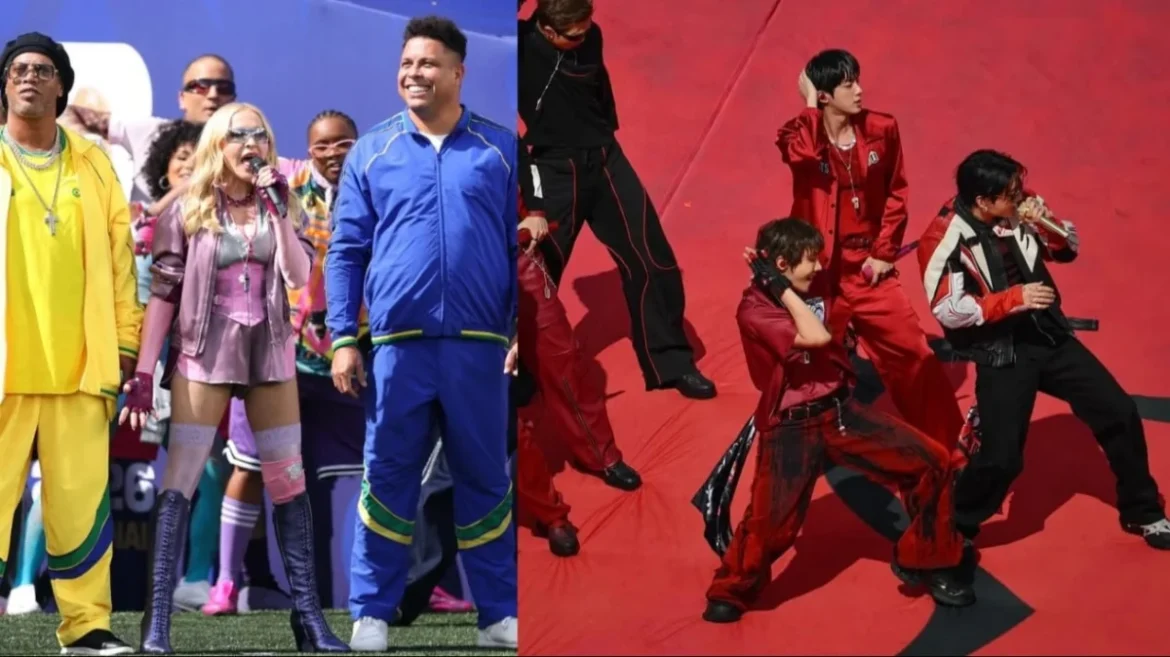
The highly anticipated final of the FIFA World Cup 2026, held on Monday, July 20, 2026, captivated global audiences not only for the thrilling on-field clash between Spain and Argentina but also for an unprecedented halftime show that transcended the boundaries of sport and entertainment. This monumental event, marked as a historic moment both within the stadium and across the digital sphere, featured a constellation of international music superstars: Shakira, Madonna, BTS, and Justin Bieber.
The halftime spectacle, spanning approximately 22 to 27 minutes, was designed as a multi-generational experience, amplifying the excitement of a final match that commanded the world’s attention for over two hours. Each artist brought their unique flair to the stage, contributing to a diverse and dynamic performance. South Korean supergroup BTS ignited the crowd with a vibrant rendition of their global hit "Dynamite," showcasing their signature energetic choreography and colorful aesthetics. Legendary pop icon Madonna followed, delivering an electrifying performance of her anthemic track "Music," proving her enduring stage presence and ability to command attention.
Canadian superstar Justin Bieber offered a more intimate moment, performing an acoustic version of his song "Everything Hallelujah," demonstrating his vocal versatility and emotional depth. The performance concluded with a powerful collaboration between Colombian superstar Shakira and Nigerian artist Burna Boy, who united to perform their collaborative track "Dai-Dai," a fusion of Latin rhythms and Afrobeat influences that resonated with the diverse global audience.
The sheer magnitude of talent assembled for this prestigious event naturally sparked widespread curiosity regarding the financial arrangements for these artists. Given the immense profitability of the FIFA World Cup, which consistently generates billions in revenue through broadcasting rights, sponsorships, and ticket sales, and considering the substantial prize money awarded to the winning nation, questions about artist compensation were inevitable.
A Commitment to Global Causes: The Unpaid Performances
Contrary to initial assumptions about substantial appearance fees, reporting from The Athletic on Monday, July 20, 2026, revealed a remarkable aspect of the halftime show: Shakira, Madonna, and BTS did not receive any direct payment for their performances. A confidential source from the organization Global Citizen, an international non-profit dedicated to ending poverty and fighting inequality, confirmed that these artists had voluntarily chosen to donate their time and talent to support the halftime show’s underlying social mission. Their participation was framed as a commitment to advancing social justice initiatives, aligning with the broader objectives of the FIFA World Cup’s charitable endeavors.
This altruistic approach mirrors precedents set by other major global sporting events. The National Football League’s (NFL) Super Bowl, one of the most-watched annual sporting events in the United States, has also featured high-profile artists in its halftime shows who have performed without direct payment. For instance, Puerto Rican rapper Bad Bunny, who performed at the Super Bowl in February of this year, did not receive a fee. Instead, the primary benefit for these artists lies in the unparalleled exposure and reach afforded by performing on one of the world’s most-watched television programs. The Super Bowl halftime show consistently garners an audience of over 100 million viewers in the United States alone, offering an invaluable platform for artists to connect with a massive and diverse demographic.
FIFA’s Vision: Education and Opportunity
The significance of the halftime show extended beyond its entertainment value, serving as a crucial platform for FIFA’s philanthropic initiatives. FIFA President Gianni Infantino articulated the organization’s vision for the event in a statement, emphasizing the critical role of education. "If we talk about what the world needs, nothing is more important than education," Infantino stated. "We are proud that Justin Bieber is joining Madonna, Shakira, and BTS as a headliner for the Halftime Show at the FIFA World Cup 2026 Final to support the FIFA Global Citizen Education Fund and our mission to expand access to quality education and football opportunities for children around the world."
This statement underscores FIFA’s strategic alignment of the World Cup with global educational goals. The FIFA Global Citizen Education Fund, established in partnership with Global Citizen, aims to leverage the immense popularity of the tournament to raise awareness and funds for educational programs. The fund’s objectives include providing access to quality schooling, developing educational resources, and creating pathways for children, particularly those in underprivileged communities, to benefit from both academic and sporting opportunities. The involvement of these global music icons amplifies the message, drawing international attention to the importance of investing in the future generation.
A Legacy of Impact: Beyond the Final Whistle
The decision to dedicate such a high-profile event to educational causes carries significant implications. By associating the world’s most popular sporting event with a philanthropic mission, FIFA aims to inspire a global movement of support for education. The participation of artists like Shakira, known for her extensive humanitarian work, Madonna, a long-standing advocate for various causes, BTS, who have championed youth empowerment through their "Love Myself" campaign, and Justin Bieber, who has increasingly used his platform for social good, lends substantial credibility and reach to the initiative.
The financial models employed by these artists in their halftime performances – prioritizing impact over personal gain – reflect a growing trend among global celebrities. Many are increasingly using their considerable influence and platforms to advocate for social and environmental issues, recognizing the power of collective action. The substantial media coverage surrounding the event, driven by the star power of the performers and the global appeal of the World Cup, ensures that the message of educational empowerment will reach millions, potentially translating into increased donations, policy changes, and grassroots support for educational initiatives worldwide.
The FIFA World Cup 2026 final halftime show, therefore, was more than just a musical interlude; it was a carefully orchestrated convergence of sport, culture, and philanthropy. It demonstrated how major global events can be harnessed to promote meaningful social change, leaving a legacy that extends far beyond the final score of the match and the final notes of the music. The financial sacrifice made by the artists underscores a profound commitment to global citizenship, aiming to ignite a lasting positive impact on the lives of children and communities around the world through the transformative power of education and the unifying spirit of football.