
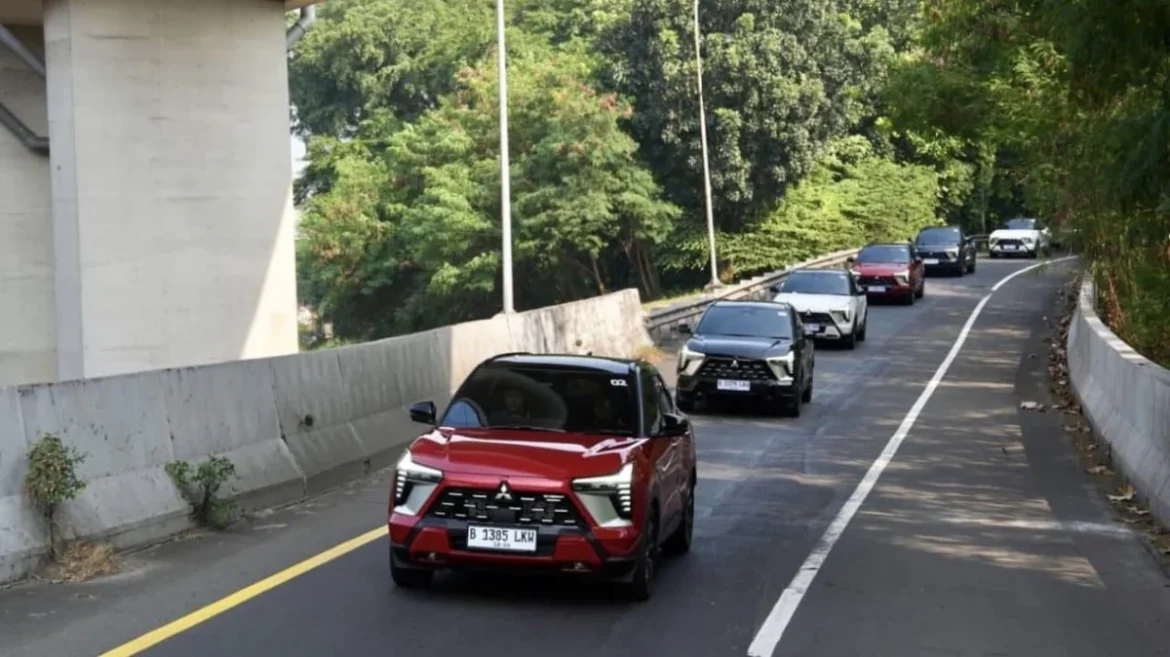
Mitsubishi Motors is not merely refreshing the exterior design of the New Xforce and introducing a hybrid variant; the Japanese automaker has also implemented a series of subtle yet impactful enhancements to the vehicle’s underpinnings, areas that are less visible but significantly contribute to the driving experience. These improvements were put to the test during an extensive media test drive event held in Karawang, West Java, on Saturday, July 18, 2026. The event distinguished itself by employing a diverse range of testing terrains designed to thoroughly evaluate the vehicle’s capabilities, spanning urban roads, highways, gravel tracks, and a dedicated proving ground equipped for various simulation maneuvers.
The comprehensive media test drive, organized by PT Mitsubishi Motors Krama Yudha Sales Indonesia (MMKSI), underscores the company’s commitment to refining its popular compact SUV. The objective was to demonstrate how these often-overlooked engineering advancements translate into tangible benefits for drivers in their daily commutes and more adventurous excursions.
A Focus on Everyday Comfort and Confidence
President Director of PT MMKSI, Atsushi Kurita, articulated the strategic rationale behind these significant engineering updates. "The New Xforce and New Xforce HEV are tangible manifestations of Mitsubishi Motors’ unwavering commitment to continuous product improvement, driven by a keen understanding of the evolving needs and lifestyles of Indonesian customers," Kurita stated in an official release. He emphasized that the enhancements were a direct response to consumer feedback, highlighting a desire for a compact SUV that offers superior comfort and an elevated sense of confidence during everyday use.
The test drive commenced on public roads, simulating typical urban traffic conditions and highway driving. During this initial phase, the primary focus was not solely on raw engine performance but on assessing how the refined chassis and suspension systems influenced the overall ride comfort and handling characteristics. MMKSI claims that the New Xforce now exhibits a more mature and composed driving demeanor. The engineers have reportedly succeeded in reducing vibrations when traversing uneven road surfaces, while simultaneously enhancing cabin insulation to ensure a more serene and pleasant journey for occupants.
Exploring the Hybrid Advantage: Normal and EV Modes
For participants experiencing the New Xforce HEV, the test drive provided an opportunity to directly compare its distinct driving modes. The transition between Normal Mode and EV Mode was designed to showcase the versatility of the hybrid powertrain. In specific driving scenarios, the vehicle can operate purely on electric power, offering an exceptionally smooth and remarkably quiet driving experience, a key differentiator for hybrid technology in the competitive SUV segment. This silent operation is particularly beneficial in urban environments, contributing to reduced noise pollution and a more relaxed atmosphere within the cabin.
Tackling the Terrain: Gravel Mode in Action
Moving beyond the paved roads, the test drive ventured onto the Karawang Baru Track, a deliberately challenging gravel surface. This segment was specifically designed to highlight the capabilities of the Gravel Mode, one of the selectable drive modes featured in the New Xforce HEV. The uneven, stone-strewn terrain provided an ideal environment to observe how the hybrid system, in conjunction with the upgraded suspension, works in synergy to maintain optimal traction and vehicle stability. The outcome, according to initial impressions, was a vehicle that maintained a confident and secure stance, even on the most demanding surfaces, without compromising the comfort of its passengers. This demonstrates a balanced approach to off-road capability and on-road refinement, a crucial balance for a versatile SUV.
Proving Ground Performance: The Ultimate Test
The culmination of the dynamic testing took place at the Bridgestone Proving Ground. This advanced facility provided a controlled environment for the New Xforce and New Xforce HEV to undergo a series of rigorous simulations, mirroring the scenarios employed during the vehicles’ development phases. These simulations are critical for validating engineering improvements and ensuring the vehicles meet stringent performance and safety standards across a wide spectrum of operational conditions.
Background Context: The Evolving Compact SUV Market
The compact SUV segment has experienced exponential growth globally and particularly in emerging markets like Indonesia. Consumers are increasingly seeking vehicles that offer a blend of practicality, fuel efficiency, and a higher driving position, often replacing traditional sedans and hatchbacks. Mitsubishi’s strategic decision to invest in refining the Xforce, including the introduction of a hybrid option, reflects a proactive approach to meeting these evolving consumer demands and staying competitive.
The compact SUV market is characterized by intense competition, with manufacturers constantly vying for market share by introducing innovative features, improved performance, and enhanced fuel economy. The inclusion of advanced driver-assistance systems (ADAS), sophisticated infotainment, and, increasingly, hybrid or electric powertrains, are becoming standard expectations rather than mere optional extras. Mitsubishi’s focus on chassis and suspension refinement, while less glamorous than a new infotainment screen, addresses a fundamental aspect of vehicle ownership: the quality of the driving experience.
Supporting Data and Engineering Insights
While specific technical data on the chassis and suspension upgrades were not fully detailed in the initial announcement, industry experts suggest that such refinements often involve a combination of:
- Optimized Spring Rates and Damping: Adjustments to the stiffness of springs and the characteristics of shock absorbers can significantly alter how a vehicle absorbs impacts and controls body roll.
- Improved Bushing Materials: The rubber or polyurethane components that isolate suspension parts from the chassis can be re-engineered for better vibration damping and noise reduction.
- Enhanced Steering Geometry: Subtle changes to the angles and pivot points of the suspension can lead to more precise and responsive steering.
- Advanced NVH (Noise, Vibration, and Harshness) Control: Multi-layered insulation, acoustic glass, and strategically placed sound-deadening materials contribute to a quieter cabin.
- Hybrid System Integration: For the HEV variant, seamless integration of the electric motor and battery with the internal combustion engine requires sophisticated powertrain control software and robust mechanical components to ensure smooth transitions and optimal energy regeneration.
The introduction of Gravel Mode, a feature often found in more rugged off-road vehicles, suggests that Mitsubishi is aiming to provide the Xforce with a level of all-terrain capability that surpasses typical urban-focused compact SUVs. This could involve specific programming for the anti-lock braking system (ABS), traction control system (TCS), and all-wheel-drive (if applicable) to optimize grip and prevent wheel spin on loose surfaces.
Timeline of Development and Launch
The media test drive on July 18, 2026, serves as a critical pre-launch or early-launch event. This timing indicates that the production versions of the New Xforce and New Xforce HEV, incorporating these refinements, are either already reaching dealerships or are slated for immediate release. The typical development cycle for such automotive updates involves extensive research and development, prototyping, rigorous testing (as demonstrated in Karawang), and finally, manufacturing ramp-up. The fact that media were invited to such an in-depth test suggests a high degree of confidence from Mitsubishi in the effectiveness of these engineering changes.
Reactions from Related Parties (Inferred)
While direct quotes from dealers or component suppliers were not included in the original report, it can be inferred that dealerships would welcome these enhancements. A more refined and capable vehicle translates to higher customer satisfaction, potentially leading to increased sales and reduced warranty claims. Component suppliers, such as those involved in suspension systems or hybrid powertrains, would likely view this as a validation of their technology and a testament to their collaborative efforts with Mitsubishi.
Broader Impact and Implications
The strategic focus on chassis and suspension improvements for the New Xforce and Xforce HEV carries several implications for the automotive market:
- Setting a New Benchmark: By prioritizing these often-understated aspects of vehicle engineering, Mitsubishi may be setting a new benchmark for ride comfort and handling within the compact SUV segment. This could pressure competitors to follow suit with similar upgrades.
- Appealing to a Wider Demographic: Enhanced comfort and confidence in driving can attract a broader range of buyers, including those who may have previously found compact SUVs to be too firm or less refined.
- Strengthening the Hybrid Proposition: For the Xforce HEV, the combination of a smooth EV mode and robust Gravel Mode capabilities makes a compelling case for its hybrid powertrain, moving beyond just fuel efficiency to encompass a more versatile and enjoyable driving experience.
- Reinforcing Mitsubishi’s Engineering Reputation: Mitsubishi has a long-standing reputation for building robust and capable vehicles, particularly in the SUV and off-road domains. These refinements reinforce that legacy, demonstrating their continued commitment to engineering excellence.
In conclusion, Mitsubishi’s comprehensive testing of the New Xforce and Xforce HEV in Karawang highlights a deliberate and sophisticated approach to product development. By focusing on the fundamental elements of chassis and suspension performance, coupled with the introduction of a refined hybrid system, Mitsubishi Motors is positioning its latest compact SUVs to offer a compelling and well-rounded proposition for consumers seeking comfort, confidence, and capability in their daily drives. The success of these enhancements will ultimately be measured by consumer reception and their impact on market share in one of the automotive industry’s most fiercely contested segments.
