
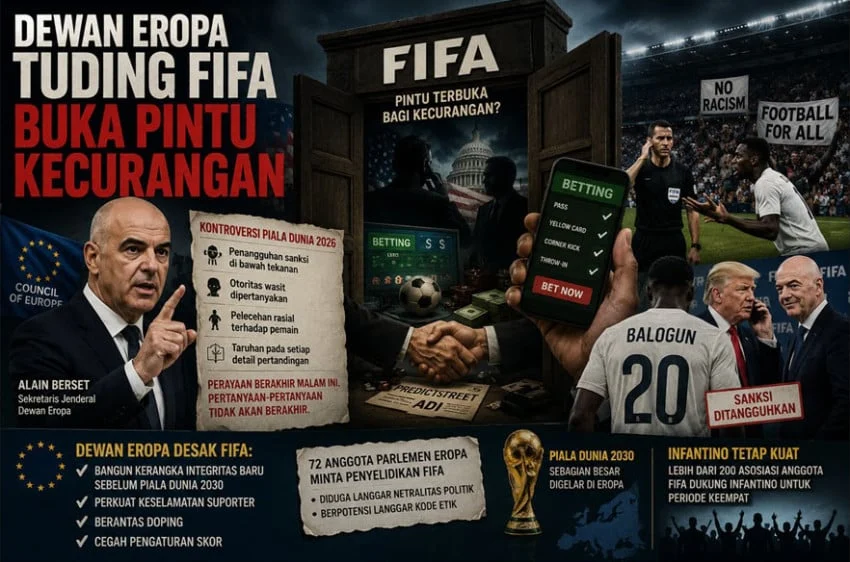
As the final whistle blows on the FIFA World Cup 2026, the world’s football governing body, FIFA, finds itself ensnared in a storm of sharp criticism from the European Council. Alain Berset, the Secretary General of the European Council, has directly accused FIFA of "opening the door to cheating" within the realm of sports betting and allowing political interference to tarnish the integrity of the prestigious tournament. This strong indictment comes at a critical juncture, with the future of major football events, including the upcoming World Cup 2030 largely hosted in Europe, hanging in the balance.
In an open letter released strategically to coincide with the tournament’s grand finale, Berset issued a stern call for FIFA to urgently establish a new integrity framework. This imperative, he stressed, is paramount before the commencement of the FIFA World Cup 2030, a significant portion of which is slated to be held across various European nations. According to Berset, the litany of controversies that have plagued the FIFA World Cup 2026 has not only cast a shadow over the event but has also precipitated a profound crisis of trust in the global governance of football.
"The FIFA World Cup 2026 has raised question after question," Berset stated, as quoted by The Guardian on Monday, July 20, 2026. His remarks underscore a growing sentiment of unease and dissatisfaction among key international stakeholders regarding FIFA’s stewardship of the sport’s premier event. The timing of his statement, immediately following a tournament that has been marked by a series of high-profile incidents, amplifies the gravity of his accusations.
A Tournament Marred by Controversy: Key Issues Raised
Berset’s open letter meticulously detailed a spectrum of issues that, in his assessment, have significantly undermined the tournament’s reputation. These concerns range from controversial disciplinary actions and questionable refereeing decisions to instances of racial abuse targeting players and the alarming proliferation of betting practices that extend far beyond match outcomes.
One of the most pressing concerns highlighted by Berset was the "suspension of sanctions carried out under pressure." This alludes to instances where disciplinary measures against individuals or teams appeared to be influenced by external forces, rather than being solely based on the merits of the case and established regulations. Such perceived pressures, Berset argued, erode the fairness and impartiality that should be the bedrock of any major sporting competition. The implications of such actions are far-reaching, potentially setting dangerous precedents for future tournaments and encouraging those with vested interests to seek undue influence.
Furthermore, the "authority of referees [being] questioned" points to a series of officiating decisions throughout the tournament that drew widespread debate and criticism. In an era where technology plays an increasingly significant role in sports, from VAR to advanced analytics, any perceived erosion of confidence in refereeing decisions can have a detrimental impact on the sport’s credibility. This can lead to fan disillusionment, player frustration, and ultimately, a diminished appreciation for the game itself. The subtle nuances of football, where a single decision can alter the course of a match, necessitate the highest level of trust in the individuals tasked with upholding the rules.
The inclusion of "cases of racial abuse against players" is a particularly sensitive and damning indictment. Football, as a global sport with a diverse player base, has a moral and ethical obligation to be a platform where all participants feel safe and respected, regardless of their background. Any instance of racial abuse not only inflicts profound personal distress on the victim but also sends a deeply damaging message to millions of fans worldwide. The effectiveness and swiftness of FIFA’s response to such incidents, and the proactive measures taken to prevent them, are critical indicators of its commitment to inclusivity and its ability to safeguard its athletes.
Perhaps the most alarming accusation leveled by Berset is the "proliferation of betting practices that now cover not only the results of matches, but also every small detail in the game." This points to an expansion of the sports betting industry that has moved beyond traditional wagers on who wins or loses, to encompass micro-betting on events within the game, such as the number of corners, yellow cards, or even the first player to touch the ball in a specific area. While sports betting itself is a legitimate industry, its unchecked expansion and the potential for manipulation or insider trading associated with such granular betting markets raise serious ethical and integrity concerns. The ease with which betting can now occur on almost any aspect of a match creates a fertile ground for potential match-fixing or corruption, a threat that could fundamentally compromise the fairness and authenticity of the sport.
Berset concluded his statement with a poignant observation: "The celebration will end tonight. The questions will not end." This stark assessment encapsulates the sentiment that while the spectacle of the World Cup may conclude, the fundamental issues of governance, integrity, and trust that have been brought to the forefront will persist and demand urgent attention.
A Timeline of Growing Concerns
The controversies surrounding FIFA and the World Cup are not isolated incidents but rather a culmination of issues that have been brewing for some time. The FIFA World Cup 2026, hosted across multiple nations including the United States, Canada, and Mexico, was heralded as a new era for the tournament, with an expanded format featuring 48 teams. However, this expansion, while intended to increase global participation, also presented new logistical and organizational challenges that may have inadvertently contributed to the perceived decline in oversight.
Early Stages of the Tournament (June 2026): Reports of logistical issues at various host venues began to surface, including difficulties with transportation and accommodation for fans and media. While not directly related to integrity, these early organizational hiccups may have foreshadowed underlying systemic weaknesses.
Mid-Tournament (July 2026): Several contentious refereeing decisions sparked significant debate. One notable incident involved a penalty awarded in a crucial group stage match, which many pundits and fans argued was a soft call, potentially influencing the outcome. This led to renewed calls for greater transparency and accountability in VAR usage.
Late Stages of the Tournament (Mid-July 2026): Allegations of racial abuse directed at a prominent player during a knockout stage match sent shockwaves through the football community. The swiftness and perceived adequacy of FIFA’s investigation and subsequent disciplinary actions came under scrutiny.
Build-up to the Final (July 19-20, 2026): Whispers of political pressure influencing a disciplinary decision regarding a player’s eligibility for a semi-final match began to circulate. While no official confirmation was provided, the rumors fueled Berset’s assertion of external interference. Simultaneously, reports from gambling industry analysts indicated a significant surge in betting volume on micro-events within matches, raising alarms about the potential for corruption.
Publication of Berset’s Letter (July 20, 2026): The open letter from the European Council Secretary General, released on the eve of the final, consolidated these disparate concerns into a comprehensive critique of FIFA’s current governance.
Supporting Data and Context
The World Cup 2026, with its expanded format, generated unprecedented levels of global interest and economic activity. The tournament was projected to generate billions of dollars in revenue through broadcasting rights, sponsorships, ticket sales, and tourism. However, the financial implications of integrity breaches can be equally staggering.
Sports Betting Market Growth: The global sports betting market is a multi-billion dollar industry, and its rapid growth has been a key factor in the increased focus on integrity. According to industry reports, the market was projected to reach over $200 billion by 2025, with football being the most popular sport for betting. The FIFA World Cup, as the pinnacle of the sport, naturally attracts a significant portion of this global betting volume. The rise of online and mobile betting platforms has made it easier than ever for individuals to place wagers, contributing to the potential for increased illicit activities.
Impact of Corruption: The ramifications of corruption in sports extend beyond financial losses. It erodes public trust, discourages genuine sporting engagement, and can disproportionately harm developing nations that rely on fair competition for national pride and economic opportunities. The European Union, as a major bloc with a significant stake in the global sports landscape, has a vested interest in ensuring the integrity of international sporting events.
Historical Precedents: FIFA has faced integrity challenges in the past, most notably the corruption scandals that led to the downfall of former president Sepp Blatter and numerous other officials. These past events underscore the persistent nature of these issues and the need for robust, ongoing reform. The current criticism from the European Council suggests that past reforms may not have been sufficient or have been undermined by new challenges.
Potential Responses and Reactions
While FIFA has yet to issue a comprehensive official response to Alain Berset’s strong accusations, it is highly probable that the organization will engage in damage control and potentially outline future strategies to address the concerns raised.
FIFA’s Stance (Inferred): Historically, FIFA has emphasized its commitment to integrity and fair play. It is likely to acknowledge the importance of the concerns raised by the European Council and reiterate its dedication to combating corruption and ensuring a level playing field. The organization may highlight existing integrity units and protocols it has in place.
Reactions from National Football Federations: Federations from participating nations, particularly those from Europe, are likely to express their support for Berset’s call for action. They may also be under pressure from their own governments and fan bases to demand greater accountability from FIFA.
Sports Betting Industry: The sports betting industry itself is likely to be concerned by the accusations, as any widespread perception of corruption could lead to increased regulatory scrutiny and potentially impact its profitability. Industry bodies may issue statements emphasizing their own commitment to integrity and cooperation with sports organizations.
Player Associations: Player unions and associations are expected to strongly support the call for enhanced player protection, particularly regarding racial abuse and the potential for match manipulation that could jeopardize players’ careers and livelihoods.
Broader Impact and Implications
Alain Berset’s direct and public critique of FIFA carries significant weight, given his position within the European Council, a key supranational body representing 27 European Union member states. The implications of these accusations are far-reaching and could shape the future governance of football on a global scale.
Increased Scrutiny on FIFA: The European Council’s intervention will undoubtedly lead to heightened scrutiny of FIFA’s operations and decision-making processes. This could translate into more stringent oversight from European governments and potentially influence future bids for hosting major tournaments.
Demand for Structural Reform: Berset’s call for a "new integrity framework" suggests that incremental changes may no longer be sufficient. The European Council may advocate for more fundamental structural reforms within FIFA, potentially involving greater transparency, independent oversight, and stronger accountability mechanisms.
Impact on World Cup 2030: With a significant portion of the World Cup 2030 slated for Europe, the European Council’s stance could heavily influence the continent’s willingness to host and participate in the bidding process. Any perceived lack of progress in addressing integrity concerns could lead to a united front among European nations to demand concessions from FIFA.
Precedent for Other Sports: The European Council’s robust criticism of FIFA could set a precedent for similar interventions in other international sports organizations that may be facing integrity challenges. This could usher in an era of greater accountability for governing bodies across the sporting world.
The Future of Football’s Integrity: The ongoing debate underscores the critical importance of maintaining the integrity of sport. As football continues to grow in popularity and economic value, the threats to its fairness and authenticity also evolve. The FIFA World Cup 2026 has served as a stark reminder that vigilance, transparency, and a steadfast commitment to ethical governance are not merely desirable but absolutely essential for the long-term health and credibility of the beautiful game. The questions raised by Secretary General Berset will undoubtedly echo in the corridors of power within FIFA and beyond, demanding concrete answers and meaningful action.
