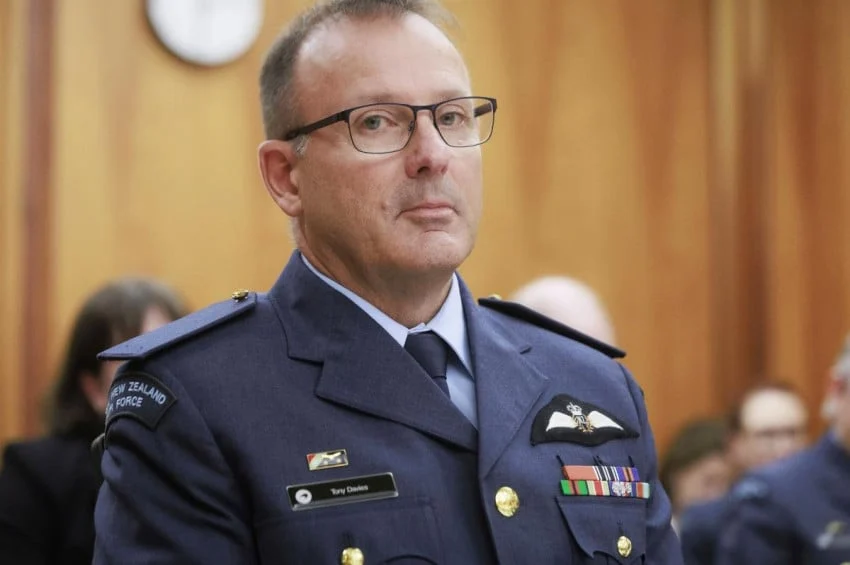
WELLINGTON — In a stunning development that has sent ripples through the upper echelons of the New Zealand Defence Force (NZDF), Chief of Defence Force Air Marshal Tony Davies has officially tendered his resignation. The abrupt departure of the nation’s top military commander came on Friday after he admitted to engaging in an inappropriate relationship during his tenure as a unit leader, a lapse in judgment that he acknowledged directly contradicted the core values expected of military personnel.
The resignation marks a sudden and unexpected end to a distinguished 42-year military career for Davies, who only recently assumed the role of Chief of Defence Force in 2024. The scandal has prompted immediate administrative action, with the leadership of the military temporarily transitioning to Rear Admiral Mat Williams, the current vice chief, as the government scrambles to ensure stability and continuity within the nation’s defense apparatus.
The Admission and Immediate Aftermath
The controversy came to light when Air Marshal Davies formally stepped forward to report his historical misconduct to the civilian leadership. In a public statement addressing his departure, Davies did not shy away from taking full accountability for his actions, though specific details regarding the nature of the relationship, the identity of the other party, or the exact timeline of when the incident occurred have been withheld from the public domain to protect privacy and maintain the integrity of the ongoing review process.
"I regret not disclosing this when I had the opportunity to do so," Davies stated candidly in his resignation address. He elaborated that his decision to step down was rooted strictly in personal accountability for a past error in judgment. "This resignation is based on personal reasons and is the result of a mistake in judgment I made in the past, for which I take full responsibility. That mistake in judgment ran counter to the values of the Defence Force."
Following his disclosure, the matter was immediately escalated to the highest levels of civilian oversight. The New Zealand military confirmed through an official channel that no further public commentary would be provided by the NZDF regarding the specifics of the relationship, as the issue has now been formally referred to an independent inspector-general tasked with investigating professional conduct and behavioral standards within the military ranks.
Government Response and the Question of Integrity
Minister of Defence Paul Goldsmith confirmed that he had received and accepted Davies’s resignation with immediate effect. Speaking on behalf of the government, Goldsmith did not mince words regarding the severity of the situation, categorizing it firmly as a crisis of institutional integrity.
"I acknowledge his 42 years of service and his contributions to the New Zealand Defence Force, but it must be noted that the circumstances behind his resignation will be deeply disappointing to all personnel within the Defence Force," Goldsmith stated. The Minister emphasized that while Davies’s long-standing service to the crown and country was a matter of historical record, the foundational standards of leadership demand absolute adherence to ethical codes, making his position ultimately untenable.
Goldsmith noted that he fully agreed with Davies’s assessment that the military could not retain a commander who had breached the behavioral framework governing its leaders. The swift acceptance of the resignation underscores the current New Zealand government’s zero-tolerance approach to ethical lapses among high-ranking public officials, particularly those entrusted with commanding armed forces and setting moral precedents for thousands of subordinates.
A Decorated Four-Decade Career Cut Short
To fully understand the gravity of Air Marshal Davies’s resignation, one must examine the extensive and decorated career that preceded this downfall. Born in Whangārei in 1966, Tony Davies dedicated nearly his entire adult life to the service of New Zealand’s aviation and defense sectors.
His journey with the military began in 1984 when he enlisted in the Royal New Zealand Air Force (RNZAF). Over the subsequent four decades, Davies built a formidable reputation as an exceptionally skilled aviator and tactical leader. Before ascending to the pinnacle of New Zealand’s military hierarchy, he logged an impressive 7,000 flight hours across a diverse array of fixed-wing aircraft. His logbooks include extensive service piloting training aircraft such as the Airtrainer, tactical transport workhorses like the Andover and the legendary C-130 Hercules, as well as strategic heavy jets including the Boeing 727 and Boeing 757.
In addition to his operational flying hours, Davies spent significant portions of his career serving as a flight instructor, mentoring generations of younger pilots who would go on to form the backbone of the RNZAF’s transport and combat support capabilities. His rise through the ranks was marked by numerous leadership assignments within various squadrons and administrative units, ultimately culminating in his appointment as the Chief of Defence Force in 2024—a post he held for only a fraction of the typical tenure before this scandal abruptly terminated his service.
Chronology of Events
The unfolding of the crisis followed a rapid timeline that caught both domestic observers and international defense partners by surprise:
- 1984: Tony Davies begins his military career by enlisting in the Royal New Zealand Air Force, eventually accumulating 7,000 flight hours as a pilot and instructor.
- 2024: Davies is appointed to the highest military post in the country, becoming the Chief of Defence Force of New Zealand.
- Friday (Resignation Day): Air Marshal Davies formally admits to an inappropriate historical relationship stemming from a period when he served as a unit leader. He submits his resignation to Defence Minister Paul Goldsmith.
- Immediate Post-Resignation: The New Zealand Defence Force confirms the transition of power, naming Rear Admiral Mat Williams as the acting head of the military.
- Ongoing Phase: The case is officially handed over to an independent inspector-general to conduct a thorough review of the circumstances surrounding the breach of conduct.
Broader Implications for the New Zealand Defence Force
The departure of a Chief of Defence Force under a cloud of ethical misconduct carries profound implications for the New Zealand Defence Force, an institution that prides itself on discipline, transparency, and high moral standards. Military analysts note that leadership scandals at the absolute apex of command can have a demoralizing effect on the rank-and-file personnel who look to top commanders as exemplars of professional conduct.
Furthermore, the referral of the case to an independent inspector-general highlights a growing institutional shift toward external accountability within New Zealand’s state apparatus. By bypassing internal military tribunals for the initial investigation, the government has signaled a commitment to impartial oversight, ensuring that allegations against high-ranking officials are scrutinized without institutional bias.
As Rear Admiral Mat Williams steps into the role of acting chief, the immediate challenge for the NZDF will be restoring internal morale and reassuring international allies—particularly within the Five Eyes intelligence-sharing network and regional Pacific partners—that New Zealand’s military leadership remains stable, focused, and uncompromised by executive-level turbulence.
While the long-term legacy of Air Marshal Tony Davies will forever be dual-faceted—defined both by his 42 years of dedicated aviation service and his abrupt, self-reported fall from grace—his resignation serves as a stark reminder that modern military leadership demands unyielding adherence to behavioral standards, regardless of rank, tenure, or past operational achievements.