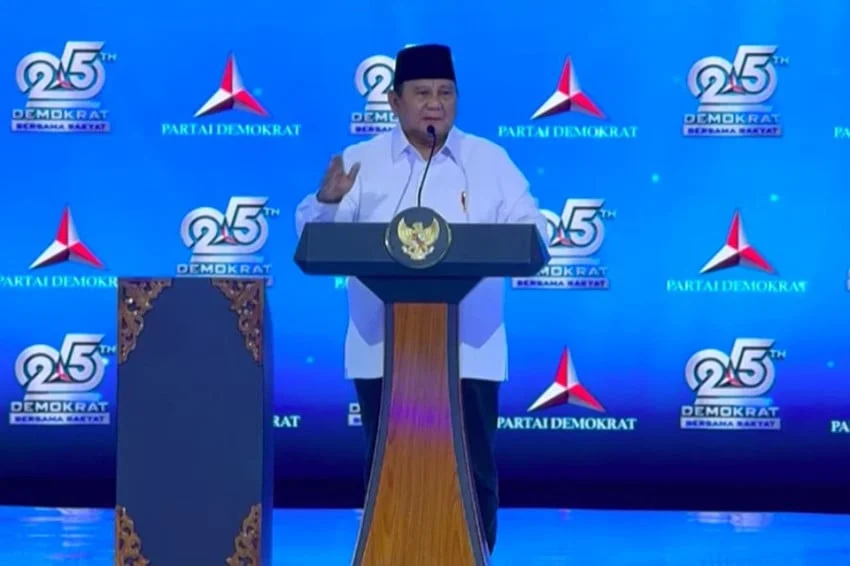
The Indonesia Arena in Central Jakarta served as the epicenter of national political discourse on Wednesday, September 9, 2026, as the Democratic Party marked its 25th anniversary. Amidst a sea of blue, symbolizing the party’s identity, President Prabowo Subianto delivered a keynote address that transcended mere celebratory rhetoric, focusing instead on the legacy of political maturity and the shared ethos of military-to-civilian leadership. At the heart of his address was a poignant tribute to Susilo Bambang Yudhoyono (SBY), the sixth President of Indonesia and the current Chairman of the Democratic Party’s High Council, whose transition from a career in the military to the pinnacle of democratic leadership was framed by President Prabowo as a benchmark for national service.
A Legacy of Service: The Intersection of Military and Democratic Values
President Prabowo’s remarks underscored a significant narrative in Indonesian politics: the evolution of former military officers into democratic leaders. Reflecting on their shared professional backgrounds, Prabowo highlighted the foundational values instilled in them during their tenures as generals in the Indonesian National Armed Forces (TNI).
"Bapak SBY and I share a common history as former generals," Prabowo stated to the assembled crowd. "However, the core of our training was not merely in defense or tactics; we were raised, mentored, and molded as soldiers of the people. We were taught from the very beginning that the military belongs to the people, serving the interest of the nation above all else. Transitioning into the political arena, this conviction remains: to serve the people effectively, one must operate through the channels of democracy."
This statement serves as a vital historical bridge. The Democratic Party, founded in 2001 in the wake of the Reformasi movement, has long positioned itself as a centrist, nationalist, and democratic entity. SBY’s rise to the presidency in 2004—the first to be directly elected by the Indonesian people—marked a pivotal moment in the nation’s democratic history. By emphasizing this, Prabowo was not only honoring his peer but also validating the legitimacy of the political institutions that have governed Indonesia for the past quarter-century.
Chronology and Evolution of the Democratic Party
To understand the weight of the 25th-anniversary celebration, one must look back at the trajectory of the Democratic Party. Founded on September 9, 2001, the party was established during a period of intense institutional transition in Indonesia.
- 2001: The Democratic Party is officially formed to provide a platform for moderate, pluralistic politics.
- 2004: In a watershed moment for Indonesian democracy, Susilo Bambang Yudhoyono wins the inaugural direct presidential election, signaling a new era of stability and policy-driven governance.
- 2009: The party secures a resounding victory in both the legislative and presidential elections, solidifying its position as the dominant force in the political landscape of the time.
- 2014–2024: The party navigates a decade of transition, shifting between the governing coalition and the opposition, eventually finding a stable footing in the current political administration.
- 2026: The 25th anniversary serves as a consolidation point, highlighting the party’s resilience and its continued role as a significant pillar in the national legislative and executive framework.
The event at the Indonesia Arena was attended by a broad cross-section of political figures, reflecting the party’s current strategy of "synergy." Representatives from various coalition partners were present, indicating that despite the competitive nature of Indonesian elections, the Democratic Party remains a central node in the web of national governance.
Supporting Data and Political Context
The Democratic Party’s 25-year tenure has been characterized by consistent adherence to its platform of "peace, stability, and prosperity." Data from the General Elections Commission (KPU) over the last five cycles shows that the party has maintained a consistent voter base, particularly among urban, middle-class demographics who prioritize institutional stability and economic predictability.
Political analysts suggest that the presence of President Prabowo at the celebration is not merely a ceremonial gesture but a calculated alignment of interests. The current administration has prioritized national unity and continuity in development policies. By publicly aligning himself with the foundational philosophy of the Democratic Party, Prabowo reinforces the narrative that his administration represents a broad-based consensus of nationalist and democratic forces.
Furthermore, the "synergy" mentioned by various attendees—including leaders from allied groups like Ferry Perindo—highlights a collective desire to maintain a stable legislative environment. In the current session of the House of Representatives (DPR), the cooperation between the Democratic Party and the administration has been crucial in passing key economic reforms and infrastructure legislation.
The Dynamics of Civil-Military Relations in Indonesian Politics
The discourse surrounding the military background of leaders is a recurring theme in Indonesian sociology and political science. Observers note that the transition of military personnel into civilian leadership roles has been a defining feature of post-1998 Indonesia.
Prabowo’s emphasis on the "soldier of the people" ethos is a strategic rhetorical device. It serves to decouple the historical image of the military as an authoritarian apparatus from the modern reality of the military as a democratic stakeholder. By grounding his and SBY’s political legitimacy in their service to the "people," Prabowo is effectively framing their political careers as an extension of their national duty rather than a deviation from it.
Official Responses and Public Reception
The address was received with widespread approval within the party ranks. Members of the Democratic Party’s central leadership expressed that the President’s presence solidified the party’s position as a key partner in the national development agenda.
"The President’s acknowledgement of Bapak SBY’s leadership is a validation of the democratic path we have chosen," said a party spokesperson. "We have always maintained that the strength of our party lies in its dedication to the rule of law and the democratic process. Having the President recognize this on our 25th anniversary is a significant milestone for our cadres."
Opposition figures, while maintaining their scrutiny of government policy, have acknowledged the historical significance of the event. The consensus among political observers is that the anniversary was a masterclass in political optics, showcasing the continuity between the Yudhoyono era and the current Prabowo administration.
Broader Impact and Future Implications
The long-term implications of this event are twofold. Firstly, it signals a period of political stability. The public alignment of the head of state with the leadership of a major political party suggests that the ruling coalition is cohesive and focused on a long-term strategic agenda.
Secondly, it sets a precedent for how future political transitions will be handled. By emphasizing the "democratic path" taken by SBY, the President is effectively establishing a standard for leadership that prioritizes institutional stability over populist volatility. This is particularly relevant as the nation looks toward the next electoral cycle.
As the Democratic Party moves into its second quarter-century, it faces the challenge of adapting to a rapidly digitizing electorate while maintaining its core principles. The emphasis placed by both Prabowo and SBY on "serving the people" suggests that the party intends to focus on welfare-oriented policies, social security reforms, and infrastructure development—areas that have traditionally been the party’s strongest policy pillars.
Conclusion
The celebration at the Indonesia Arena was more than a birthday commemoration; it was a reaffirmation of the enduring strength of Indonesia’s democratic institutions. By honoring the past—specifically the legacy of Susilo Bambang Yudhoyono—President Prabowo Subianto provided a roadmap for the future. The event underscored a shared commitment to national service, framed within the necessary structures of a vibrant, active democracy.
As the party looks toward the future, its ability to translate this "synergy" into tangible policy outcomes for the Indonesian people will be the ultimate measure of its success. For now, the message from the Indonesia Arena is clear: the path to progress lies in the alignment of democratic ideals with a steadfast, principled commitment to the national interest. The 25th anniversary of the Democratic Party thus stands as a significant marker in the history of a nation that continues to refine its democratic character, balancing its military-forged history with the requirements of a modern, globalized state.