
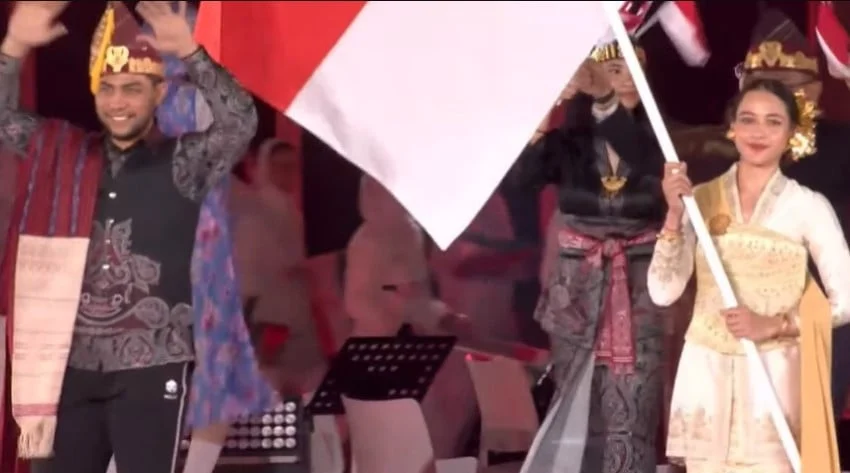
The Asian Games Aichi-Nagoya 2026 officially commenced on Saturday, September 19, 2026, with a spectacular opening ceremony at the Paloma Mizuho Stadium in Nagoya, Japan. Amidst the global gathering of athletes, the Indonesian contingent made a profound impression by highlighting the country’s rich cultural diversity. Leading the Indonesian delegation were flag bearers Dewa Ayu Made Sriartha Kusuma Dewi, a prominent basketball player, and Daniel Hutapea, a distinguished karateka. The duo, dressed in elaborate traditional attire, carried the Red and White flag, symbolizing the nation’s spirit and ambition on the international sporting stage.
A Vibrant Display of Cultural Diplomacy
The Indonesian delegation’s appearance was characterized by a sophisticated fusion of tradition and modernity. Designed through a strategic collaboration between Ghea Fashion Studio and the state-owned retail entity Sarinah, the official attire for the contingent centered on the theme "Harmony in Diversity." This thematic approach was not merely aesthetic; it served as a calculated effort in cultural diplomacy, projecting Indonesia’s national identity to a global audience of millions.
Daniel Hutapea, representing the martial arts discipline, donned traditional Batak Toba attire, while Dewa Ayu Made Sriartha Kusuma Dewi wore a costume reflecting her Balinese roots. The inclusion of the Gorga motif—a traditional decorative art form from the Batak culture—was a focal point of the design. This intricate pattern was meticulously applied to the jerseys worn by the approximately 50 athletes participating in the parade, as well as the official apparel worn by the National Olympic Committee (NOC) of Indonesia and the Chef de Mission (CdM) team. The women’s contingent further elevated the ensemble with kebaya tops featuring Gorga motifs, paired with authentic Ulos fabrics and traditional headpieces, striking a balance between formal elegance and heritage preservation.
Context and Background: The Aichi-Nagoya 2026 Asian Games
The 2026 Asian Games, officially known as the 20th Asian Games, represent a significant milestone for the Olympic Council of Asia (OCA). Hosted in the Aichi Prefecture and the city of Nagoya, Japan, this event follows the delayed 2022 Hangzhou Asian Games. The selection of Aichi-Nagoya as the host city emphasizes Japan’s long-standing commitment to international sporting excellence, following the success of the Tokyo 2020 Olympic Games.
The games are scheduled to span from September 19 to October 4, 2026, featuring a broad spectrum of sports ranging from traditional Olympic disciplines to newer, high-growth sports such as Teqball and E-sports. For Indonesia, these games serve as a critical evaluation point for the country’s high-performance sports program, particularly as the nation aims to maintain its standing among Southeast Asia’s elite sporting powers. The government, through the Ministry of Youth and Sports, has emphasized the importance of these games as a precursor to future Olympic qualification cycles.
Chronology of the Indonesian Delegation’s Preparation
The journey to the opening ceremony began months prior, with rigorous selection processes and training camps conducted across various training centers in Indonesia. The preparation phase for the 2026 Asian Games involved:
- February 2026: Finalization of the official apparel design by Ghea Fashion Studio and Sarinah, focusing on sustainable and culturally resonant materials.
- April 2026: The official announcement of the Indonesian contingent’s target, focusing on strategic sports where Indonesia holds a competitive advantage, such as badminton, weightlifting, and pencak silat.
- July 2026: The official handover of the national flag to the contingent leaders, marking the commencement of the final training phase.
- September 15, 2026: Arrival of the advance team in Nagoya to finalize logistics and athlete registration.
- September 19, 2026: The opening ceremony at Paloma Mizuho Stadium, where the Indonesian contingent formally entered the arena.
Strategic Objectives and Athlete Performance
While the opening ceremony provided a moment of cultural pride, the primary focus for the Indonesian contingent remains the competitive objective. Data from previous editions of the Asian Games indicates that Indonesia has been steadily improving its medal count, with the 2018 Jakarta-Palembang Games serving as a benchmark for home-field success.
For the 2026 edition, the Indonesian NOC has set ambitious targets. The inclusion of athletes from diverse backgrounds—such as the karate and basketball teams—highlights a broader effort to diversify Indonesia’s sporting expertise. The performance of athletes like Dewa Ayu and Daniel Hutapea is being closely monitored by analysts who suggest that a strong showing in the early stages of the games could provide the psychological momentum needed for the rest of the team.
"The Asian Games are not just about the medal tally; they are about the projection of our nation’s soft power," stated a representative from the Indonesian Ministry of Youth and Sports during a press briefing. "By showcasing our cultural motifs like the Gorga on an international platform, we are reminding the world of the depth and longevity of Indonesian heritage."
Implications and Future Outlook
The decision to emphasize cultural identity during the opening ceremony carries broader implications for Indonesia’s image on the international stage. In an era where sports events are increasingly used as platforms for national branding, Indonesia’s focus on its cultural narrative—rather than just the uniforms—distinguishes the contingent from others that rely on standard, high-performance athletic wear.
Furthermore, the collaboration between Ghea Fashion Studio and Sarinah signals a shift toward the professionalization of the Indonesian sports delegation’s appearance. By integrating fashion and national heritage, the NOC is effectively positioning Indonesia as a nation that values its traditions while simultaneously engaging with global modern trends.
However, the real test for the Indonesian contingent lies in the coming weeks of competition. The pressure on the athletes to translate this symbolic representation into tangible success is immense. With Japan hosting the games, the logistical and environmental conditions are familiar to many Asian athletes, yet the competition level remains fierce, with China, South Korea, and Japan typically dominating the top of the medal table.
As the games progress, the Indonesian contingent will look to leverage the morale boost from the opening ceremony to excel in their respective categories. The success of the Indonesian athletes will be measured not only by their podium finishes but also by their resilience and sportsmanship throughout the two-week event.
Analysis of the Sporting Landscape
The 2026 Asian Games are taking place in a rapidly evolving sporting landscape. The inclusion of non-traditional sports reflects a shift in the Olympic Council of Asia’s strategy to engage younger demographics. For Indonesia, this represents both an opportunity and a challenge. While Indonesia has deep roots in traditional sports like Pencak Silat, adapting to newer, faster-paced sports is essential for long-term relevance.
The collaboration with national brands like Sarinah also suggests a sustainable business model for future delegations. By creating branded apparel that holds cultural significance, the NOC can potentially increase revenue through the sale of replica merchandise, thereby funding future athlete development programs. This commercial aspect is becoming increasingly vital as the cost of sending delegations to international multi-sport events continues to rise.
Conclusion
The opening ceremony at the Paloma Mizuho Stadium was a testament to the meticulous planning and cultural pride of the Indonesian delegation. With the world watching, the contingent successfully navigated the balance between athletic readiness and cultural expression. As the Aichi-Nagoya 2026 Asian Games move into full swing, the Indonesian public and the international community await the results of the hard work and dedication demonstrated by the athletes.
The combination of professional apparel design, a clear thematic vision, and a determined group of athletes positions Indonesia as a noteworthy participant in the 20th Asian Games. Whether or not the contingent achieves its medal targets, the opening ceremony has already ensured that Indonesia’s cultural identity is firmly etched into the narrative of the 2026 games. The journey has only just begun, and the coming days will prove whether this symbolic strength can be matched by athletic dominance on the field, the court, and the mat.
