
History is replete with audacious military operations, born from meticulous planning and the promise of swift victory through surprise and overwhelming force. Commanders often harbor a fervent belief that elite troops, innovative tactics, or cutting-edge weaponry will decimate the enemy before effective defenses can be mustered. However, the brutal crucible of warfare has an uncanny ability to expose even the most minuscule flaws in a grand design. A single intelligence failure, an unforeseen tempest, a breakdown in communication, or a tenacious enemy response can transform an ambitious endeavor into a costly catastrophe. Many of history’s most infamous failures were not born from a lack of courage. Instead, they stemmed from flawed intelligence, unrealistic assumptions, logistical nightmares, or sheer bad luck. Ironically, some of these profound setbacks have fundamentally reshaped military doctrine, influencing everything from amphibious assaults to special operations for decades to come. From clandestine invasions and precision air strikes to daring rescue missions, these operations serve as stark reminders that even the most courageous plans can culminate in spectacular failure.
The Bay of Pigs Invasion (1961): A Cold War Fiasco
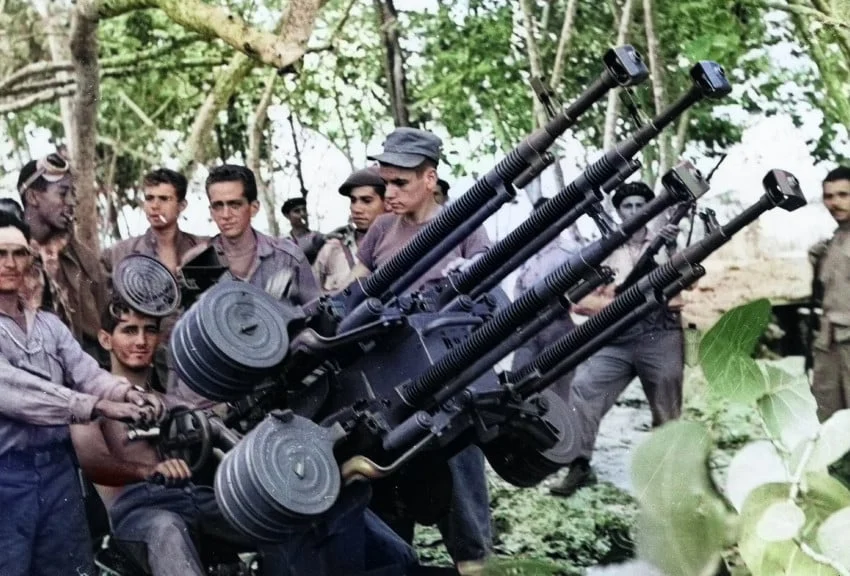
The Bay of Pigs invasion remains one of the most notorious military blunders of the Cold War, a stark testament to the perils of underestimating an adversary and the complexities of covert operations. In April 1961, the United States, under the leadership of President John F. Kennedy, orchestrated a clandestine operation aimed at overthrowing the revolutionary government of Fidel Castro in Cuba. The Central Intelligence Agency (CIA) spearheaded the effort, recruiting, training, and arming approximately 1,400 Cuban exiles. These exiles, deeply disillusioned with Castro’s communist regime, were envisioned as the spearhead of an amphibious assault on the southern coast of Cuba. The core strategic assumption was that this landing would establish a beachhead, ignite a popular uprising among the Cuban populace, and ultimately lead to Castro’s downfall, all while allowing the U.S. to maintain plausible deniability.
The meticulously crafted plan, however, unraveled with alarming speed, as nearly every critical assumption proved to be fundamentally flawed. The Cuban security apparatus, far from being caught by surprise, had detected significant warning signs of the impending operation well before the invasion commenced on April 17, 1961. This forewarning allowed Cuban forces to meticulously prepare defensive positions, effectively nullifying the element of surprise. Furthermore, the expected widespread popular support for the invading exiles failed to materialize. Instead of rallying to their cause, a substantial portion of the Cuban population remained loyal to Castro, viewing the invaders as foreign-backed puppets.
The exiled brigade found itself facing a far more formidable and organized resistance than anticipated. Cuban tanks, artillery, and aircraft mounted a fierce and coordinated defense, overwhelming the lightly armed exiles. Compounding these tactical difficulties were political anxieties within Washington. President Kennedy, deeply concerned about the potential for direct U.S. military involvement to escalate into a full-blown conflict with the Soviet Union, significantly curtailed American air support. This decision, made to minimize the perception of direct U.S. intervention, left the invading force critically vulnerable and isolated. The consequences were swift and devastating. Within a mere three days, the invasion collapsed. Over a hundred members of the brigade were killed in action, and nearly 1,200 were captured, marking a profound humiliation for the United States and a significant propaganda victory for Cuba and the Soviet Union.
Chronology of the Bay of Pigs Invasion:
- Early 1960: Following the Cuban Revolution and the nationalization of U.S. assets, President Eisenhower authorizes the CIA to plan for the overthrow of Fidel Castro.
- March 1960: The CIA begins recruiting and training Cuban exiles in the United States and Central America.
- November 1960: John F. Kennedy is elected President of the United States. He is briefed on the invasion plan and, despite some reservations, approves its continuation.
- April 15, 1961: U.S. B-26 bombers, disguised as Cuban aircraft, strike Cuban airfields in an attempt to neutralize Castro’s air force. The strikes are only partially successful.
- April 17, 1961: Brigade 2506, the force of Cuban exiles, lands at Playa Girón and Playa Larga in the Bay of Pigs.
- April 18-19, 1961: Cuban government forces, supported by tanks and artillery, engage the invaders. The exiles, lacking adequate air support and facing overwhelming numbers, are pushed back.
- April 19, 1961: The invasion is defeated. Survivors are captured, and the operation is declared a failure.
Supporting Data and Context:
- Intelligence Failures: The CIA’s intelligence assessment significantly underestimated Castro’s military strength, the loyalty of the Cuban population, and the effectiveness of Cuban air defenses.
- Logistical Shortcomings: The exiled brigade was poorly equipped and lacked adequate heavy weaponry and artillery to overcome entrenched Cuban forces.
- Political Interference: President Kennedy’s decision to limit U.S. air support, while politically motivated to avoid direct U.S. involvement, critically weakened the invading force.
- Propaganda Victory: The failure was a major propaganda coup for Cuba and the Soviet Union, bolstering Castro’s image as a defender of Cuban sovereignty against American imperialism.
- Human Cost: Over 100 exiles were killed, and nearly 1,200 were captured. Many of the captured exiles were later exchanged for food and medicine in a deal with the U.S.
Official Responses and Reactions:
Following the disastrous outcome, President Kennedy took responsibility for the failure, stating in a televised address, "The course of events has been a source of great concern. I am, of course, the final responsibility for the events." This admission, while a sign of leadership, did little to assuage the domestic and international fallout. The failed invasion intensified anti-American sentiment in Cuba and led to a hardening of relations between the U.S. and Cuba, ultimately contributing to the Cuban Missile Crisis in 1962. The Soviet Union, meanwhile, used the event to further solidify its alliance with Cuba and to criticize U.S. foreign policy.
Broader Impact and Implications:
The Bay of Pigs invasion had profound and lasting implications for U.S. foreign policy and intelligence operations. It led to a significant reassessment of the CIA’s role and capabilities, resulting in internal reforms. The failure also underscored the dangers of covert operations and the importance of understanding the local political and social dynamics of a target country. For Cuba, the invasion solidified Castro’s grip on power and deepened its reliance on the Soviet Union for military and economic support. The memory of the Bay of Pigs continues to be a potent symbol of Cuban resistance against perceived U.S. aggression.
Operation Eagle Claw (1980): A Desert Rescue Gone Wrong
Operation Eagle Claw, launched by the United States in April 1980, was a desperate attempt to rescue 52 American hostages held in the U.S. Embassy in Tehran, Iran. The crisis had begun in November 1979 when Iranian students, angered by the U.S. harboring of the Shah, seized the embassy and took its staff captive. For months, diplomatic efforts to secure their release had stalled, prompting President Jimmy Carter to authorize a military rescue mission. The plan was daring and complex, involving a multi-pronged assault by elite U.S. Army, Navy, and Air Force special operations forces.
The mission aimed to insert special forces personnel into Tehran by helicopter from an aircraft carrier stationed in the Persian Gulf. These forces would then proceed to the embassy, neutralize any guards, and extract the hostages. Simultaneously, other forces were to secure the Iranian Foreign Ministry, where a smaller group of hostages was held. The operation was fraught with immense logistical and environmental challenges, operating deep within hostile territory under strict secrecy.
However, like the Bay of Pigs, Operation Eagle Claw was doomed from its inception by a series of catastrophic failures. The primary obstacle emerged just hours into the operation, when helicopters encountered unexpected sandstorms and severe dust clouds in the Iranian desert. These conditions drastically reduced visibility, making navigation incredibly perilous. One helicopter suffered a catastrophic mechanical failure and was forced to abort. A second helicopter experienced critical hydraulic problems and also had to be grounded.
The most devastating incident occurred when a third helicopter collided with a refueling aircraft at their desert rendezvous point, the Masjed-e Soleyman desert landing zone. The collision ignited a massive fireball, killing eight U.S. servicemen and destroying both the helicopter and the refueling aircraft, along with vital equipment and intelligence. The catastrophic loss of life and matériel, coupled with the compromised secrecy of the operation, forced a grim decision: abort the mission. The remaining helicopters, along with the special forces, were forced to retreat to the aircraft carrier, leaving the hostages behind.
The failure of Operation Eagle Claw was a profound blow to American prestige and morale. It exposed significant shortcomings in the planning, coordination, and execution of complex special operations missions. The inability to successfully rescue the hostages fueled public frustration and contributed to President Carter’s declining popularity.
Chronology of Operation Eagle Claw:
- November 4, 1979: Iranian students seize the U.S. Embassy in Tehran, taking 66 Americans hostage.
- Late 1979 – Early 1980: Diplomatic negotiations to secure the hostages’ release fail.
- January 1980: President Carter authorizes the planning of a military rescue operation.
- April 24, 1980: The operation commences. Eight RH-53D Sea Stallion helicopters depart from the USS Nimitz.
- April 24, 1980 (Evening): Helicopters encounter severe sandstorms and navigational difficulties. One helicopter aborts due to mechanical failure. A second helicopter is grounded due to hydraulic issues.
- April 25, 1980 (Early Morning): The remaining helicopters converge at the desert rendezvous point. A collision occurs between an RH-53D helicopter and an EC-130 Hercules transport aircraft, resulting in a massive explosion and fire. Eight U.S. servicemen are killed.
- April 25, 1980 (Morning): President Carter, upon learning of the disaster, orders the immediate termination of the operation.
Supporting Data and Context:
- Environmental Challenges: The mission was conducted in a hostile desert environment with unpredictable sandstorms, significantly impacting visibility and helicopter performance.
- Equipment Malfunctions: Several helicopters experienced critical mechanical and hydraulic failures, highlighting potential issues with equipment readiness and maintenance for extended, high-stress operations.
- Intelligence Gaps: While the general location of the hostages was known, detailed intelligence on Iranian defenses, the exact layout of the embassy, and potential escape routes was less comprehensive than ideal.
- Coordination Issues: The complex coordination required between different branches of the military and various aircraft types proved to be a significant challenge.
- Human Cost: The operation resulted in the tragic deaths of eight U.S. servicemen: five U.S. Air Force aircrew members and three U.S. Marine Corps pilots.
Official Responses and Reactions:
The immediate aftermath of Operation Eagle Claw was marked by shock and disbelief. President Carter, in a somber televised address, announced the mission’s failure and the tragic loss of life. He stated, "The risks were great, and the mission was not successful. We tried. We tried to save American lives." The Pentagon launched an extensive investigation into the causes of the failure, which led to significant reforms in U.S. special operations. The Iranian government, meanwhile, used the failed rescue attempt to further rally domestic support and denounce American interventionism.
Broader Impact and Implications:
The failure of Operation Eagle Claw had far-reaching consequences for U.S. military doctrine and capabilities. It directly led to the establishment of the Joint Special Operations Command (JSOC) in 1980, a unified command responsible for planning and executing the most sensitive special operations missions. The lessons learned from Eagle Claw informed the development of new tactics, training regimens, and equipment for special forces. The incident also reinforced the importance of meticulous planning, robust contingency measures, and realistic assessment of environmental and enemy factors in high-risk operations. The hostage crisis itself continued for another 14 months, finally ending with the release of the hostages on January 20, 1981, shortly after Ronald Reagan’s inauguration as president.
These historical examples, from the shores of Cuba to the deserts of Iran, serve as enduring cautionary tales in the annals of military history. They underscore the inherent unpredictability of warfare and the critical importance of accurate intelligence, realistic planning, and adaptability in the face of unforeseen circumstances. The ambition to achieve swift victory, while a powerful motivator, must always be tempered by a sober understanding of the potential for catastrophic failure.
