
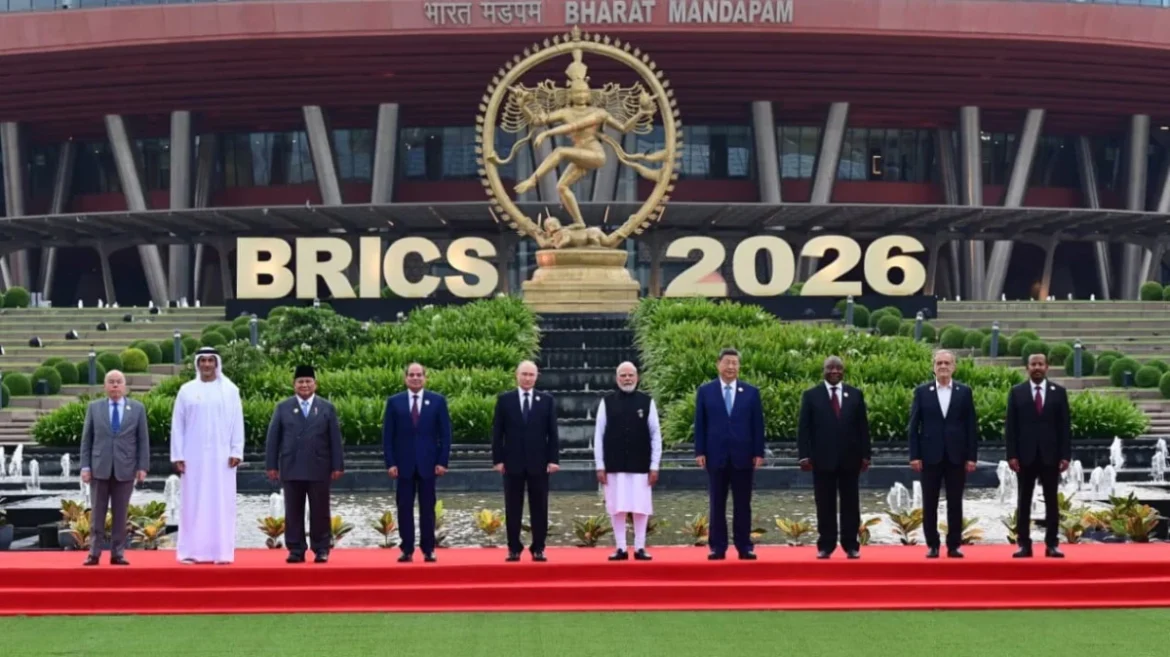
The international diplomatic landscape reached a significant milestone on Saturday, September 12, 2026, as the BRICS Summit officially concluded at the prestigious Bharat Mandapam convention center in New Delhi, India. The high-profile gathering of emerging economies culminated in the formal adoption of the New Delhi Declaration, a comprehensive framework designed to translate long-standing diplomatic commitments into tangible, actionable outcomes. Hosted by the Republic of India, the summit drew international attention not only for its policy directives regarding the reform of global institutions but also for the powerful coalition-building among member states aiming to amplify the voices of developing nations on the world stage.
Background and Context of the BRICS 2026 Summit
The BRICS bloc—originally comprising Brazil, Russia, India, China, and South Africa, and subsequently expanded to include several new member states—has steadily evolved from an economic acronym into a formidable geopolitical and financial counterweight to traditional Western-led institutions. The 2026 summit in New Delhi took place against a backdrop of escalating global uncertainties, including fragmented supply chains, post-pandemic economic recoveries, ongoing geopolitical conflicts, and systemic inequities within global governance bodies such as the United Nations Security Council, the International Monetary Fund (IMF), and the World Bank.
For months leading up to the September gathering, sherpas and foreign ministers from member states negotiated extensively to craft a unifying document that could address these multi-faceted crises. The choice of New Delhi as the host city underscored India’s growing diplomatic clout and its strategic vision of bridging the interests of the Global North and the Global South. Security was exceptionally tight throughout the event, punctuated by high-profile arrivals, including Russian President Vladimir Putin, whose transport aboard the advanced Illyushin Il-96-300PU command aircraft—often referred to in geopolitical circles as the "Doomsday plane"—underscored the high-stakes nature of modern summit diplomacy.
Chronology of the Summit and Key Proceedings
The path to the New Delhi Declaration involved a rigorous schedule of multilateral engagements, restricted-format leadership dialogues, and plenary sessions spanning several days in mid-September 2026.

- September 11, 2026: Delegations arrived in the Indian capital, accompanied by bilateral sideline meetings addressing trade agreements, local currency settlements, and technological cooperation. The arrival of key heads of state set a tense yet cooperative tone for the economic powerhouse bloc.
- September 12, 2026: The core of the leadership deliberations took place at Bharat Mandapam. During the restricted session, leaders engaged in transparent, constructive assessments of contemporary global realities. Indian Prime Minister Narendra Modi opened the dialogue by emphasizing that the accelerating pace of global change demands an urgent, comprehensive overhaul of international institutions. Later that afternoon, the finalized New Delhi Declaration was formally adopted, committing members to actionable metrics rather than rhetorical promises.
- September 13, 2026: Post-summit analyses, bilateral press briefings, and regional reactions began circulating globally, evaluating the immediate economic and political ripples of the declaration.
Prime Minister Narendra Modi’s Vision for Institutional Reform
Addressing the plenary session, Indian Prime Minister Narendra Modi provided a sharp critique of the current architecture of global governance. He argued that the world’s institutional frameworks remain woefully outdated, lacking the representation, agility, and modern rules of engagement required to navigate twenty-first-century challenges.
"We must work through partnership and collective action to bridge the gap between commitment and result," Prime Minister Modi stated during his address. Highlighting the core achievement of the summit, he added, "The ‘New Delhi Declaration’ adopted today provides a clear direction for our shared resolve. Now it is our responsibility to translate these commitments into real outcomes."
Modi’s remarks resonated deeply with delegations seeking structural reforms in international financial institutions, advocating for a system that better reflects the economic weight of emerging markets rather than post-World War II power dynamics.
President Prabowo Subianto and the Voice of the Global South
Among the prominent voices shaping the dialogue was Indonesian President Prabowo Subianto, who delivered a compelling address emphasizing that the strength of BRICS must extend far beyond diplomatic paperwork. Representing one of Southeast Asia’s most dynamic economies, Prabowo positioned his remarks around the practical empowerment of ordinary citizens and the structural elevation of the Global South.
"Inilah jenis kekuatan kolektif yang kita butuhkan. Kekuatan yang tidak berhenti di atas kertas, tetapi diterjemahkan menjadi peluang bagi masyarakat kita. Kekuatan yang memungkinkan Global South memiliki suara yang lebih besar dalam membentuk masa depannya sendiri," President Prabowo asserted, translating his vision for equitable global participation.

Expanding on this theme, the Indonesian leader stressed that collective solidarity within the bloc should serve as a practical instrument for forging a fairer, more balanced international order. He argued that when emerging nations pool their diplomatic and economic capital, their collective interests can no longer be sidelined by traditional power centers.
"Kekuatan yang sama juga harus digunakan untuk membangun tatanan internasional yang lebih adil dan setara. Bersama-sama, kita dapat membuat kekuatan kita diperhitungkan," he added.
Fact-Based Analysis of Implications and Future Outlook
The adoption of the New Delhi Declaration carries profound implications for international relations, global trade, and multilateral diplomacy. By institutionalizing mechanisms for closer cooperation, the BRICS bloc has signaled its intent to challenge unipolar financial systems, promote alternative payment mechanisms to reduce reliance on dominant reserve currencies, and foster resilient supply chains among developing nations.
However, analysts point out that the true test of the New Delhi Declaration will lie in its implementation. Past declarations by large multilateral blocs have frequently faced hurdles regarding domestic political shifts, divergent national interests among member states, and bureaucratic inertia. For Indonesia, India, and their partners, maintaining cohesion while expanding membership will require delicate balancing acts.
Nevertheless, the 2026 New Delhi summit has fundamentally redrawn the parameters of diplomatic engagement. It has reinforced the narrative that the Global South is no longer a passive recipient of global rules formulated elsewhere, but an active, assertive architect of its own economic and political destiny. As the delegations depart New Delhi, the global community watches closely to see how quickly and effectively these lofty declarations materialize into ground-level realities.
