
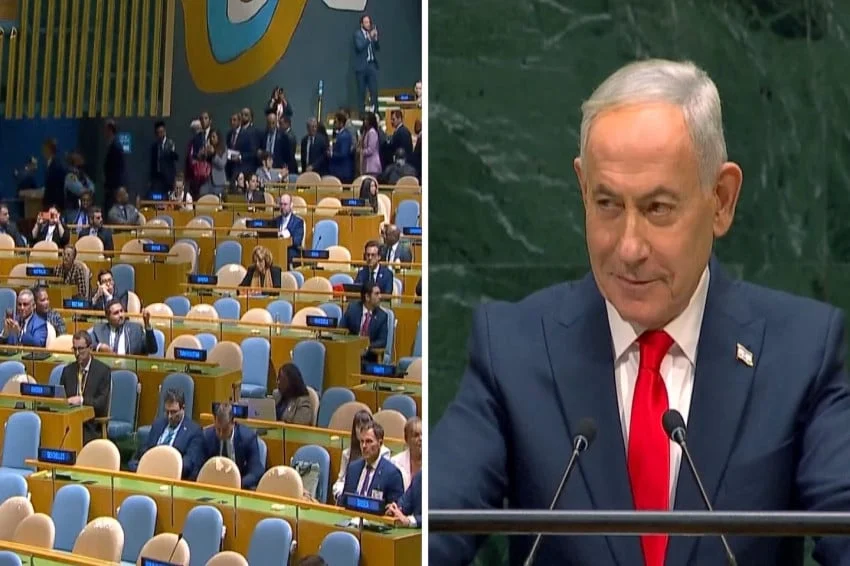
The 81st session of the United Nations General Assembly in New York witnessed an unprecedented display of diplomatic defiance on Thursday, September 24, 2026, as dozens of international delegates staged a mass walkout moments before Israeli Prime Minister Benjamin Netanyahu took the podium. This coordinated protest underscored a deepening chasm between Israel’s current administration and the broader international community regarding the ongoing conflict in Gaza. The spectacle of empty chairs, captured by international broadcasters, served as a stark visual representation of the mounting diplomatic pressure and isolation facing the Israeli leader on the global stage.
The Scene at the General Assembly Hall
As Benjamin Netanyahu approached the rostrum, a significant portion of the diplomatic corps, representing nations from various continents, rose from their seats and exited the assembly hall in a synchronized gesture of disapproval. The action was swift and noticeable, leaving vast sections of the chamber vacant. Reports from Israeli media outlets, including Channel 12 and Yedioth Ahronoth, corroborated the visual evidence of the near-empty rows.
The reaction from the Prime Minister was immediate. Visibly agitated by the empty hall, Netanyahu deviated from the tone typically associated with high-level diplomatic addresses, labeling the departing delegates as "moral cowards." His speech, which was intended to project strength and defiance, instead became defined by the very protest he sought to dismiss.
Chronology of Escalating Tensions
The events of September 24 did not occur in a vacuum. The roots of this diplomatic friction extend back to the escalation of violence in October 2023. Since the onset of the war in Gaza, the international community has grappled with the humanitarian crisis, resulting in significant legal and political consequences for the Israeli government.
- October 2023: The conflict in Gaza intensifies, sparking global protests and early calls for a ceasefire from UN agencies.
- 2024: The International Criminal Court (ICC) issues warrants, effectively marking Netanyahu as a wanted individual in signatory jurisdictions due to allegations of war crimes.
- September 2026: The lead-up to the UN General Assembly sees intense lobbying and protests across New York City, with various advocacy groups calling for the arrest or exclusion of the Israeli leadership.
- September 24, 2026: The mass walkout occurs during the UNGA session, highlighting the symbolic and practical collapse of diplomatic consensus surrounding Israel’s military policies.
Protests Beyond the United Nations
Outside the fortified perimeter of the United Nations headquarters, the atmosphere was equally charged. Demonstrators, including members of anti-Zionist Orthodox Jewish groups, American civil rights organizations, and Palestinian solidarity movements, filled the streets of New York. The protestors carried banners explicitly accusing the Israeli government of genocide and war crimes.
This coalition of dissent represents a shift in the traditional discourse surrounding the Israeli-Palestinian conflict. By bringing together diverse groups—ranging from religious organizations to secular political activists—the movement has managed to maintain sustained pressure on Western leaders to re-evaluate their military and political support for Israel. The intensity of these demonstrations forced local law enforcement to implement heavy security protocols, further highlighting the controversial nature of Netanyahu’s visit.
Rhetoric and Diplomatic Fallout
During his address, Netanyahu attempted to seize the narrative, focusing his ire on critics both inside and outside the assembly. He specifically singled out Zohran Mamdani, a prominent local political figure in New York who had previously campaigned on the promise of holding the Israeli Prime Minister accountable for alleged war crimes.
"You tried to prevent me from coming here. You tried to silence me. You cannot silence the truth," Netanyahu declared, framing his presence at the UN as a triumph of resolve against an international "antisemitic mob."
However, his rhetoric extended beyond domestic critics. He directed sharp criticism toward European nations, accusing them of surrendering to extremist elements, and leveled accusations of disinformation against Qatar and Turkey. These remarks, rather than unifying the assembly, appeared to further alienate potential diplomatic allies, signaling a breakdown in the traditional protocols of international diplomacy.
Analysis: The Implications of Isolation
The events at the General Assembly reflect a broader trend of "diplomatic fragmentation." For decades, the UN has served as a forum for balancing competing national interests. However, the current crisis has challenged the efficacy of the UN as a mediator.
- The ICC Factor: The fact that the Prime Minister of a major US ally is now an internationally wanted figure by the ICC creates a complex legal environment. It complicates the ability of other nations to engage in standard diplomatic exchange without risking domestic or international legal backlash.
- Erosion of Traditional Alliances: The explicit criticism of Western European leaders by Netanyahu suggests that the "special relationship" between Israel and the Western bloc is undergoing a period of profound stress. The accusation that these leaders are bowing to "antisemitic mobs" is a high-stakes rhetorical gamble that may alienate the moderate political center in Europe.
- The Role of Civil Society: The protests in New York serve as a reminder that foreign policy is increasingly influenced by domestic public opinion. As grassroots movements gain momentum, political leaders find it increasingly difficult to maintain unwavering support for regimes accused of international law violations.
Official Responses and the Road Ahead
While official responses from the United Nations Secretariat remained largely neutral, emphasizing the importance of open dialogue and adherence to international law, the sentiment among the delegates was clear. Many diplomats, speaking on condition of anonymity, indicated that the walkout was not a spontaneous act but a calculated expression of frustration with the lack of progress in Gaza.
The humanitarian data remains the primary driver of this diplomatic volatility. With the death toll in Gaza climbing and infrastructure in ruins, the international community faces increasing pressure to move beyond rhetoric. The failure of the diplomatic process to secure a lasting resolution has created a vacuum that is increasingly being filled by confrontational politics.
The Changing Landscape of International Law
The inclusion of the ICC warrants in the public discourse surrounding this UNGA session marks a turning point. It suggests that international law is no longer a peripheral concern in high-level diplomacy but a central factor that dictates the legitimacy of state leaders. By challenging the authority of these international bodies, Netanyahu is effectively challenging the post-World War II order that the United Nations was established to uphold.
As the 2026 UNGA continues, the fallout from this walkout will likely dominate discussions in the corridors of power. The incident serves as a barometer for the state of global politics, where the divide between state sovereignty and international accountability has never been more pronounced. Whether this leads to a shift in policy or a further entrenchment of existing positions remains to be seen, but the events of Thursday have undeniably altered the diplomatic landscape for the foreseeable future.
Conclusion
The mass walkout at the UN General Assembly is more than just a symbolic protest; it is a manifestation of the profound political and moral crisis surrounding the war in Gaza. By choosing to confront the assembly with defiance rather than reconciliation, Benjamin Netanyahu has deepened the isolation of his government. As the international community continues to grapple with the complexities of the conflict, the events in New York will likely be remembered as a pivotal moment where the consensus on global norms was tested, and in many respects, found wanting. The challenge for the future lies in whether the international system can bridge these widening gaps or if it will continue to witness the erosion of the institutions designed to keep global peace and security.
