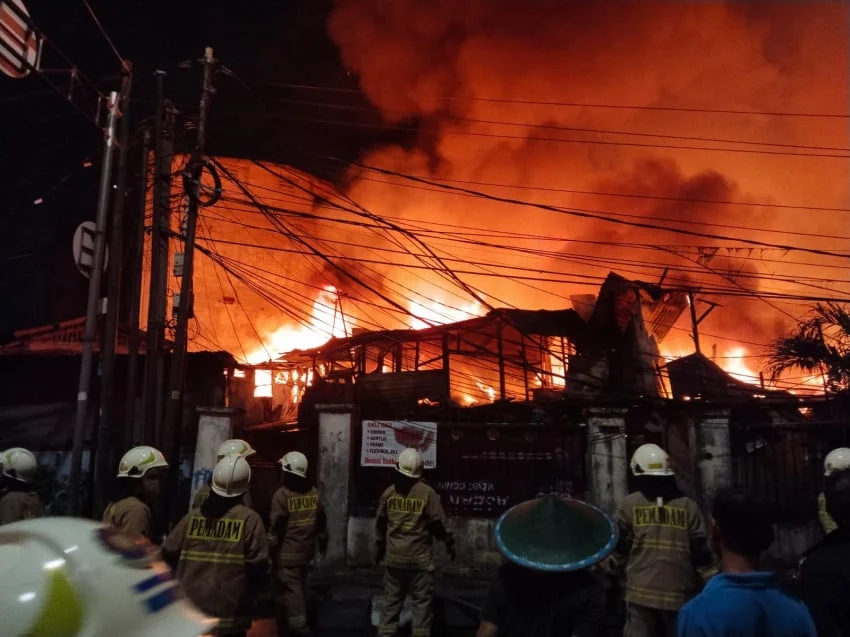
A devastating fire broke out in a densely populated residential area located along Jalan Teuku Nyak Arif, within the administrative bounds of Kebayoran Lama Utara Village, Kebayoran Lama Subdistrict, South Jakarta. The catastrophic incident, which unfolded on Tuesday night, September 22, 2026, generated widespread panic among local residents and required an aggressive, large-scale emergency response from the Jakarta Fire and Rescue Department. Driven by strong evening winds, close-set housing structures, and highly combustible materials, the flames rapidly consumed multiple properties, leaving a trail of destruction in this densely populated urban pocket.
In response to the escalating crisis, authorities mobilized a massive contingent of emergency responders. A total of 128 professional firefighters, supported by 24 heavy-duty fire engines and specialized tactical units, were dispatched to the scene to combat the raging inferno. The sheer scale of the deployment underscores the inherent vulnerabilities of Jakarta’s high-density neighborhoods, where narrow access roads, tightly packed residential blocks, and semi-permanent structures frequently turn localized electrical faults or domestic accidents into widespread urban disasters.
Rapid Chronology of the Emergency Response
The critical timeline of the incident highlights the swift mobilization of Jakarta’s emergency services, as well as the harrowing speed at which the fire propagated through the neighborhood. According to official logs from the Command Center of the Jakarta Provincial Fire and Rescue Department (Sudin Gulkarmat Jakarta Selatan), the initial emergency call was received from an alert local resident at 20:31 Western Indonesia Time (WIB).
The dispatch center immediately triggered an alarm, alerting nearby fire stations to mobilize units toward the crisis epicenter, situated in close proximity to the Kramat Street traffic light intersection—a prominent local landmark that aided responding drivers in navigating the congested evening traffic.
Despite the challenges posed by urban congestion and narrow thoroughfares, the first wave of firefighting units successfully breached the perimeter, arriving at the scene (TKP) by 20:39 WIB, a mere eight minutes after the initial distress call. Tactical operations commenced almost immediately at 20:41 WIB, with fire crews establishing water lines and initiating aggressive perimeter defense to prevent the flames from leaping across adjacent alleys and consuming a wider swathe of the community.
While firefighters battled the blaze from multiple flanks, thick plumes of dark smoke billowed high into the South Jakarta night sky, visible from kilometers away. Residents evacuated their homes in frantic haste, rescuing whatever personal belongings, documents, and valuables they could carry while emergency sirens wailed continuously through the narrow streets.
Preliminary Cause and Initial Investigation Findings
Initial reports gathered from eyewitness testimony and preliminary assessments conducted by neighborhood wardens suggest that the fire originated from a suspected electrical short circuit—commonly referred to in Indonesia as korsleting listrik. Investigators and local informants indicated that the spark likely ignited on the upper floor of a multi-story rental housing unit (rumah kontrakan) before swiftly turning into an unmanageable blaze.
Because many residential structures in Jakarta’s densely populated quarters feature aging electrical installations, improvised wiring setups, and wooden partition walls, electrical anomalies frequently escalate into destructive conflagrations. In this specific instance, the combustible nature of the initial structure, combined with strong drafts moving through the alleyways, allowed the fire to jump rapidly to surrounding properties.
Among the structures engulfed or heavily damaged in the wake of the primary ignition point were an active local eatery (warung makan) and a commercial tire repair workshop (bengkel ban). The presence of automotive tires, rubber compounds, and cooking gas cylinders within these commercial annexes acted as heavy accelerants, producing intense heat, toxic black smoke, and localized mini-explosions that further complicated the firefighting efforts.
Urban Vulnerability and the Persistent Threat of Jakarta Fires
The incident in Kebayoran Lama highlights a recurring and systemic urban planning challenge in the Indonesian capital: the extreme fire vulnerability of high-density kampungs. Jakarta, as a bustling metropolis of millions, features numerous pockets where rapid urbanization has outpaced formal spatial planning. In these zones, homes are built immediately adjacent to one another, often utilizing lightweight, non-fire-retardant materials to maximize living space on constrained plots of land.
Furthermore, infrastructure limitations severely hamper emergency responses. Narrow access roads, which are frequently obstructed by parked vehicles, street vendors, and overhead electrical cables, make it exceptionally difficult for modern fire trucks to reach the exact core of a fire zone. Consequently, firefighters often have to lay down hundreds of meters of flexible hose lines from main thoroughfares into narrow interior alleys, adding critical minutes to the initial containment phase.
Urban development experts and municipal analysts frequently point out that while emergency response teams under the Jakarta Provincial Government maintain high readiness and rapid deployment times, structural mitigation remains the most effective long-term solution. Public awareness campaigns addressing substandard household electrical installations, illegal power taps, and the safe storage of liquefied petroleum gas (LPG) cylinders are vital components of community-level disaster risk reduction.
Socio-Economic Impact and Humanitarian Concerns
While official figures regarding total material losses, displaced persons, and potential casualties continue to be compiled by local disaster management agencies, the humanitarian toll of the Kebayoran Lama fire is immediate and profound. Dozens of families have been abruptly displaced from their homes, losing shelter, clothing, personal identification documents, and means of livelihood overnight.
Displaced residents typically find temporary refuge in makeshift evacuation posts set up in local community halls, neighborhood association (RT/RW) offices, or emergency tents erected by the Indonesian Red Cross (PMI) and the Social Service Agency (Dinas Sosial). In the immediate aftermath of such disasters, urgent priorities include the distribution of clean drinking water, ready-to-eat meals, infant care supplies, emergency bedding, and medical evaluations for smoke inhalation or psychological shock.
Local authorities, community leaders, and volunteer networks have mobilized to coordinate relief efforts, establishing public kitchens and donation collection points. The psychological trauma experienced by children and the elderly, who witnessed their homes reduced to ash and rubble within minutes, requires coordinated psychosocial support from municipal health workers and trauma-healing volunteers.
Broader Implications and Municipal Recommendations
The Kebayoran Lama fire serves as a sobering reminder of the constant vigilance required to maintain fire safety in densely populated metropolitan environments. As Jakarta transitions through various phases of modernization, municipal authorities face mounting pressure to upgrade infrastructure within legacy neighborhoods, improve electrical grid safety inspections in cooperation with state electricity enterprise PLN, and enforce stricter building codes regarding spatial separation and fire-resistant materials.
Moving forward, the South Jakarta local government and the Gulkarmat agency are expected to ramp up community-based fire prevention training programs. These initiatives empower local residents—often the first line of defense before professional units arrive—with basic firefighting skills, such as the proper operation of lightweight dry-powder fire extinguishers and the safe evacuation of vulnerable populations.
As recovery and cooling operations conclude at the Jalan Teuku Nyak Arif site, forensic investigators from the local police sector will conduct a thorough crime scene examination to officially determine the precise point of origin and exact cause of the disaster. Meanwhile, the resilience of the affected community is already being tested as families begin the arduous process of clearing debris, salvaging personal belongings, and charting a path toward physical and financial reconstruction in the heart of South Jakarta.