
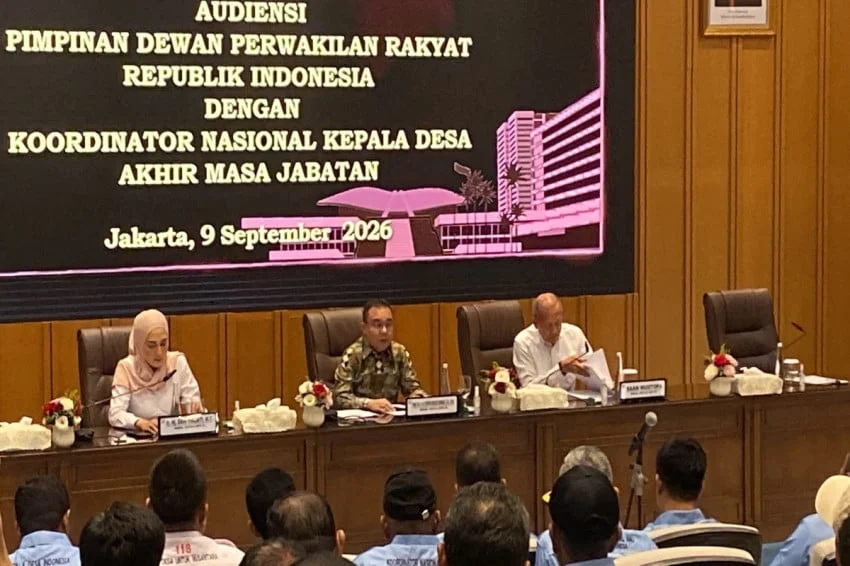
The leadership of the House of Representatives of the Republic of Indonesia (DPR RI) officially convened with representatives from the National Coordinator of Village Heads with Expiring Terms of Office (Kades AMJ) at the Parliament Complex in Senayan, Jakarta. The high-level delegation meeting brought to light critical legislative, financial, and administrative concerns revolving around village governance, specifically focusing on the timing of upcoming village head elections (Pilkades) slated for 2027, tenure continuity, and broader socio-economic pressures impacting rural communities across the archipelago.
The legislative leadership team—comprising DPR RI Deputy Speaker Sufmi Dasco Ahmad, alongside fellow leadership members Sari Yuliati and Saan Mustopa—listened intently to the grievances and proposals put forth by the Kades AMJ delegation. The discourse held inside the Abdul Muis Room at Nusantara Building highlighted a growing friction between mandated administrative schedules and the realities of localized fiscal constraints, post-pandemic economic recovery, and global macroeconomic instability affecting local governance.
Core Grievances and the Quest for Policy Certainty
At the heart of the dialogue was the impending expiration of terms for numerous village heads scheduled for 2027. Village leaders voiced deep concerns regarding the operational clarity of transition periods, demanding definitive legal frameworks and policy adjustments from the central government. Beyond the procedural execution of Pilkades, the delegation underscored fundamental issues concerning the legal rights of village heads, institutional recognition of their public service tenure, and the preservation of long-term developmental programs at the grassroots level.
According to the representatives of Kades AMJ, rural administrators are currently grappling with multifaceted challenges. These include the residual impacts of global inflationary pressures, volatile commodity prices, and constrained local revenues that could potentially compromise the structural integrity and financial viability of conducting independent regional elections. Local leaders argued that forcing an uncoordinated electoral timeline amidst these economic headwinds might inadvertently trigger localized social friction and administrative paralysis within village governance structures.
Addressing the press following the closed-door session, DPR RI Deputy Speaker Sufmi Dasco Ahmad acknowledged the gravity of the concerns presented by the Kades AMJ delegation. He noted that the socio-economic climate—marked by inflationary trends and broader international financial turbulence—directly influences the preparedness and financial capability of villages to execute seamless electoral transitions.
"They conveyed aspirations regarding the current conditions, wherein inflation and global impacts also affect the implementation of the Pilkades, which is perceived as potentially burdensome to the current financial situation and the dynamics occurring in rural areas," stated Sufmi Dasco Ahmad.
Chronology of Legislative Engagement and Grassroots Advocacy
The meeting on Wednesday, September 9, 2026, was not an isolated event, but rather the culmination of an escalating advocacy campaign spearheaded by rural leaders seeking legislative intervention. Over the preceding months, various coalitions of village heads have intensified lobbying efforts directed at both the executive and legislative branches of the Indonesian government.
The trajectory of the Kades AMJ movement traces back to widespread nationwide debates concerning the revision of Village Law regulations, which previously ignited intense legislative deliberations regarding tenure extensions. While previous legislative adjustments addressed specific terms for incumbent officials, cohorts whose mandates conclude in 2027 have consistently flagged regulatory gaps that threaten administrative continuity.

Recognizing the urgency of these petitions, the DPR leadership committed to acting as a strategic bridge between local administrators and the relevant ministries. Rather than offering unilateral policy changes, the parliamentary leadership emphasized the necessity of inter-institutional coordination to establish a synchronized timeline for the 2027 Pilkades.
"We accept these aspirations and we will try to coordinate with the relevant parties," Dasco added, affirming that the parliamentary apparatus will channel the formal feedback to pertinent government bodies, including the Ministry of Home Affairs and relevant state agencies tasked with regional autonomy and village development oversight.
Socio-Economic Implications and Administrative Challenges
The synchronization of village head elections carries profound implications for Indonesia’s national stability and administrative efficiency. With over 74,000 villages spread across the nation’s vast archipelago, the village government serves as the primary frontline of public service delivery, infrastructural development, and social welfare distribution.
Political analysts and administrative governance experts have frequently highlighted that the timing of regional and village-level elections must be meticulously calibrated to avoid administrative fatigue and excessive fiscal expenditure. When national political cycles, regional elections (Pilkada), and localized Pilkades overlap or occur within compressed timeframes, local bureaucracies often experience severe operational strain.
Furthermore, the fiscal independence of villages heavily relies on the disbursement of the Village Fund (Dana Desa) alongside local revenue-generating mechanisms. In periods of global economic uncertainty, where inflationary pressures erode purchasing power and escalate the costs of public goods, local governments find themselves hard-pressed to balance administrative operational costs with developmental expenditures. Imposing rigid electoral schedules without accommodating these fiscal realities risks precipitating financial deficits at the village level, potentially stalling community-driven infrastructure projects.
By urging a coordinated approach to the 2027 Pilkades stages, the DPR aims to mitigate these systemic risks. Proper synchronization allows the central government, provincial authorities, and regency/city governments to allocate sufficient budgetary support, streamline security protocols, and ensure that the democratic transition at the village level does not disrupt ongoing public services.
Institutional Response and Future Outlook
As the legislative branch processes the inputs delivered by the Kades AMJ delegation, attention now shifts toward the executive branch. The formal transmission of these aspirations to relevant ministries is expected to trigger inter-ministerial coordination meetings designed to evaluate regulatory options, financial allocations, and legal feasibility.
Key stakeholders, including the Directorate General of Village Government at the Ministry of Home Affairs, will likely play a pivotal role in drafting technical guidelines and adjusting regulatory timelines. Any adjustments to the Pilkades framework will require careful balancing between upholding democratic principles of periodic leadership renewal and safeguarding administrative continuity.
For the millions of citizens residing in rural Indonesia, the resolution of these policy debates holds direct consequence for the quality of local governance. As the political calendar moves closer to 2027, the proactive engagement between the DPR and village heads underscores the enduring importance of grassroots representation in shaping national legislative agendas. The upcoming months will test the capacity of state institutions to harmonize top-down legal mandates with the nuanced, ground-level realities of Indonesia’s diverse rural landscape.
