
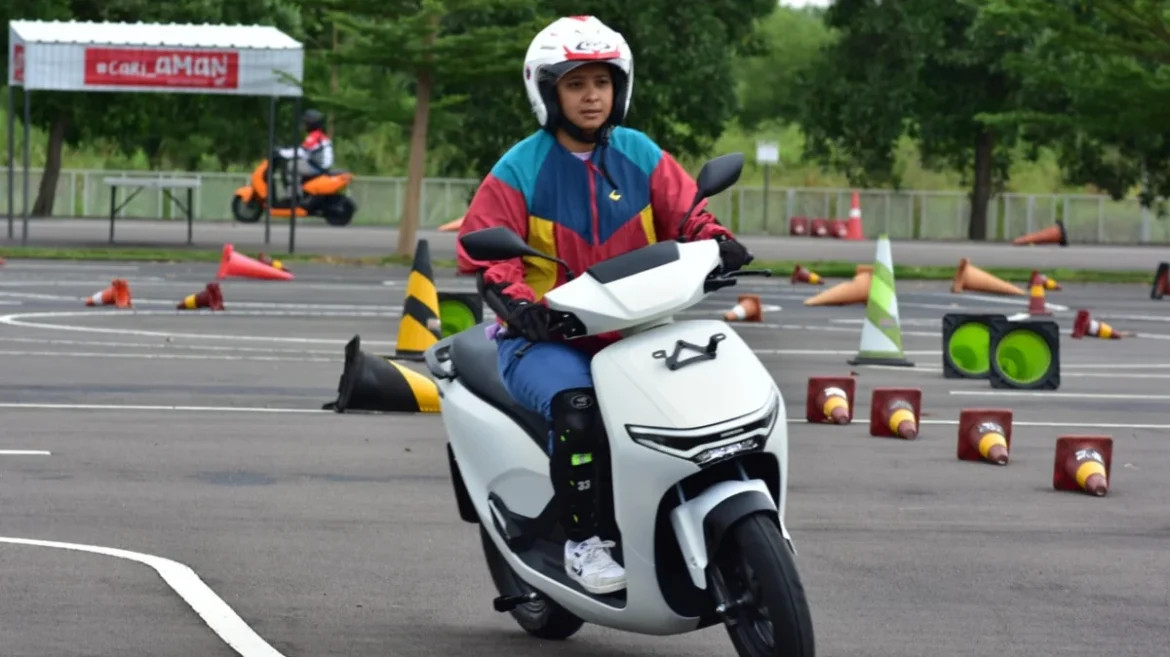
The transition toward sustainable mobility in Indonesia has reached a critical juncture in 2026, as urban commuters increasingly prioritize practicality alongside eco-friendly transportation. For residents of apartments, high-density residential areas, or urban housing units without dedicated garage charging infrastructure, the primary barrier to adopting electric vehicles (EVs) has historically been the difficulty of recharging batteries. However, a growing segment of the motorcycle market is addressing this challenge through the adoption of removable battery technology, allowing owners to detach their power cells and charge them conveniently within their homes or offices.
The Evolution of Urban Electric Mobility
As of September 2026, the Indonesian electric motorcycle market has diversified significantly. This shift is not merely a trend but a strategic response to the infrastructure gap in major cities like Jakarta, where traditional charging stations—while growing in number—cannot yet accommodate the sheer volume of prospective EV owners. The "swap or carry" model has emerged as the most viable solution for the average commuter.
By opting for motorcycles equipped with removable batteries, consumers bypass the need to install expensive high-voltage charging outlets at their residences. Instead, they can simply carry the battery pack—often weighing between 8 to 15 kilograms—indoors, connecting it to a standard 220-volt household electrical outlet. This convenience factor is currently the strongest driver of adoption among the middle-class urban demographic.
Honda’s Strategic Portfolio in the Removable Battery Segment
Honda, a dominant player in the Indonesian automotive landscape, has aggressively expanded its electric lineup to cater to various consumer needs, all utilizing the standardized Honda Mobile Power Pack e:.
The Honda ICON e:, priced starting at Rp28 million, serves as an entry-level gateway for urban commuters. With a certified range of 53 kilometers and a top speed of 55 km/h, it is positioned as an ideal daily commuter for short-to-medium urban distances. The ease of detaching the Mobile Power Pack e: allows for a seamless transition from the road to the home.
Moving up the tier, the Honda EM1 e:, which carries a price tag starting at Rp40 million, offers a more premium build quality. Despite a shorter certified range of 41.1 kilometers and a top speed of 45 km/h, it is favored for its refined design and engineering standards. For those requiring higher performance, the recently introduced Honda CUV e: represents the pinnacle of the current Honda lineup. Retailing from Rp54.45 million, it utilizes dual Mobile Power Pack e: units, pushing the certified range to 80.7 kilometers and achieving a top speed of 83 km/h with a peak power of 6 kW. This model signals Honda’s intent to compete not just in the commuter segment, but in the performance-oriented electric market.
Domestic Players and Competitive Landscape
While global giants like Honda are scaling up, local Indonesian manufacturers have maintained a strong competitive edge by focusing on affordability and direct integration with local grid standards.
Gesits, a pioneer in the local electric motorcycle industry, continues to offer the G1 model. Priced at Rp28.7 million (OTR Jakarta as of August 2026), the Gesits G1 has become a benchmark for local innovation. Its lithium-ion battery system is designed specifically for the Indonesian climate and infrastructure, allowing users to charge via standard residential electrical circuits.
United E-Motor has also carved out a significant niche by offering flexibility in charging. The United T1800, priced at approximately Rp31.5 million, provides a dual-method charging system—either through a direct-to-vehicle port or by removing the battery. This versatility is highly valued by consumers who may have occasional access to parking charging stations but prefer the security of indoor charging. The United TX series, including the TX1800 (Rp34.9 million) and the high-performance TX3000 (Rp50.9 million), further demonstrates this versatility. The TX3000, with its two-slot battery configuration, allows for a range of up to 120 kilometers under optimal conditions, bridging the gap between urban scooters and long-distance motorcycles.
Budget-Friendly Solutions and Market Accessibility
The market is further bolstered by manufacturers such as Volta, which focuses on high-volume, budget-conscious consumers. Models such as the Volta 401 (Rp16.95 million), Volta Virgo (Rp18.1 million), and Volta Mandala (Rp18.95 million) have made electric mobility accessible to a broader segment of the population. By maintaining price points below the psychological Rp20 million threshold, these brands have effectively democratized electric transport in Indonesia, proving that the removable battery model is scalable across different price brackets.
Technical Implications and Charging Infrastructure
From an engineering perspective, the transition to removable batteries involves a delicate balance between energy density and portability. The industry is currently moving toward standardizing battery form factors to allow for future cross-brand compatibility—a critical step for the mass adoption of "battery swapping" networks.
Data from the Ministry of Energy and Mineral Resources (ESDM) suggests that the current growth in electric motorcycle ownership is directly correlated with the availability of decentralized charging methods. In 2026, the reliance on household charging is expected to account for over 70% of total charging events for electric motorcycles, highlighting the critical role of removable battery designs in the national energy transition plan.
Industry analysts note that while fast-charging stations are essential for long-term growth, the "home-charging" paradigm is the immediate solution to the "range anxiety" that plagues new adopters. The simplicity of plugging in a battery unit alongside home appliances like a laptop or a refrigerator reduces the psychological barrier to switching from internal combustion engines to electric powertrains.
Challenges and Future Outlook
Despite the progress, the industry faces ongoing challenges. Thermal management remains a primary concern; batteries that are frequently removed and charged in non-controlled environments require sophisticated Battery Management Systems (BMS) to ensure safety and longevity. Manufacturers are currently investing heavily in "smart charging" technology, which allows the battery to communicate with the charger to optimize current flow, preventing overcharging and heat buildup.
Furthermore, the secondary market for electric motorcycles is just beginning to take shape. Experts suggest that the resale value of these vehicles will be heavily tied to the health of the removable battery packs. As such, manufacturers are increasingly offering battery leasing or exchange programs to mitigate the risks associated with long-term battery degradation.
Policy and Economic Impact
The Indonesian government’s commitment to providing incentives for electric vehicle purchases has played a vital role in keeping these prices competitive. As of mid-2026, the combination of tax exemptions and direct subsidies has helped keep the cost of ownership significantly lower than equivalent internal combustion engine (ICE) motorcycles over a five-year period, factoring in fuel savings and reduced maintenance requirements.
The shift toward removable batteries also supports the development of a circular economy. When these batteries eventually reach the end of their lifecycle for vehicle use, they can be repurposed for residential energy storage systems, a concept currently being piloted in several industrial parks in West Java.
Conclusion
The landscape of electric motorcycles in Indonesia is undergoing a rapid transformation. By focusing on models with removable batteries, manufacturers are solving the "last mile" problem of the charging infrastructure. Whether it is the high-performance Honda CUV e:, the rugged United TX3000, or the budget-friendly Volta series, the options available to the Indonesian consumer have never been more diverse. As 2026 progresses, the convergence of technological reliability, affordability, and practical design is setting the stage for a permanent change in how the nation moves, ensuring that electric mobility is not just a luxury for the few, but a daily reality for the many.
