
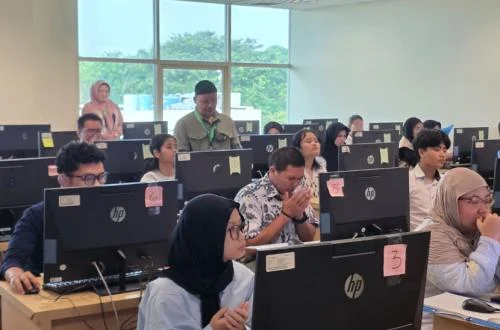
The landscape of higher education in Indonesia is witnessing a transformative shift toward greater inclusivity, as evidenced by the recent surge in applicants for the independent entrance examination for students with disabilities at Jakarta State University, known locally as Universitas Negeri Jakarta. On Saturday, July 18, 2026, the university conducted its Penmaba Mandiri Jalur Disabilitas (Independent Admissions Path for Persons with Disabilities) at the Dewi Sartika Building on its main campus. This year’s selection process saw a notable increase in participation, with 138 prospective students undergoing the examination—a 9.6 percent rise compared to the 125 applicants recorded during the 2025 admission cycle. This steady upward trajectory highlights not only the growing aspirations of individuals with disabilities to pursue academic excellence but also the increasing public confidence in the university’s ability to provide a supportive and accessible learning environment.
I Wayan Sugita, the Head of the Admissions Office at UNJ, emphasized that the rising numbers are a clear indicator of a broader societal shift. He noted that the annual increase suggests that more individuals with disabilities now view higher education as a viable and reachable goal. According to Sugita, the 138 participants this year represent a diverse group of individuals seeking to leverage education as a tool for empowerment. The university has positioned itself as a pioneer in inclusive education, and the data reflects a successful outreach to a demographic that has historically faced significant barriers to entry in the Indonesian tertiary education system.
Popular Academic Paths and Vocational Interests
The 2026 admissions data reveals specific trends in the academic preferences of applicants with disabilities. Three faculties emerged as the most sought-after destinations: the Faculty of Engineering, the Faculty of Education, and the Faculty of Languages and Arts. Within these faculties, the Bachelor of Applied Science in Culinary Arts and Food Service Management stood out as the most popular study program. The preference for this specific program suggests a strong interest among students with disabilities in vocational fields that offer tangible skills and clear pathways to the labor market.
Experts in inclusive education suggest that the high interest in Culinary Arts and Engineering may be linked to the practical nature of these disciplines. For many students with disabilities, acquiring specialized technical skills provides a sense of autonomy and a competitive edge in professional environments. Furthermore, the Faculty of Education remains a traditional stronghold for UNJ, which has a long-standing reputation as a "Lembaga Pendidikan Tenaga Kependidikan" (LPTK) or a Teacher Training Institute. Many applicants in this category aim to become educators themselves, potentially returning to the special education sector to mentor future generations of students with disabilities.
The Role of REDIS and On-Site Support Mechanisms
To ensure that the examination process was both fair and accessible, UNJ deployed a comprehensive support system tailored to the specific needs of the candidates. Central to this effort was the Universitas Negeri Jakarta Disability Volunteers, known as REDIS. For the 2026 selection process, REDIS mobilized 65 volunteers drawn from various academic years and departments. These volunteers were tasked with providing one-on-one assistance to candidates from the moment they arrived on campus until the conclusion of their examinations.
Prila Ahdanila, the Coordinator of REDIS for the 2026 Penmaba Disabilitas, explained that the logistical planning for the event began weeks in advance. The admissions office provided the volunteer team with detailed data regarding the specific requirements of each participant. This allowed REDIS to map out the necessary accommodations, which included physical guiding for visually impaired students, specialized communication support for those with autism or Attention-Deficit/Hyperactivity Disorder (ADHD), and the placement of professional sign language interpreters in examination rooms for candidates with hearing impairments.
The presence of sign language interpreters is a critical component of the university’s commitment to the "Universal Design" philosophy. By ensuring that instructions and clarifications are accessible in real-time, the university mitigates the risk of candidates underperforming due to communication barriers rather than a lack of academic merit. For students with neurodivergent conditions such as ADHD, the volunteers provided a calming presence and assisted in navigating the potentially overwhelming environment of a large-scale examination hall.
Institutional Advocacy for Equitable Assessment
The Vice Rector for Academic, Student, and Alumni Affairs, Professor Ifan Iskandar, reiterated that the disability admission path is a manifestation of the university’s mandate to uphold the constitutional rights of every citizen to access quality education. He stated that the institution’s primary goal is to ensure that every candidate has an equal opportunity to demonstrate their academic potential. Professor Ifan highlighted that the university is continuously refining its support services to make the selection process more accessible and just.
However, the 2026 selection process also sparked internal discussions regarding the need for further structural reforms. During a site visit to the examination rooms, the Rector of UNJ, Professor Komarudin, expressed his appreciation for the logistical support provided by the volunteers and the admissions office but raised a poignant question regarding the nature of the examination materials themselves.
Rector Komarudin noted that while the physical and communicative barriers are being addressed, the cognitive and pedagogical barriers remain a challenge. He pointed out that if the examination questions for the disability path are identical to those used in the regular admissions path, the process may not be entirely equitable. He advocated for a review of the assessment criteria and the potential customization of test materials to better suit the diverse ways in which students with disabilities process information and demonstrate knowledge. "If the questions remain the same as the regular path, then there must be adjustments in the evaluation criteria to ensure the selection process is truly fair," the Rector remarked.
Contextualizing Inclusive Education in Indonesia
The developments at UNJ do not occur in a vacuum but are part of a larger national movement toward disability rights. Indonesia’s Law No. 8 of 2016 on Persons with Disabilities mandates that both government and private higher education institutions provide inclusive environments and a minimum quota for students with disabilities. Since the enactment of this law, universities across the archipelago have been under increasing pressure to modernize their infrastructure and pedagogical approaches.
UNJ’s 9.6 percent increase in applicants is a significant benchmark when compared to national averages. Historically, the transition rate for students with disabilities from secondary to tertiary education in Indonesia has been disproportionately low due to a lack of facilities, financial constraints, and social stigma. By creating a dedicated admissions path and a visible support network like REDIS, UNJ is effectively lowering the threshold for entry and setting a standard for other state universities (PTN) to follow.
Analysis of Broader Implications and Future Outlook
The implications of this growth extend beyond the walls of the university. As more students with disabilities enter higher education, the Indonesian labor market will eventually see an influx of highly skilled professionals who happen to have disabilities. This shift is crucial for Indonesia’s "Golden Generation 2045" vision, which aims to transform the country into a developed nation by its centenary. An inclusive workforce is a prerequisite for sustainable economic growth and social stability.
Furthermore, the focus on programs like Culinary Arts and Engineering suggests that the university is successfully aligning its inclusive programs with industry needs. By training students in these fields, UNJ is challenging the stereotype that individuals with disabilities are only suited for a narrow range of "sheltered" occupations. Instead, they are being prepared for mainstream roles in the hospitality, manufacturing, and education sectors.
Looking forward, the challenges identified by Rector Komarudin regarding assessment fairness will likely become a focal point for academic research and policy development within the university. The transition toward "Differentiated Assessment"—where the method of testing is adjusted while maintaining academic rigor—could become the next frontier for UNJ. This might involve the use of assistive technology, extended time limits, or alternative formats for questions that accommodate different learning styles and sensory needs.
The 2026 Penmaba Mandiri Jalur Disabilitas at Jakarta State University serves as a case study in institutional evolution. The increase from 125 to 138 participants is more than just a statistic; it is a narrative of progress. It reflects a synergy between institutional policy, student volunteerism, and the resilience of the candidates themselves. As UNJ continues to evaluate and improve its inclusive practices, it reinforces its role as a leader in the national effort to ensure that "education for all" is not merely a slogan, but a tangible reality for every Indonesian citizen, regardless of their physical or neurological condition.
