
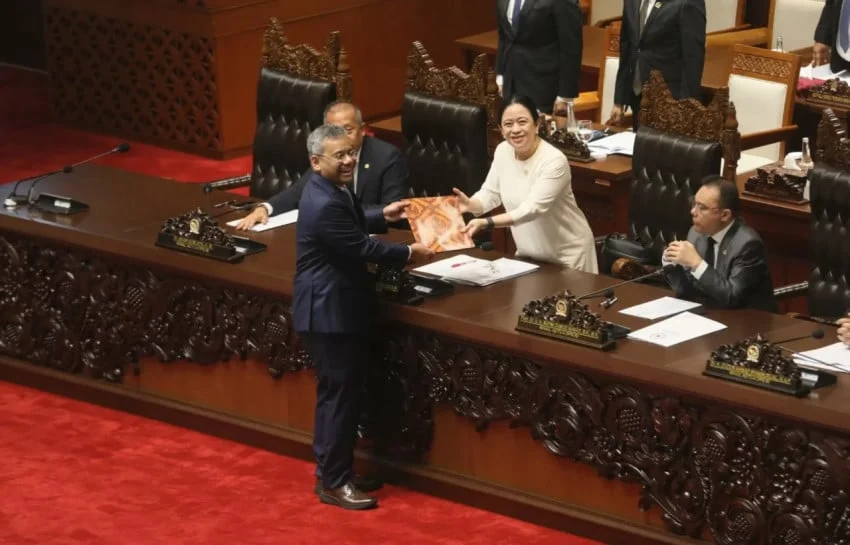
The House of Representatives of the Republic of Indonesia (DPR RI) officially ratified the 2027 State Budget (APBN) Bill into law during the 7th Plenary Session of the 2026-2027 Parliamentary Year, held on Tuesday, September 29, 2026, at the Parliament Complex in Senayan, Jakarta. The landmark legislative move marks the official roadmap for Indonesia’s fiscal policy for the upcoming year, with the government and the legislature reaching a consensus on a spending ceiling of Rp4,106.2 trillion.
The ratification ceremony, attended by legislative leaders and representatives from the executive branch, including Minister of Finance Suahasil Nazara, signals a strategic pivot toward fiscal consolidation while maintaining a robust commitment to social welfare and infrastructure development. The approved budget is designed to navigate global economic uncertainties, such as fluctuating commodity prices and potential shifts in global trade policies, while keeping the domestic economy on a stable growth trajectory.
Fiscal Posture and Key Economic Indicators
According to the final draft approved by the House, the 2027 fiscal framework is built upon three core pillars: revenue generation, expenditure prioritization, and deficit management. The state revenue target is set at Rp3,435.1 trillion. This revenue stream is expected to be derived from a combination of taxation reforms, non-tax state revenue (PNBP), and strategic asset management.
A critical aspect of the 2027 budget is the government’s commitment to fiscal discipline, with the budget deficit maintained at 2.4% of the Gross Domestic Product (GDP). This figure represents a balanced approach; it provides sufficient fiscal space for the government to stimulate the economy through infrastructure and social safety nets, while simultaneously adhering to the legal mandate that limits the budget deficit to a maximum of 3% of GDP, a cornerstone of Indonesia’s prudent fiscal management since the 2003 State Finance Law.
The Legislative Process: A Timeline of Deliberation
The passage of the APBN 2027 was the culmination of an intensive months-long negotiation process between the government’s economic team and the Budget Committee (Banggar) of the DPR RI. The process began with the government submitting the Financial Note and the Draft State Budget in August 2026.
Following the submission, the Budget Committee held a series of "level one" discussions, where detailed allocations for ministries, agencies, and regional transfer funds were scrutinized. Legislators focused heavily on the efficacy of social protection programs and the sustainability of ongoing national strategic projects (PSN). By late September, the House and the government reconciled their differences regarding tax revenue projections and subsidy allocations, leading to the final approval during the plenary session on September 29.
Parliamentary Perspective and Strategic Objectives
Ahmad Sahroni, Deputy Chairman of Commission III of the DPR RI, expressed strong support for the finalized budget. In his post-session remarks, Sahroni emphasized that while the fiscal space is admittedly tight, the allocation is optimized to serve the public interest.
"The 2027 APBN is secure and robust. While the margins are narrow, we have prioritized expenditures that directly impact the welfare of the people. We fully endorse the government’s strategic approach to this budget," Sahroni stated. He further noted that the legislature’s role in the coming year would shift toward stringent oversight, ensuring that every trillion rupiah allocated is translated into tangible outcomes for the public.

Sahroni’s sentiment reflects a broader legislative mandate: to ensure that the budget acts as an engine for economic growth rather than merely a bureaucratic exercise. The focus, according to parliamentary observers, is on "pro-people" spending, which encompasses healthcare, education, and social assistance, as well as capital expenditure that supports the digital transformation and energy transition goals of the nation.
Fact-Based Analysis of Economic Implications
The Rp4,106.2 trillion budget represents a significant expansion in the government’s fiscal capability compared to previous years. Economists have noted that the 2.4% deficit target is strategically chosen to maintain investor confidence. By keeping the deficit well below the 3% threshold, the government signals to international rating agencies and global investors that Indonesia remains committed to fiscal sustainability.
However, the challenge remains in the implementation. Historically, the absorption rate of state budgets in the first two quarters of the year has been a point of contention. The success of the 2027 APBN will depend on the speed and efficiency with which ministries and local governments deploy the funds.
Furthermore, the budget takes into account the global inflationary environment. With global food and energy prices remaining volatile, the 2027 budget includes buffer funds to manage potential price spikes, ensuring that the purchasing power of low-to-middle-income households is protected. This is particularly crucial as Indonesia continues its transition toward a more industrialized economy, moving away from a heavy reliance on raw commodity exports.
Strengthening Social Foundations
A core component of the 2027 budget is the continued emphasis on human capital development. Significant portions of the budget have been ring-fenced for the education sector and universal healthcare coverage (BPJS Kesehatan). By investing in these areas, the government aims to boost productivity in the long term, creating a workforce that is resilient and capable of competing in the global market.
The government’s decision to maintain high levels of social assistance spending is also a response to the lingering effects of the post-pandemic recovery era. By providing targeted subsidies, the state aims to maintain domestic consumption, which remains the primary driver of Indonesia’s GDP growth.
Future Outlook and Next Steps
With the APBN 2027 now officially enacted, the executive branch must move swiftly to prepare the operational guidelines for budget execution. This involves finalizing the list of project priorities (DIPA) for every ministry and state agency. The Ministry of Finance is expected to coordinate closely with regional governments to ensure that the transfer of funds—a vital part of the decentralized budget system—is executed smoothly to avoid the common end-of-year "spending rush."
As Indonesia looks toward 2027, the focus will be on maintaining macroeconomic stability while accelerating growth. The legislative oversight process will remain central to the success of this budget. As noted by various parliamentary factions during the plenary session, the House will monitor the government’s performance through quarterly reviews, ensuring that the ambitious target of using the budget as a catalyst for economic growth is met.
In summary, the ratification of the 2027 APBN is a critical milestone that defines the government’s financial strategy for the year ahead. With a balanced focus on fiscal discipline, social welfare, and economic development, the budget is positioned to be a cornerstone of Indonesia’s continued economic resilience in an increasingly complex global landscape. The success of this fiscal plan now shifts from the halls of the Parliament to the front lines of implementation, where the real-world impact of the Rp4,106.2 trillion will be tested.
