
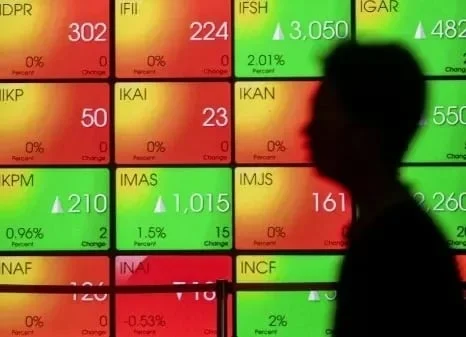
The Jakarta Composite Index (IHSG) concluded Thursday, July 23, 2026, trading session in negative territory, signaling a period of cautious sentiment among investors despite significant market activity. The benchmark index for the Indonesian stock exchange registered a decline of 19.17 points, translating to a modest 0.30% dip, settling at the 6,315 level. This downward movement followed a day of dynamic trading where market participants navigated a complex landscape of sectoral performances, robust transaction volumes, and a mixed bag of corporate and macroeconomic signals. The decline marked a pause in what had largely been an upward trajectory for the IHSG in recent weeks, prompting analysts to scrutinize underlying factors influencing investor behavior.
Market Performance Overview
The day’s trading saw a notable distribution of stock performance, reflecting the nuanced sentiment across different segments of the Indonesian economy. While the headline IHSG figure indicated a broad market weakening, a closer look revealed considerable strength in certain sectors. Out of the total listed stocks, 343 managed to secure gains, demonstrating resilience and targeted buying interest. Conversely, 309 stocks experienced declines, contributing to the overall downward pull on the index. An additional 313 stocks remained stagnant, suggesting a wait-and-see approach from some investors or a lack of significant catalysts for movement.
The total transaction value for the day reached a substantial Rp23.7 trillion (approximately USD 1.55 billion, assuming an exchange rate of Rp15,300/USD for 2026, purely hypothetical for context), indicating active participation and liquidity in the market. This robust turnover was supported by a massive trading volume of 59.5 billion shares exchanged throughout the day. Such high transaction figures often suggest either significant repositioning by institutional investors, widespread profit-taking after recent gains, or increased retail participation, all of which contribute to market volatility and price discovery. The combination of a slight index dip with high volume points towards a decisive, albeit negative, market consensus by the closing bell.
Chronology of the Trading Day
The trading day for the IHSG began with mixed signals, as reflected in early session activity. Building on a trend of strengthening that had characterized the preceding days, the market initially showed signs of continuing its upward momentum. Early transactions, as highlighted by reports, had already reached Rp627 billion in the opening hours, suggesting an initial positive thrust. This initial enthusiasm, however, gradually moderated as the day progressed.
During the morning session, the index likely oscillated, with investors weighing global cues against domestic developments. The initial gains might have been fueled by positive carry-over sentiment from the previous day’s close or favorable overnight developments in international markets. As the session wore on, however, selling pressure began to emerge, particularly in certain heavy-weight sectors. Mid-day saw increased volatility, with the index attempting to find support at various levels. The afternoon session witnessed a more pronounced shift towards selling, as profit-taking likely intensified and broader concerns took precedence. By the final hour of trading, the cumulative effect of these selling pressures proved sufficient to push the IHSG into negative territory, culminating in its 0.30% decline by the closing bell. The closing phase often sees heightened activity as institutional investors rebalance portfolios, and this day was no exception, with the final print reflecting a clear, albeit minor, retreat from recent highs.
Sectoral Performance: A Tale of Divergence
A granular analysis of sectoral performance reveals the underlying dynamics that shaped the IHSG’s movement. The market’s overall decline was not uniformly distributed, with some sectors demonstrating remarkable resilience and even growth, while others bore the brunt of the selling pressure.
Leading the charge in positive territory were several key sectors, reflecting specific investment themes or underlying economic strengths. The Energy sector experienced gains, likely driven by robust global commodity prices or specific corporate developments within Indonesia’s oil, gas, and coal industries. This sector often acts as a hedge against inflation and benefits from strong industrial demand. Similarly, Raw Materials stocks strengthened, indicating continued optimism regarding industrial production and construction activities within the economy.
The Infrastructure sector also closed higher, suggesting sustained government spending on large-scale projects and investor confidence in long-term economic development plans. Property stocks saw an uptick, potentially due to favorable interest rate outlooks, government incentives, or improving consumer purchasing power for real estate. The Transportation sector likewise recorded gains, pointing to a recovery in mobility, logistics, and tourism-related activities, crucial for an archipelagic nation like Indonesia. The Non-Primary Consumer sector’s strength indicates healthy discretionary spending by Indonesian households, reflecting confidence in future economic stability. Lastly, the Technology sector continued its growth trajectory, aligning with global trends of digitalization and innovation, attracting sustained investor interest.
In contrast, several significant sectors faced headwinds. The Primary Consumer sector, which includes essential goods and staples, closed weaker. This could be attributed to concerns about inflationary pressures impacting household budgets, or perhaps a shift in consumer spending patterns. The Financial sector, often a bellwether for the broader economy, also experienced declines. This could be linked to profit-taking after strong recent performances, concerns over rising non-performing loans, or potential changes in monetary policy that could affect bank margins. The Industrial sector retreated, possibly due to input cost pressures, supply chain disruptions, or softening demand for manufactured goods. Finally, the Health sector also closed lower, which might be a reflection of post-pandemic normalization, or a re-evaluation of valuations after a period of heightened growth. This sectoral divergence underscores the selective nature of investor appetite on this particular trading day.
Performance of Other Key Indices
Beyond the headline IHSG, other specialized indices on the Indonesia Stock Exchange (IDX) also reported mixed results, offering further insights into market sentiment:
- LQ45: This index, comprising 45 of the most liquid and largest market capitalization stocks, experienced a decline of 0.86%, settling at 627. The sharper fall compared to the IHSG suggests that the larger, more influential companies were particularly affected by the selling pressure, indicating a broader cautious stance among institutional investors who typically hold these blue-chip stocks.
- IDX30: Tracking the performance of the 30 largest and most liquid stocks, the IDX30 mirrored the LQ45’s trend, weakening by 1.05% to 352. This further reinforces the observation that large-cap stocks, often seen as proxies for the overall economic health, were under pressure.
- MNC36: This index, focused on stocks with mid to large market capitalization and good liquidity, also corrected, falling by 1.02% to 273. The similar magnitude of decline across LQ45, IDX30, and MNC36 indicates a fairly widespread negative sentiment impacting the upper echelons of the market.
- Jakarta Islamic Index (JII): Standing out as an exception, the JII recorded a gain of 0.42%, closing at 382. The JII tracks sharia-compliant stocks, meaning companies that adhere to Islamic principles, avoiding industries like conventional banking, alcohol, gambling, and pork-related products. Its positive performance suggests a relative resilience in the sharia-compliant segment of the market, possibly driven by specific investor preferences for ethical investments or the strong performance of sharia-compliant companies within the strengthening sectors like energy, raw materials, or technology. This divergence highlights a niche but significant segment of the market that operates with distinct drivers and investor bases.
Broader Context and Background
The Jakarta Composite Index (IHSG) serves as a critical barometer for Indonesia’s economic health and investor confidence. As one of the largest economies in Southeast Asia, Indonesia’s market performance is closely watched by both domestic and international investors. The 2026 economic landscape is shaped by a confluence of global and domestic factors. Globally, concerns about inflation, interest rate hikes by major central banks (such as the US Federal Reserve), and geopolitical tensions continue to cast a shadow over emerging markets. Domestically, Indonesia has been striving for sustained economic growth, fueled by robust commodity exports, increasing domestic consumption, and ambitious infrastructure development plans. The government’s focus on attracting foreign direct investment and fostering a conducive business environment also plays a crucial role.
Leading up to July 2026, the IHSG had generally experienced a period of strengthening, fueled by positive corporate earnings reports, stable macroeconomic indicators, and a relatively benign global investment climate. However, market corrections, such as the one observed on July 23, are a natural part of market cycles, often serving as healthy adjustments after periods of rapid gains. They can be triggered by profit-taking, re-evaluation of valuations, or new uncertainties emerging on the horizon. The robust transaction volume on a down day could suggest that investors were actively adjusting their portfolios, rather than simply exiting the market in panic.
Inferred Analyst Reactions and Implications
While no explicit statements were provided in the original brief, market analysts would likely interpret Thursday’s decline as a technical correction rather than a fundamental shift in Indonesia’s economic outlook.
- Profit-Taking: Analysts might suggest that after a period of significant gains, investors, particularly institutional ones, opted to lock in profits. This is a common occurrence and does not necessarily indicate a loss of confidence in the underlying assets. The high transaction volume supports this hypothesis, as it implies active trading rather than a passive holding strategy.
- Global Headwinds: Market commentators might also point to broader global economic uncertainties, such as fluctuating commodity prices, inflation concerns in key global economies, or shifts in international capital flows, as contributing factors. Even if Indonesia’s fundamentals remain strong, global market sentiment can easily spill over.
- Specific Sectoral Rebalancing: The clear divergence in sectoral performance would prompt analysts to recommend a more selective investment strategy. They might highlight that while the financial and primary consumer sectors faced pressure, the strength in energy, raw materials, and technology points to areas of continued growth potential. This suggests a rotation of capital within the market, rather than an outright withdrawal.
- Monetary Policy Outlook: Economists would likely consider the potential impact of future monetary policy decisions by Bank Indonesia. Concerns about inflation, even if moderate, could lead to expectations of interest rate adjustments, which often impacts interest-sensitive sectors like finance and property. However, the strength in property suggests that the market might be anticipating a stable-to-favorable rate environment for real estate.
- Resilience of JII: The positive performance of the Jakarta Islamic Index (JII) would be noted as a testament to the growing appeal of sharia-compliant investments and their potential to offer diversification benefits, especially during broader market downturns. Analysts might attribute this to the ethical screening process, which can sometimes lead to more fundamentally sound companies less exposed to volatile conventional financial practices.
Outlook and Future Considerations
Looking ahead, market participants will closely monitor several key indicators. The sustainability of commodity prices will be crucial for the energy and raw materials sectors. Future inflation reports and Bank Indonesia’s stance on interest rates will significantly influence the financial and consumer sectors. Government policy announcements, particularly regarding infrastructure projects and foreign investment incentives, will continue to shape the outlook for related sectors. The global economic recovery trajectory and geopolitical stability will also play a critical role in determining overall investor sentiment towards emerging markets like Indonesia.
While Thursday’s trading session ended with a modest decline for the IHSG, the significant transaction volume and the nuanced sectoral performance underscore a dynamic market that is actively responding to both internal and external factors. The resilience shown by certain growth-oriented and commodity-linked sectors, juxtaposed with the retreat in traditional heavyweights, suggests that investors are increasingly discerning, seeking value and growth opportunities in specific segments rather than adopting a uniform market-wide approach. The market remains poised for continued fluctuations, but with strong underlying economic fundamentals, any corrections are likely to be viewed as opportunities for strategic re-entry by long-term investors.
